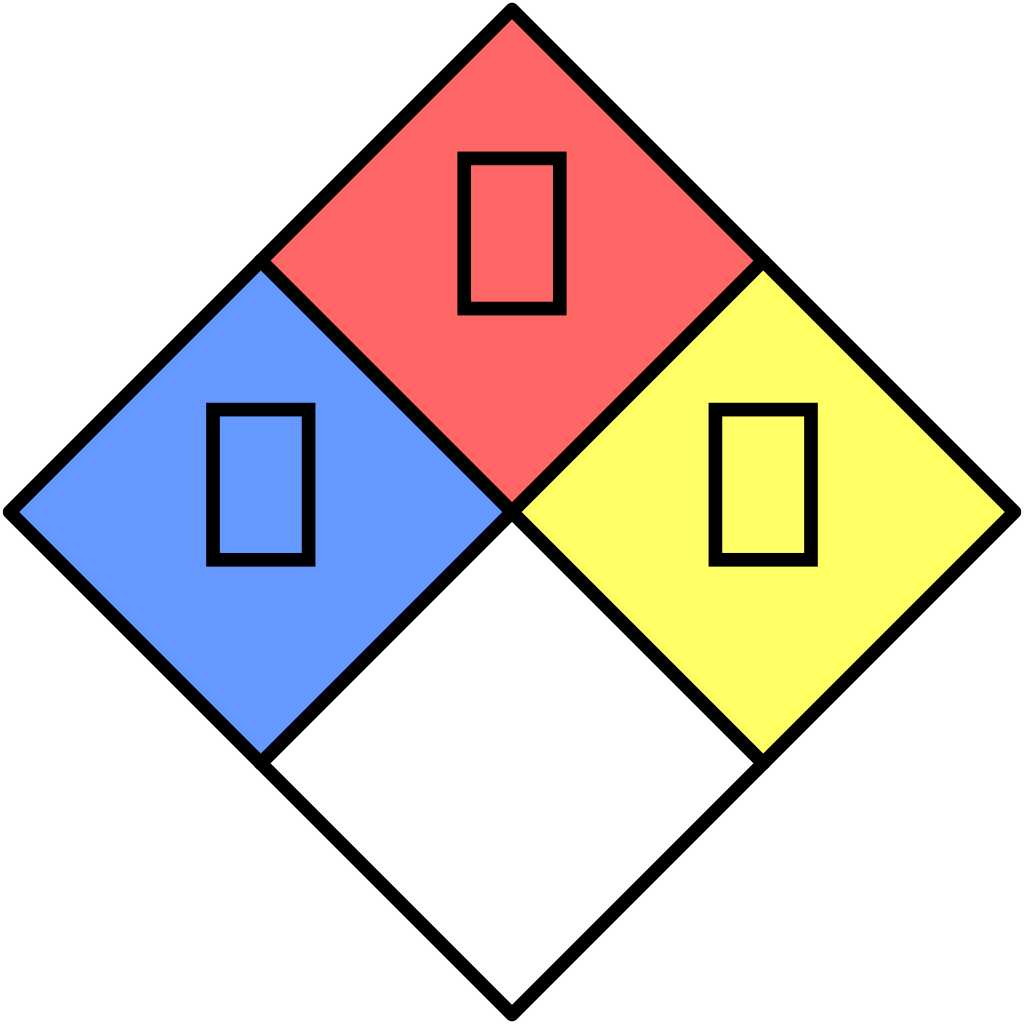
NFPA 704 Gasoline Fire Diamond
This example NFPA 704 diamond shows health 1, flammability 3, and instability 0, with a blank special-hazard field. It is not a universal rating for every gasoline product; determine actual ratings from product-specific information and NFPA criteria.

Download source credit · Print reference sheet · Build a diamond with your ratings
Understanding this sign
The NFPA 704 diamond shows health, flammability, instability, and special hazards for emergency response.
Ratings depend on the material and its properties. Do not copy GHS category numbers into the diamond.
Reading the Gasoline Diamond: 1-3-0
Gasoline's NFPA 704 placard shows 1 in the blue health quadrant, 3 in the red flammability quadrant, 0 in the yellow instability quadrant, and an empty white quadrant. The message to an arriving fire crew is precise: expect a serious fire hazard from a liquid whose vapors ignite at ordinary temperatures, but do not expect unusual toxicity beyond irritation from exposure, violent decomposition, water reactivity, or oxidizing behavior.
The flammability 3 is the rating that drives tactics. Gasoline's flash point is far below room temperature (around -40 degrees), so ignitable vapor is present at essentially all ambient conditions; it earns 3 rather than 4 because it is a liquid whose boiling point keeps it short of the gas-like volatility that defines the top rating. The health 1 reflects irritation and narcotic effects from vapor rather than acute lethality, and the instability 0 reflects a chemically stable fuel that does not self-react.
Where the Placard Is Posted
Fire codes adopted by state and local jurisdictions require NFPA 704 placards where flammable liquids are stored above permit thresholds, which makes the gasoline diamond one of the most common placards in service. Typical postings include fuel storage rooms and cabinets in vehicle maintenance shops, above-ground and underground tank fill points at fueling stations, bulk plants and terminals, marina fuel docks, and generator fuel-day-tank rooms.
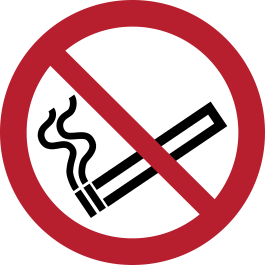
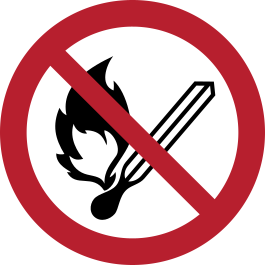
The placard is a building- and container-level sign for emergency responders. It does not replace the GHS label on a gasoline container, the UN 1203 transport placard on a cargo tank, or the P002 and P003 prohibition signs that control ignition sources around dispensing points; a compliant fueling facility typically displays several of these systems at once, each serving a different reader.
Why Ratings Differ From Label Severity
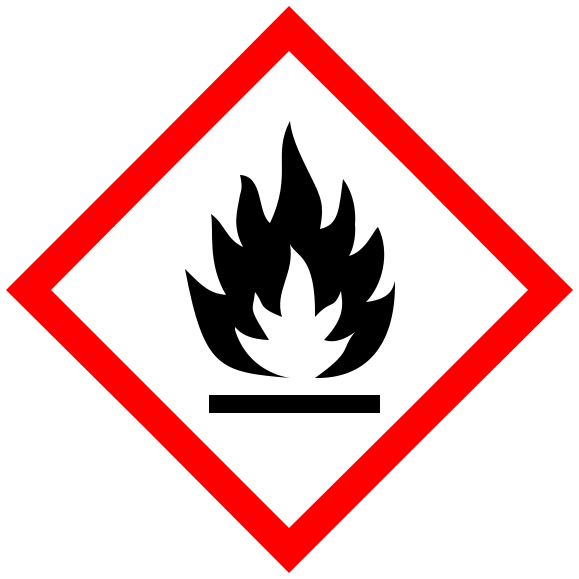
Gasoline illustrates the numbering trap between NFPA 704 and GHS. On the fire diamond, higher is more hazardous, and gasoline's flammability 3 signals severe fire risk. On the GHS label, lower categories are more severe: gasoline is typically classified as a Category 1 or 2 flammable liquid carrying the GHS02 flame pictogram and the signal word Danger. A worker who assumes both systems count the same direction will misread one of them.
Composite placards add a second trap. A placard on a mixed storage room reflects the most severe rating in each quadrant among everything stored inside, so a room placarded 3-3-1 may owe its red 3 to gasoline while the blue 3 and yellow 1 come from entirely different products. Responders read the placard as an envelope of worst cases, not as a description of one chemical.
An example, not a universal gasoline rating
The downloaded example shows health 1, flammability 3, and instability 0, with the special-hazard field blank. Treat it as a reference illustration. Determine ratings for the actual product using its safety data and the applicable NFPA criteria; formulation and conditions matter.
Do not copy GHS category numbers
NFPA ratings run from 0 at the lower end to 4 at the higher end of the hazard scale. GHS category numbers follow a different scheme. The OSHA/NFPA comparison explicitly explains that the hazard categories in SDS section 2 must not be copied into an NFPA diamond.
The application notes above were checked against the linked public sources on . Jurisdiction-specific notes are identified in the text.
Where you will see NFPA 704
Used as responder-facing identification at fuel rooms, gasoline tanks, storage buildings, exterior access points, maintenance shops, generator fuel systems, bulk liquid storage, and locations where emergency personnel need rapid hazard severity information.
Common questions about NFPA 704
What do the numbers on the gasoline fire diamond mean?
Gasoline is rated 1 for health (blue), 3 for flammability (red), and 0 for instability (yellow), with no special-hazard symbol in the white quadrant. The 3 means the liquid produces ignitable vapors at ordinary ambient temperatures; the 1 means exposure causes irritation rather than serious acute injury; the 0 means the material is chemically stable even in a fire.
Why is gasoline rated 3 for flammability instead of 4?
Rating 4 is reserved for flammable gases and liquids so volatile they behave like gases, with boiling points below roughly 35 °C. Gasoline's flash point is extremely low, but its boiling range keeps it in the liquid regime, which places it at 3 — still a severe fire hazard, ignitable at essentially all ambient temperatures.
Is the NFPA diamond required at gas stations?
Placarding requirements come from the fire code adopted in your jurisdiction, and the authority having jurisdiction — usually the local fire marshal — decides placement. Tanks, fill points, and storage rooms holding gasoline above permit quantities are routinely required to carry NFPA 704 placards, while the dispensers themselves more often carry ignition-control and emergency shutoff signage.
Does the fire diamond replace the GHS label on gasoline containers?
No. The GHS label with the GHS02 flame pictogram informs the person handling the container and is required by hazard communication rules; the NFPA diamond informs emergency responders about the building or tank. US OSHA explicitly treats NFPA 704 as a complement to, not a substitute for, workplace container labeling.
Reference details
| Symbol code | NFPA 704 |
|---|---|
| Sign family | NFPA 704 Fire Diamonds |
| Standard reference | NFPA 704:2022 NFPA 704 publisher information |
| Screen color reference | #FF0000 / #0055A4 / #FFCC00 / #FFFFFF. Screen colors are not a production color specification. |
| Download formats | SVG reference artwork; a 1024 × 1024 pixel PNG conversion on a white canvas. |
| Record date | · How to interpret our dates |
| Page updated |
Choosing a physical sign size
Download dimensions are not installation dimensions. Select sign size, material, placement, and lighting using the applicable standard and the actual viewing conditions. Chemical label sizing follows its own rules. Read the artwork and sizing guide.
Sources and artwork credits
- Artwork source
- Wikimedia Commons file page
- Creator credited by source
- User:Denelson83
- License
- Public domain
- Source metadata checked
SVG files are local reference copies. PNG files are raster conversions. The NFPA illustration is a local adaptation of the source diamond with example ratings added. Check the linked file history and license terms before reuse; a source-metadata check is not certification of the artwork or a workplace installation.
Report a correction to this reference