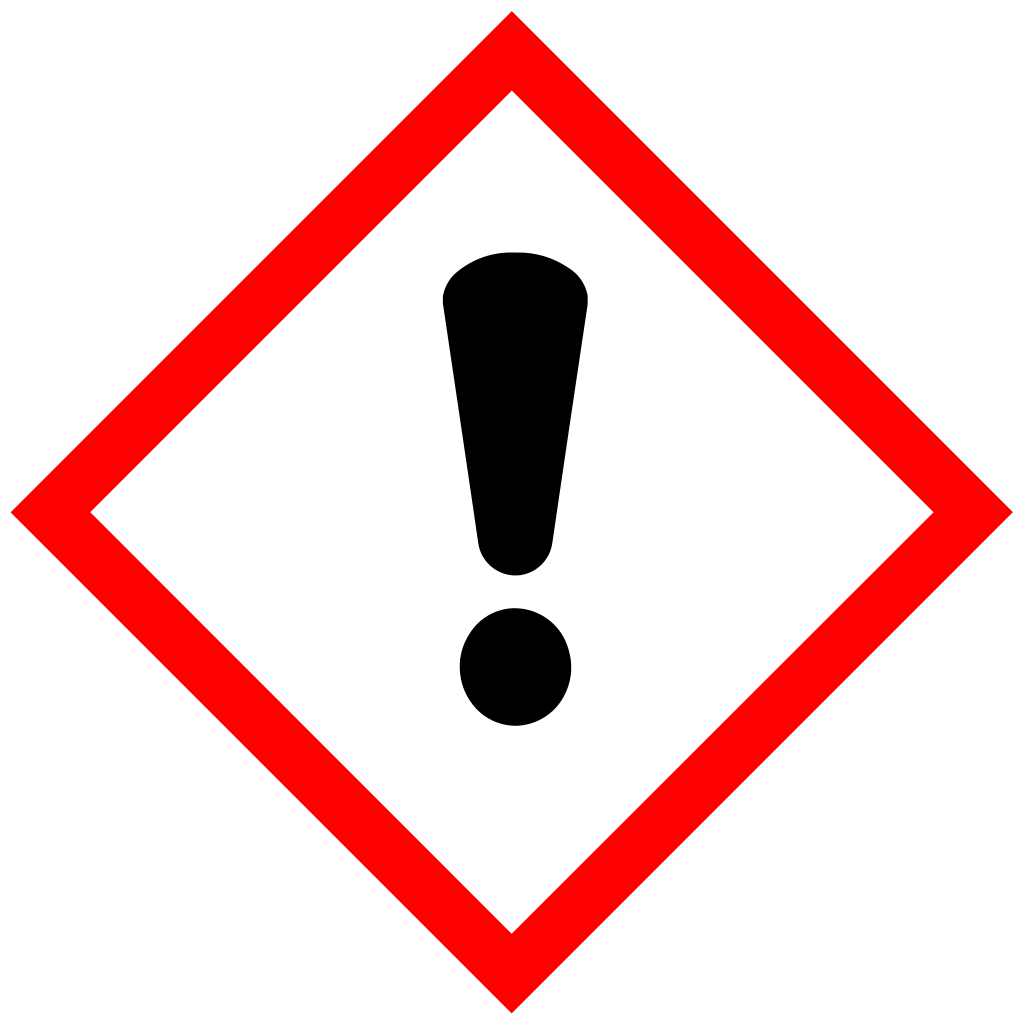
Exclamation Mark
The exclamation mark identifies specified harmful, irritant, skin-sensitizing, or single-exposure effects. Its use depends on classification and pictogram precedence.
Understanding this sign
GHS pictograms use a black symbol on white within a red diamond border to communicate chemical hazard classes.
Read the whole label and safety data sheet. A pictogram can cover several hazards and does not specify controls by itself.
The Catch-All for Lower-Severity Health Hazards
GHS07 gathers the health hazards that are real but fall short of corrosion, lethality, or chronic disease: acute toxicity Category 4 by any route, skin irritation Category 2, eye irritation Category 2 (2A under the full GHS scheme), skin sensitization Category 1, and specific target organ toxicity single exposure Category 3, which covers respiratory tract irritation (H335) and narcotic effects such as drowsiness and dizziness (H336). GHS and CLP also assign it to substances hazardous to the ozone layer (H420).
That breadth makes GHS07 the most common pictogram in most workplaces — it sits on general-purpose cleaners, many paints and adhesives, common solvents like some glycol ethers, and countless mixtures. The risk is desensitization: because the symbol is everywhere, workers stop reading past it. The corrective is the same as for every GHS label — the H-statements distinguish a mild eye irritant (H319) from a skin sensitizer (H317) that can end someone's career in that trade through allergic dermatitis.
Always Warning, Never Danger
GHS07 is the only hazard pictogram whose classifications uniformly take the signal word Warning. Its characteristic hazard statements are H302, H312, and H332 (harmful if swallowed, in contact with skin, if inhaled) for acute toxicity Category 4; H315 (causes skin irritation); H319 (causes serious eye irritation); H317 (may cause an allergic skin reaction); H335 (may cause respiratory irritation); and H336 (may cause drowsiness or dizziness). H336 deserves particular respect in practice, since narcotic solvent effects impair judgment and coordination around machinery and at height.
Skin sensitization is the endpoint most often underestimated on GHS07 labels. Unlike irritation, sensitization is not dose-proportional in the ordinary sense: once a worker is sensitized to an epoxy amine hardener or a preservative like isothiazolinones, minute subsequent exposures trigger reactions. The classification carries preventive statements such as P261 and P272 (contaminated work clothing should not be allowed out of the workplace), which encode the fact that avoidance, not tolerance, is the only reliable control.
Precedence Rules: When GHS07 Must Disappear
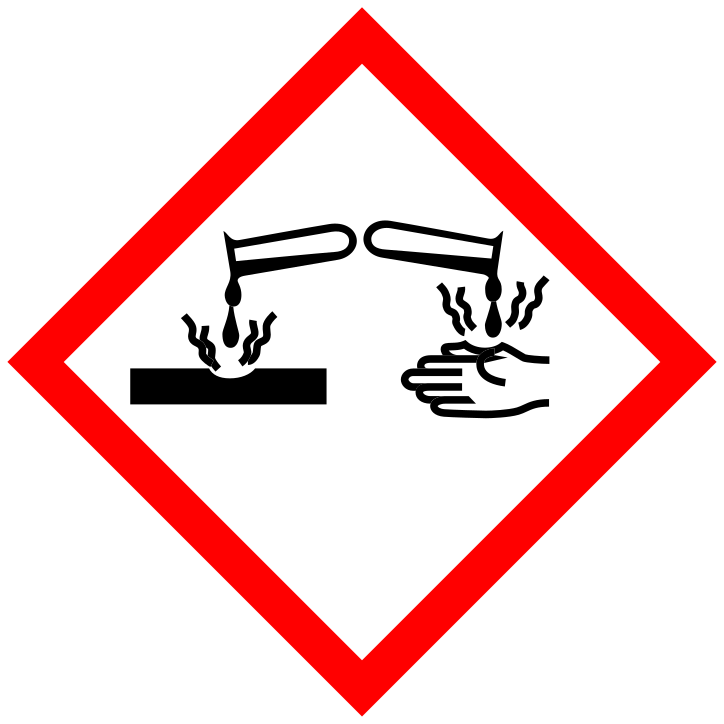
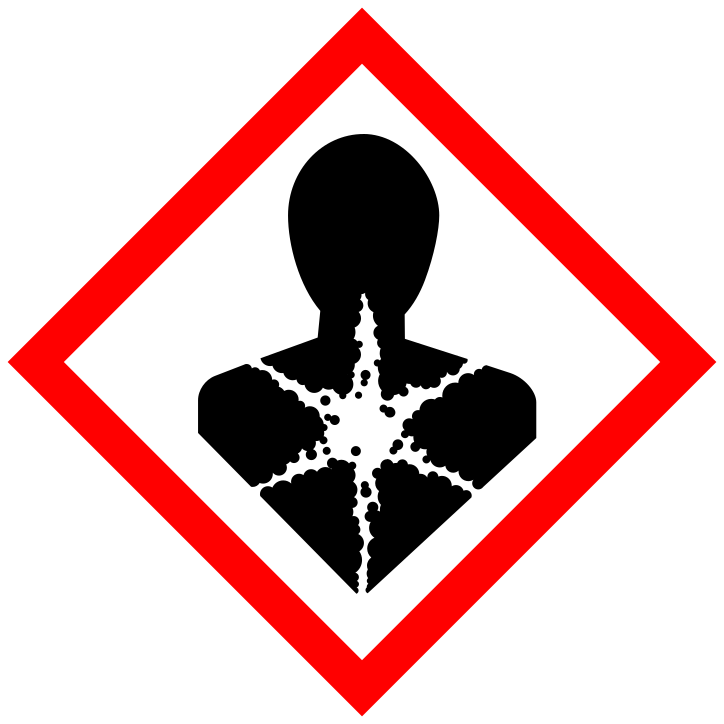
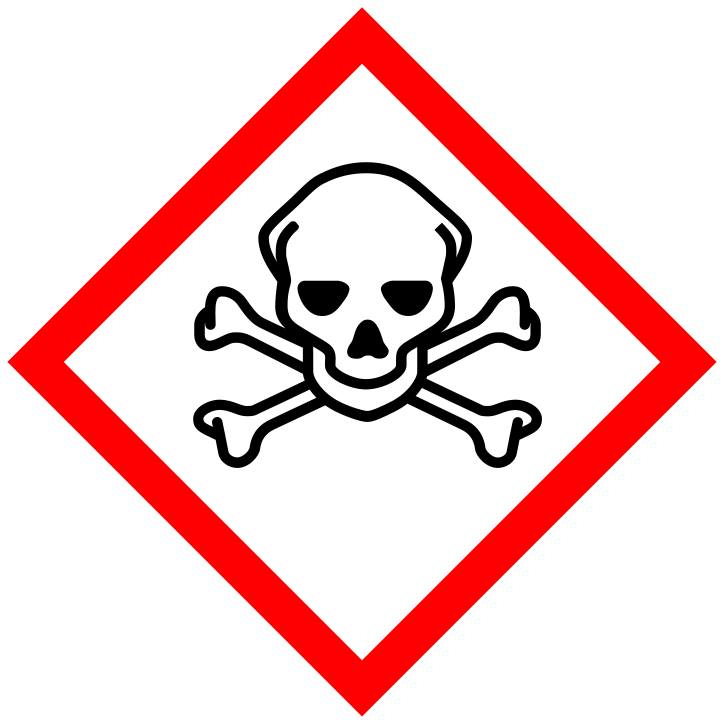
GHS, OSHA HazCom 2012, and EU CLP all subordinate the exclamation mark to more severe pictograms covering the same ground. If the GHS06 skull and crossbones appears, GHS07 must not be used for acute toxicity. If the GHS05 corrosion pictogram appears, GHS07 must not be used for skin or eye irritation. And if the GHS08 silhouette appears for respiratory sensitization, GHS07 must not be used for skin sensitization or for skin and eye irritation. These rules exist to stop labels drowning severe warnings in redundant symbols.
GHS07 can still legitimately share a label with those pictograms when it flags a different hazard. A degreasing solvent might carry GHS08 for aspiration hazard alongside GHS07 for narcotic effects; a corrosive cleaner concentrate might show GHS05 for skin corrosion and GHS07 for acute oral toxicity Category 4. Checking which H-statement each pictogram anchors is the only way to decode a multi-symbol label correctly.
What the Exclamation Mark Is Not
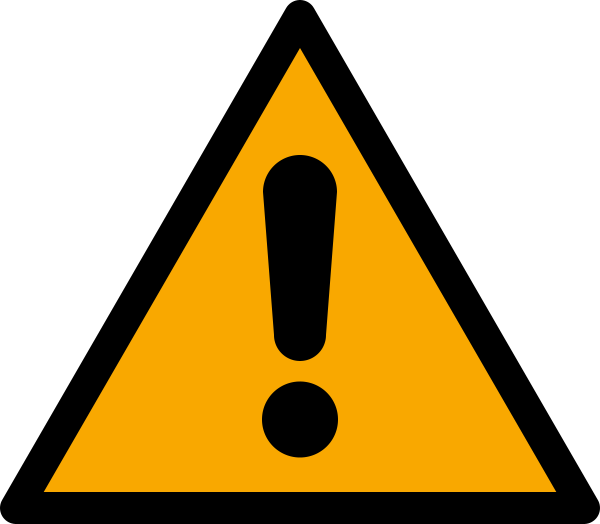
The most damaging confusion is with GHS08. The exclamation mark means harmful or irritating effects that are generally acute and reversible; the health hazard silhouette means serious, often chronic outcomes such as cancer, reproductive harm, respiratory sensitization, or organ damage. A product wearing only GHS07 has not been classified for any of those long-term endpoints. Nor is GHS07 a general caution symbol like the ISO 7010 W001 yellow triangle — it appears only when a mixture or substance meets specific classification criteria under 29 CFR 1910.1200 or CLP (EC) No 1272/2008.
GHS07 replaced the old European orange-square symbols Xn (harmful) and Xi (irritant) when CLP superseded the Dangerous Substances Directive, and legacy stock bearing the St Andrew's cross still surfaces in older storerooms; those labels have been invalid in the EU since the CLP transition ended in 2017. There is also no transport counterpart: goods that are merely irritant or harmful generally travel unregulated for those endpoints, so GHS07 appears on supply labels without any matching diamond on the freight.
Reading the exclamation mark pictogram
The exclamation mark can communicate harmful acute toxicity, skin or eye irritation, skin sensitization, respiratory tract irritation, or narcotic effects in the applicable categories.
What to check alongside it
It is not a universal marker for all hazards. The skull, corrosion, and respiratory-sensitization pictograms take precedence for specified endpoints. Read the hazard statements to understand why the exclamation mark appears.
The application notes above were checked against the linked public sources on . Jurisdiction-specific notes are identified in the text.
Where you will see GHS07
Common on solvents, cleaners, resins, aerosols, laboratory reagents, maintenance chemicals, paint products, and mixed formulations that can irritate workers or create harmful exposure without meeting the more severe toxicity thresholds of GHS06 or GHS08.
Common questions about GHS07
What does the exclamation mark pictogram mean?
It flags lower-severity health hazards: harmful if swallowed, inhaled, or absorbed through skin (acute toxicity Category 4), skin or eye irritation, allergic skin reactions (skin sensitization), respiratory tract irritation, or drowsiness and dizziness from narcotic effects. It always appears with the signal word Warning. It also marks substances hazardous to the ozone layer under GHS and EU CLP.
Is GHS07 the same as the general warning triangle?
No. The yellow ISO 7010 W001 triangle is a workplace sign meaning a general, unspecified hazard in an area. GHS07 is a chemical-label pictogram that appears only when a product meets defined classification criteria under GHS, OSHA HazCom 2012, or EU CLP, and it always comes with specific hazard statements explaining exactly which harmful or irritant effect was classified.
When is the exclamation mark left off a label even though the product is irritating?
When a more severe pictogram covers the same endpoint. The rules in GHS, OSHA HazCom, and CLP require dropping GHS07 for skin or eye irritation when the GHS05 corrosion pictogram is present, for acute toxicity when the GHS06 skull appears, and for skin sensitization or irritation when GHS08 appears for respiratory sensitization. The irritant hazard still exists; it is communicated through the H-statements.
Does GHS07 mean a product can cause cancer or long-term illness?
No. Chronic and serious systemic endpoints — carcinogenicity, mutagenicity, reproductive toxicity, respiratory sensitization, organ damage, and aspiration hazard — are assigned the GHS08 health hazard silhouette. A label carrying only the exclamation mark indicates the product was classified for acute harmful effects, irritation, skin sensitization, or narcotic effects, not for long-term disease.
Reference details
| Symbol code | GHS07 |
|---|---|
| Sign family | GHS Chemical Pictograms |
| Standard reference | UN GHS Revision 11 (2025); local implementation varies UN GHS Revision 11 (2025) |
| Screen color reference | #FF0000. Screen colors are not a production color specification. |
| Download formats | SVG reference artwork; a 1024 × 1024 pixel PNG conversion on a white canvas. |
| Record date | · How to interpret our dates |
| Page updated |
Choosing a physical sign size
Download dimensions are not installation dimensions. Select sign size, material, placement, and lighting using the applicable standard and the actual viewing conditions. Chemical label sizing follows its own rules. Read the artwork and sizing guide.
Sources and artwork credits
- UN GHS Revision 11 (2025)
- OSHA hazard communication pictograms
- OSHA 1910.1200 Appendix C: allocation of label elements (US)
- Artwork source
- Wikimedia Commons file page
- Creator credited by source
- Unknown author
- License
- Public domain
- Source metadata checked
SVG files are local reference copies. PNG files are raster conversions. Check the linked file history and license terms before reuse; a source-metadata check is not certification of the artwork or a workplace installation.
Report a correction to this reference