Fire Alarm Call Point
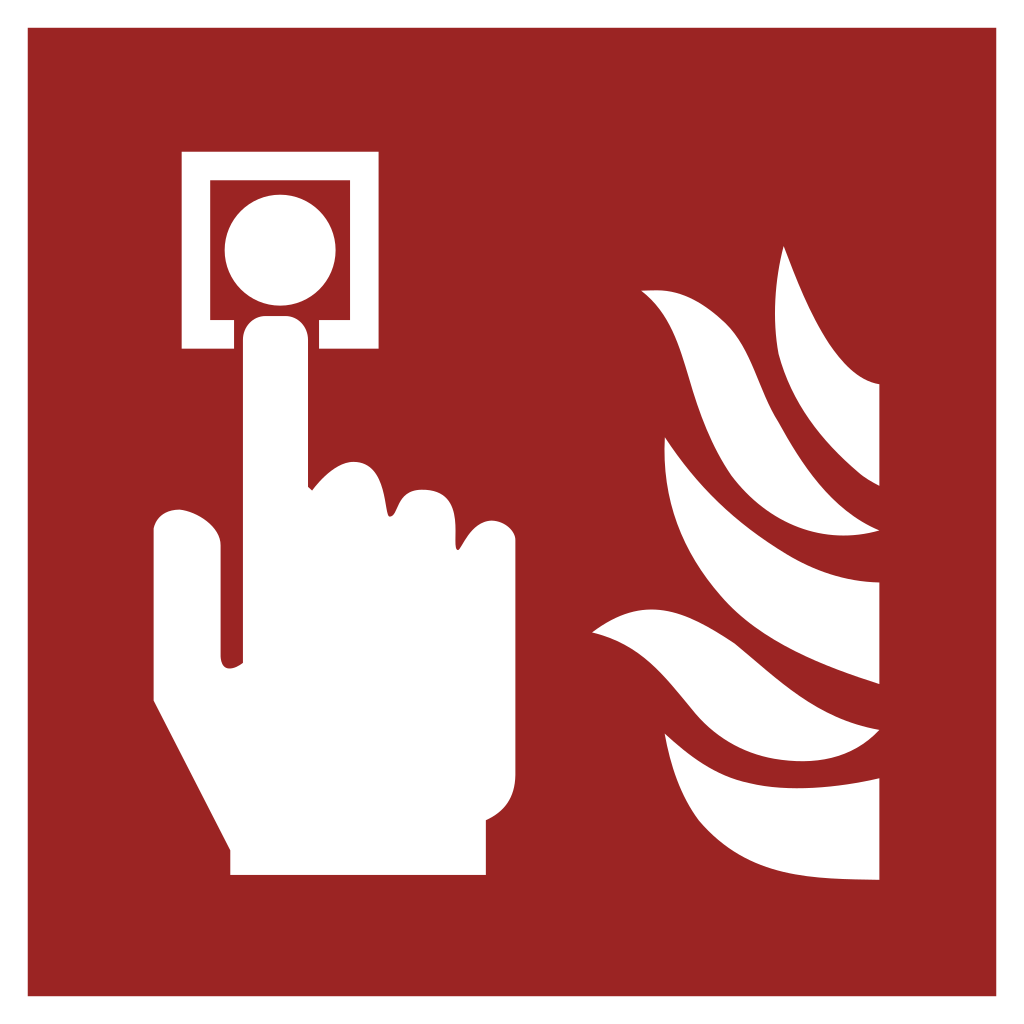
Identifies a manual fire alarm call point.
Understanding this sign
Red square or rectangular signs identify fire equipment and manual alarm points.
Finding equipment does not mean it is suitable or safe to use. Follow your training and the site emergency procedure.
What F005 Marks
F005 shows a white hand pressing a button beside a flame symbol, in the red square format ISO 7010 assigns to fire equipment. It marks a manual fire alarm call point — the break-glass unit or pull station a person operates to raise the alarm when they discover a fire. Automatic detection covers spaces nobody is watching; the manual call point covers the opposite and often faster case, a human who has already seen the fire and needs only a way to tell the building.
The sign exists because the device it marks is small. A call point is typically a hand-sized red box, easy to lose against cluttered walls, notice boards, and switchgear, and easy for a visitor to have never consciously registered. F005 above the unit raises its visual footprint, and directional variants extend that reach along corridors and across large halls, so that raising the alarm does not depend on the discoverer happening to know the building.
EN 54-11 and the Two Device Types
In Europe, manual call points are manufactured to EN 54-11, part of the EN 54 fire detection and alarm series. The standard defines two operation types: Type A, single action, where one motion — pressing or breaking the frangible element — triggers the alarm immediately; and Type B, double action, where the user must break or lift a cover and then operate a separate control. Type A is the general default for public and workplace buildings because seconds matter; Type B suits environments with a demonstrated malicious or accidental activation problem.
EN 54-11 also fixes the device's appearance — the familiar red housing with a marked operating face — which the F005 sign then amplifies rather than replaces. The equivalent hardware in North America is the manual pull station installed under NFPA 72, a lever-operated device rather than a break-glass one, but the signage logic is identical: a standardized red marker telling any occupant where the alarm can be raised by hand.
Mounting Height and Location Conventions
Call points cluster where evacuating people already go: at storey exits, at final exits to open air, and along escape routes, so raising the alarm and leaving are the same journey rather than competing ones. UK practice under BS 5839-1 mounts the device about 1.4 meters above floor level and spaces call points so occupants do not have to travel unreasonably far to reach one — the code's general benchmark is on the order of 45 meters, reduced where occupants have limited mobility or the hazard demands faster initiation.
US installations under NFPA 72 put pull stations within a few feet of exit doorways with the operable part at an accessible height, in the region of 42 to 48 inches above the floor. Whichever code applies, the F005 sign earns its place when the device is not self-evident: mounted above the call point so it clears door swings and queues, flag-mounted in long corridors, and duplicated with an arrow where a call point serves a large open floor from one wall.
Keeping Call Points Usable
The failure modes of manual call points are almost all about access and awareness rather than electronics. Units end up hidden behind propped-open doors, screened by vending machines and display stands, or painted over during refurbishments; in warehouses, pallets stack against the wall the call point occupies. A signage audit should walk the escape routes asking one question at each F005: could a stranger to this building find and operate the device within seconds of seeing smoke?
Call points also belong in the drill script. Fire drills that always start from the panel teach occupants that raising the alarm is someone else's job; rotating drills that begin with a nominated person operating a call point (or a test-friendly equivalent) verify both the device and the human behavior the F005 sign supports. Weekly alarm system tests in many regimes involve operating a different call point in rotation, which conveniently exercises every signed location over the year and flags any unit that has become blocked or defective.
Where you will see F005
Used above manual pull stations or break-glass call points at exits, corridors, warehouse doors, public buildings, industrial process halls, and high-occupancy areas where rapid alarm initiation is part of the fire strategy.
Common questions about F005
What height should a fire alarm call point be mounted?
UK practice under BS 5839-1 is about 1.4 meters above floor level, a height reachable by most adults including wheelchair users. US pull stations under NFPA 72 are installed with the operable part at an accessible height in the region of 42 to 48 inches. The F005 sign goes above the device, higher, so it can be seen across the space.
What is the difference between Type A and Type B call points?
Under EN 54-11, a Type A call point triggers the alarm with a single action — pressing or breaking the element — while a Type B requires two actions, such as lifting a hinged cover before operating the control. Type A is the default because it is faster; Type B is chosen where false or malicious activations are a real problem.
Where are manual call points required?
Typically at storey exits and final exits to open air and along escape routes, positioned so occupants can reach one without excessive travel — BS 5839-1 works to a general benchmark of about 45 meters, less in higher-risk situations. Exact requirements come from the fire alarm design code applying to the building.
Do call points need a sign above them?
The device's standardized red housing provides some self-identification, but an F005 sign is expected wherever the call point is not immediately conspicuous — behind door swings, on cluttered walls, or serving large open areas — and EU workplaces must identify fire equipment locations with red signage under Directive 92/58/EEC. The sign also survives when the small device itself is blocked from view by people or stock.
Reference details
| Symbol code | F005 |
|---|---|
| Sign family | ISO Fire Equipment Signs |
| Standard reference | ISO 7010:2019 / ISO 3864-1 ISO Online Browsing Platform: F005 |
| Screen color reference | #FF0000. Screen colors are not a production color specification. |
| Download formats | SVG reference artwork; a 1024 × 1024 pixel PNG conversion on a white canvas. |
| Record date | · How to interpret our dates |
| Page updated |
Choosing a physical sign size
Download dimensions are not installation dimensions. Select sign size, material, placement, and lighting using the applicable standard and the actual viewing conditions. Chemical label sizing follows its own rules. Read the artwork and sizing guide.
Sources and artwork credits
- Artwork source
- Wikimedia Commons file page
- Creator credited by source
- MaxxL
- License
- Public domain
- Source metadata checked
SVG files are local reference copies. PNG files are raster conversions. Check the linked file history and license terms before reuse; a source-metadata check is not certification of the artwork or a workplace installation.
Report a correction to this reference