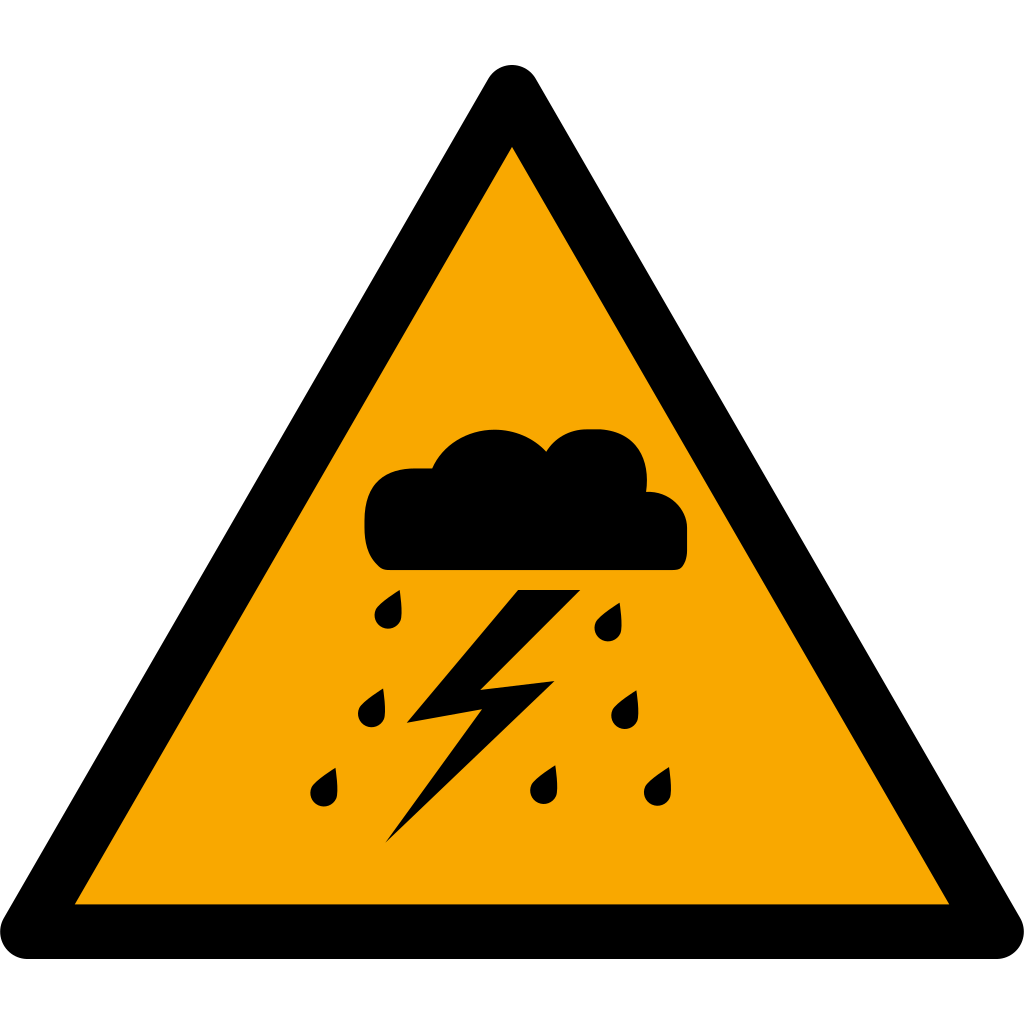
Thunderstorm
Warns of thunderstorms.
Understanding this sign
Yellow triangular signs draw attention to a hazard, such as electricity, moving machinery, or a hot surface.
A warning pictogram does not state the severity, safe distance, or protective measures. Read the accompanying instructions.
Purpose of the W084 Thunderstorm Sign
W084 warns of thunderstorms — above all of lightning, the storm hazard that kills people in open terrain. It extends the ISO 7010 natural-hazard series, added by amendment in the wake of the Japanese-led standardization of disaster signage, to a hazard that is not tied to rare geography: lightning threatens golf courses, beaches, pools, ridgelines, and sports fields on ordinary summer afternoons everywhere.
Unlike the earthquake-and-terrain signs in its family, W084 marks activity-and-exposure settings rather than mapped geological zones. It is posted where people are predictably outdoors, elevated, in water, or far from shelter when convective storms build, telling them in advance that this is a place to take approaching thunder seriously and to know where the nearest safe building or vehicle is.
Where the Sign Earns Its Place
Typical hosts are recreation operators and land managers: golf clubs, marinas and beaches, open-air pools, campgrounds, ski and mountain-hut operators on exposed ridges, sports grounds, and via ferrata or summit trails with fixed metal installations. These are settings where lightning casualties actually occur, because people are the tallest object around, holding conductive equipment, or standing in water.
Many such venues already operate lightning protocols — detection systems, pool-clearing rules, sirens or horn signals that suspend play. W084 gives those protocols a permanent visual anchor: the symbol at the entrance or on the notice board explains why the horn will sound and primes visitors to comply quickly instead of debating whether the sky looks bad enough.
Lightning Safety the Sign Points To
The widely taught public rule of thumb is the 30-30 guideline: if thunder follows a lightning flash within 30 seconds, the storm is close enough to strike you, so get to safety, and stay there until 30 minutes have passed since the last thunder. Meteorological agencies increasingly simplify the first half to when thunder roars, go indoors, since audible thunder alone means you are within striking range.
Safety means a substantial enclosed building or a hard-topped vehicle. Rain shelters, tents, dugouts, and isolated trees do not qualify and standing under a lone tree is a classic strike scenario. If genuinely caught in the open, move off ridges and away from water and tall objects, separate from your group, and avoid lying flat; but the sign's real message is not to let it come to that.
W084 Within the Hazard-Zone Family
W084 covers the convective storm cell; W085 covers the vastly larger rotating tropical systems — typhoons, hurricanes, and cyclones — and W074 covers tornadoes, which thunderstorms can spawn. A single severe-weather-prone site might legitimately display more than one of these, each implying its own protective action: shelter from lightning, evacuate or harden against a tropical storm, take underground cover from a tornado.
The pairing logic of the series applies here too, in modest form. A thunderstorm sign works best when the safe destination is obvious — a clubhouse, a signed refuge building, or the E065 natural disaster refuge symbol at multi-hazard sites — and when supplementary text states the local suspension signal. Warning plus destination plus trigger is the complete message; the pictogram alone supplies only the first third.
Where you will see W084
Golf clubs, marinas and beaches, open-air pools, campgrounds, sports grounds, ski and mountain-hut operators on exposed ridges, and via ferrata routes with fixed metal installations are its typical hosts. Venues running lightning protocols mount it at entrances and on notice boards as the permanent anchor explaining why the suspension horn will sound, best paired with text naming the safe building or refuge and the local signal.
Common questions about W084
What does the ISO 7010 W084 thunderstorm sign mean?
It marks a location — typically an exposed outdoor venue like a golf course, beach, pool, ridge trail, or sports field — where thunderstorms and lightning pose a real danger and where you should plan for shelter before storms arrive. It signals standing exposure; actual storm alerts come from forecasts, venue horns, and your own observation of thunder.
What is the 30-30 rule for lightning?
Count the seconds between a lightning flash and its thunder: 30 seconds or fewer means the storm is within roughly ten kilometers and you should reach a substantial building or hard-topped vehicle immediately. Then wait 30 minutes after the final thunder before resuming outdoor activity, because strikes still occur as storms depart. Many agencies now shorten the advice to going indoors as soon as you hear thunder at all.
Where is it safe to shelter during a thunderstorm?
In a fully enclosed building with wiring and plumbing, or in a metal-roofed vehicle with the windows up. Picnic shelters, tents, bus stops, dugouts, and trees give no meaningful lightning protection, and a solitary tree is one of the most dangerous places to stand. Inside, stay off corded devices and away from plumbing until the storm passes.
Why post a permanent thunderstorm sign when storms are occasional?
Because the danger window is short and behavior must be pre-loaded. Venues with lightning protocols use W084 to explain their suspension horns and clearing rules in advance, so that when a storm builds, visitors already understand the signal and move without argument. The sign builds the habit that live warnings then trigger.
Reference details
| Symbol code | W084 |
|---|---|
| Sign family | ISO Warning Signs |
| Standard reference | ISO 7010:2019 / ISO 3864-1 ISO Online Browsing Platform: W084 |
| Screen color reference | #FFCC00. Screen colors are not a production color specification. |
| Download formats | SVG reference artwork; a 1024 × 1024 pixel PNG conversion on a white canvas. |
| Record date | · How to interpret our dates |
| Page updated |
Choosing a physical sign size
Download dimensions are not installation dimensions. Select sign size, material, placement, and lighting using the applicable standard and the actual viewing conditions. Chemical label sizing follows its own rules. Read the artwork and sizing guide.
Sources and artwork credits
- Artwork source
- Wikimedia Commons file page
- Creator credited by source
- Clemenspool
- License
- CC0
- Source metadata checked
SVG files are local reference copies. PNG files are raster conversions. Check the linked file history and license terms before reuse; a source-metadata check is not certification of the artwork or a workplace installation.
Report a correction to this reference