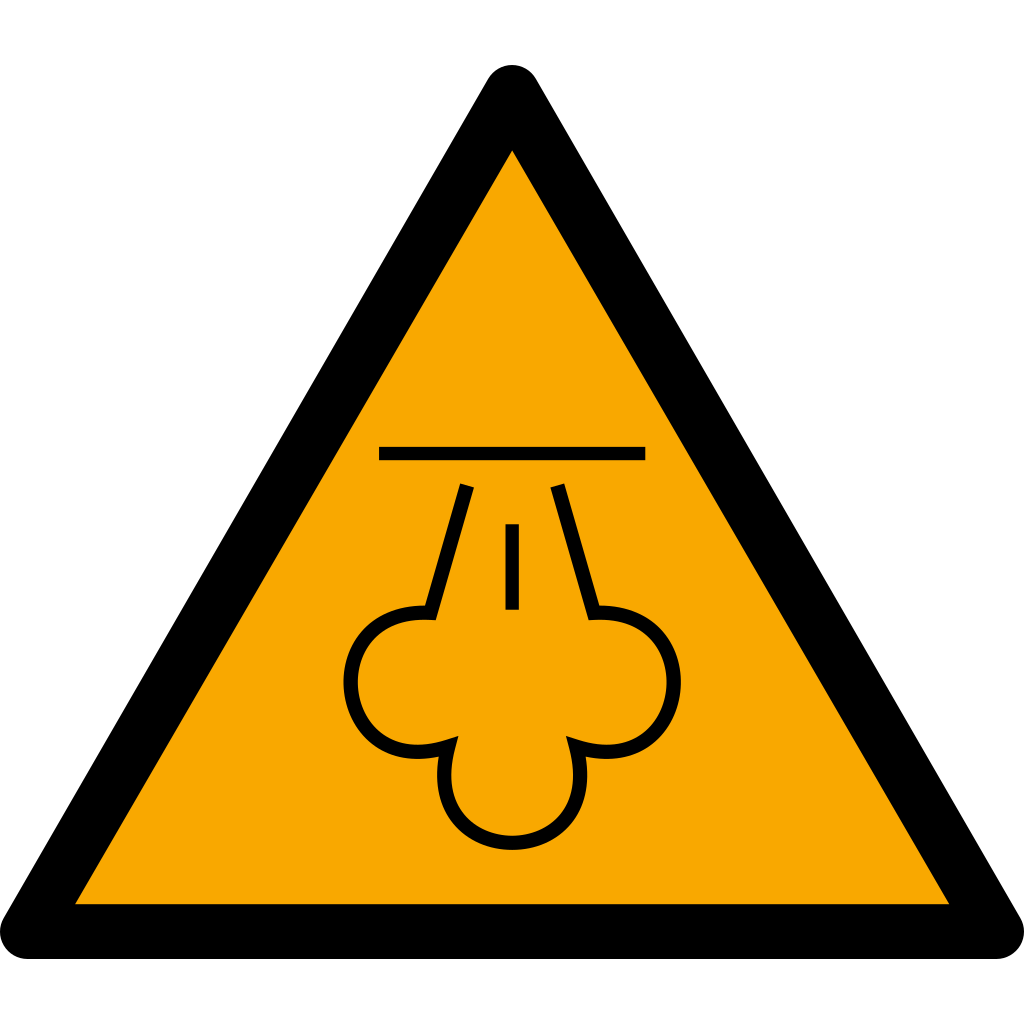
Hot steam
Warns of hot steam.

Understanding this sign
Yellow triangular signs draw attention to a hazard, such as electricity, moving machinery, or a hot surface.
A warning pictogram does not state the severity, safe distance, or protective measures. Read the accompanying instructions.
What W080 Warns About
W080 warns of the emission of hot steam. The pictogram — a jet of vapor escaping in the yellow warning triangle — marks points where pressurized steam can be released, deliberately or accidentally: safety valve and vent discharges, steam traps, boiler blowdown outlets, autoclave and sterilizer doors, condensate drains, and steam pipework joints. It is one of the referents added to ISO 7010 after the original 2011 edition and consolidated into the 2019 revision.
Steam injures faster than hot water at the same temperature reading suggests, because condensing vapor dumps its latent heat directly into skin. A brief pass through a steam jet can inflict deep scalds, and steam at face height adds airway burns to the injury list. The sign targets the moments when this energy is closest to people: opening equipment, working near vents, and maintenance on live steam systems.
The Invisible Jet Problem
The visible white plume is not the dangerous part — that is condensed water droplets, already cooling. Live steam close to the leak point is transparent, and superheated steam can remain invisible for a considerable distance from a failed gasket or pinhole. A fine high-pressure jet can cut into flesh before the victim sees anything, which is why steam-plant crews check suspected leaks by passing a broom handle or sheet of paper ahead of them, never a hand.
This invisibility is the strongest argument for signage. Around most hazards, eyes provide the last line of defense; around a steam system, they do not. W080 posted on trench covers, valve pits, vent discharge points, and pipe runs tells maintenance staff and passers-by to treat the space as potentially live even when nothing appears to be escaping, and to verify isolation rather than trust appearances.
Autoclaves, Boilers, and Process Plant
Sterilization equipment concentrates the risk into a routine task. Autoclaves in hospitals, laboratories, and food plants release steam when the door seal breaks at the end of a cycle, and retorts and cook vessels behave the same way; W080 on the door and unloading zone reminds operators to stand clear of the door swing and let pressure fully vent. Boiler houses use it at blowdown valves and discharge lines, where periodic blowdown ejects flashing hot water and steam.
Other regular hosts include steam humidifiers, textile and laundry pressing equipment, distilleries and breweries, paper machines, tire curing presses, and district heating installations, whose buried mains surface in chambers and manholes that fill with steam when a joint weeps. On any of these systems, the sign supports rather than replaces isolation procedures: lockout, drain-down, and cool-down before a flange is broken remain the actual protection.
Choosing Between W080 and W017
ISO 7010 separates two burn warnings that often coexist. W017, the hot surface sign, addresses contact burns from touching hot equipment — the outside of the sterilizer, uninsulated pipework, press platens. W080 addresses emission: vapor escaping under pressure and traveling through the air to reach a person who never touched anything. A steam system typically justifies both, on different components.
Placement follows the release point and its throw. Mount the sign where a person would stand when the release occurs — beside the autoclave door, facing the vent outlet, on the guard around a blowdown discharge — rather than on distant walls. Pair it with PPE mandates where operators must work near live steam (face shield, heat-resistant gauntlets) and with supplementary text such as "steam vent — keep clear" where the discharge point aims into a walkway.
Where you will see W080
Safety valve and vent discharges, steam traps, boiler blowdown outlets, autoclave and sterilizer doors, condensate drains, and steam pipework joints are the marked release points, with the sign mounted where a person would stand when the release occurs. Hospitals, laboratories, and food plants place it on autoclave doors and unloading zones, boiler houses at blowdown valves, and district heating operators on the chambers and manholes where buried mains surface, alongside laundries, breweries, paper machines, and tire curing presses.
Common questions about W080
What does the hot steam warning sign mean?
ISO 7010 W080 warns that hot steam can be emitted at that location — from a vent, safety valve, autoclave door, steam trap, blowdown outlet, or leaking pipework. It tells you to keep clear of discharge points, expect releases that may be invisible, and follow isolation procedures before opening or working on the equipment.
Why is escaping steam sometimes invisible?
The white cloud you associate with steam is condensed droplets, which form only after the vapor has cooled in air. At the point of release, live steam is transparent, and superheated steam stays that way for some distance from the leak. A fine pressurized jet can scald or lacerate before anything is visible, which is why steam fitters sweep a broom handle or paper through a suspected leak path instead of feeling for it.
What is the difference between W080 hot steam and W017 hot surface?
W017 warns you not to touch — the hazard is contact with hot equipment such as pipework, platens, or oven casings. W080 warns that steam can be discharged toward you — the hazard reaches out through the air from vents, doors, and leaks. Steam plant usually needs both: W017 on the hot casing and uninsulated lines, W080 at release points such as valves, traps, and autoclave doors.
Where should hot steam warning signs be placed on an autoclave?
At the positions a person occupies when steam is released: on or beside the door where the seal vents at cycle end, at the unloading area within the door swing, and at any external vent or drain discharge. The operator should see the warning while deciding where to stand, and supplementary text telling users to let the cycle fully depressurize before opening makes the required behavior explicit.
Reference details
| Symbol code | W080 |
|---|---|
| Sign family | ISO Warning Signs |
| Standard reference | ISO 7010:2019 / ISO 3864-1 ISO Online Browsing Platform: W080 |
| Screen color reference | #FFCC00. Screen colors are not a production color specification. |
| Download formats | SVG reference artwork; a 1024 × 1024 pixel PNG conversion on a white canvas. |
| Record date | · How to interpret our dates |
| Page updated |
Choosing a physical sign size
Download dimensions are not installation dimensions. Select sign size, material, placement, and lighting using the applicable standard and the actual viewing conditions. Chemical label sizing follows its own rules. Read the artwork and sizing guide.
Sources and artwork credits
- Artwork source
- Wikimedia Commons file page
- Creator credited by source
- Clemenspool
- License
- CC0
- Source metadata checked
SVG files are local reference copies. PNG files are raster conversions. Check the linked file history and license terms before reuse; a source-metadata check is not certification of the artwork or a workplace installation.
Report a correction to this reference