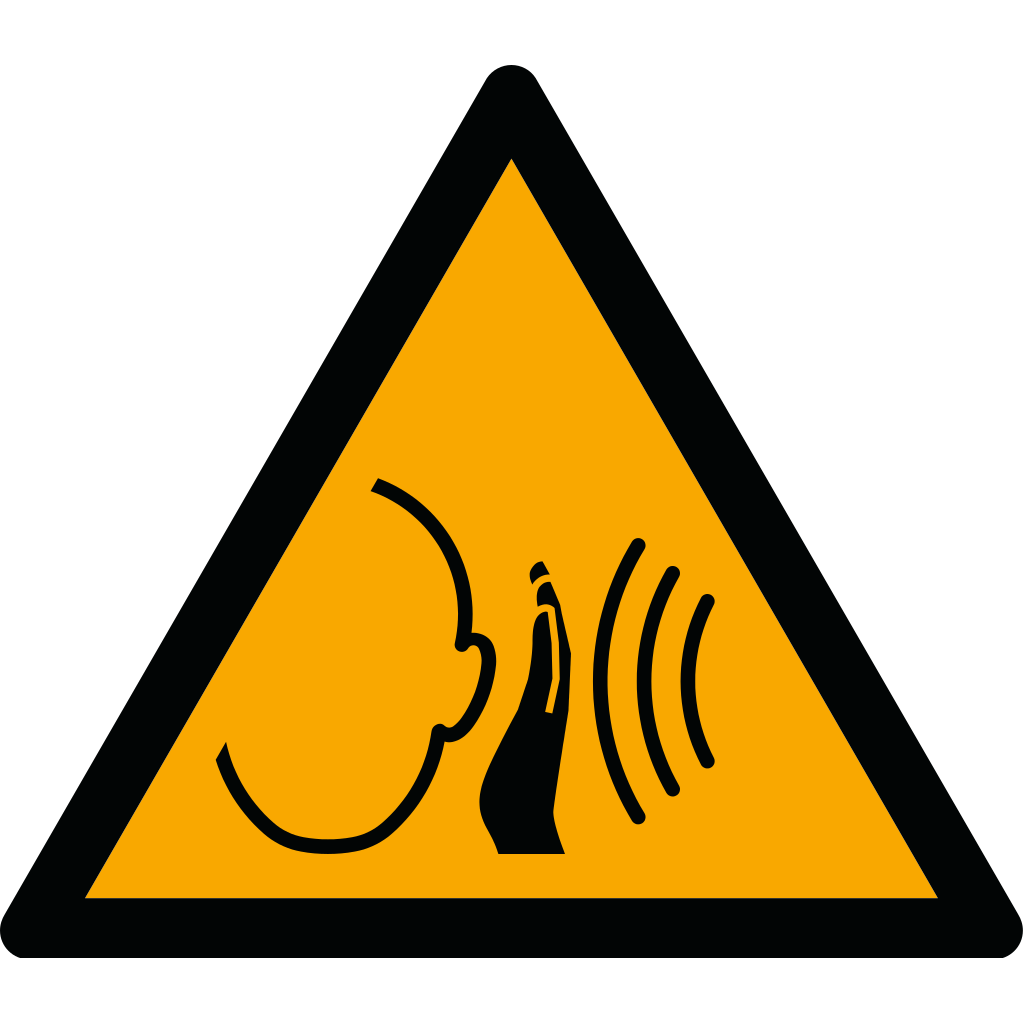
Sudden loud noise
Warns of sudden loud noise.
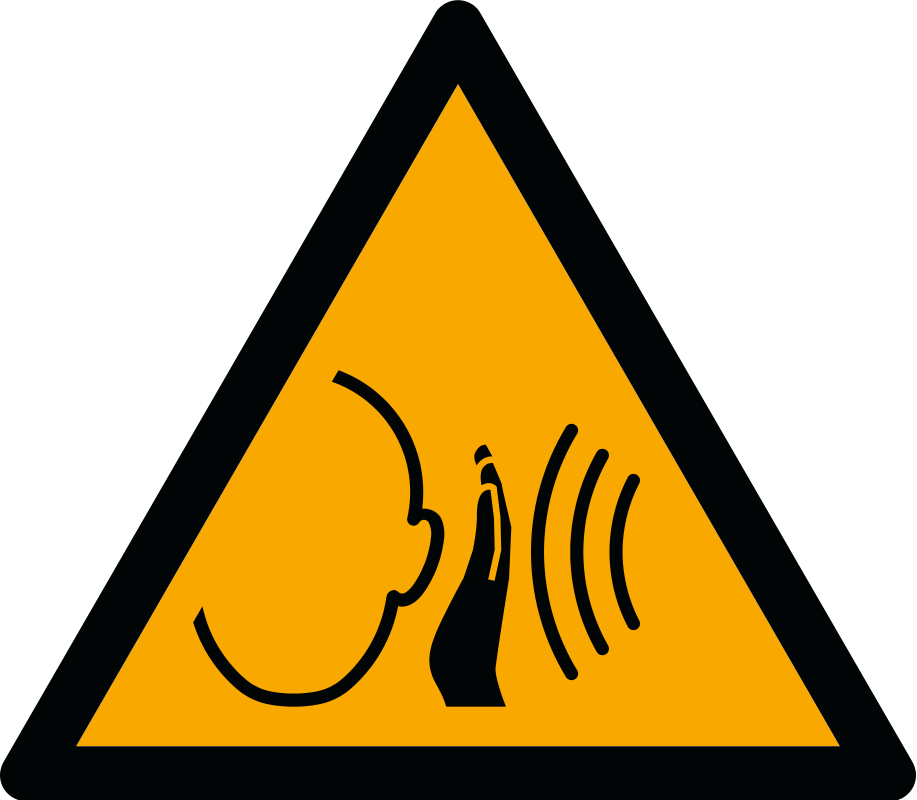
Understanding this sign
Yellow triangular signs draw attention to a hazard, such as electricity, moving machinery, or a hot surface.
A warning pictogram does not state the severity, safe distance, or protective measures. Read the accompanying instructions.
Impulse Noise Is a Different Hazard
W038 warns of sudden loud noise — not the steady roar of a machine hall, but intermittent, high-intensity sound events: pressure relief and safety valves lifting, steam or compressed-gas blowdowns, drop hammers and forging presses, proof-testing of vessels and components, airbag and pyrotechnic test benches, siren and alarm testing, gunfire on ranges, and engine test cells. Because the event is unpredictable, a visitor hears nothing on arrival and has no sensory cue to protect themselves before the first blast.
Impulse noise damages hearing differently from continuous exposure. A single sufficiently intense peak can cause immediate, permanent acoustic trauma, with no gradual warning of the kind steady noise gives through temporary threshold shift. OSHA's noise standard, 29 CFR 1910.95, reflects this by treating impulsive noise distinctly, advising that exposure should not exceed a 140 dB peak sound pressure level in addition to its limits on time-weighted average exposure.
The Startle Effect and Secondary Injuries
Hearing loss is not the only reason W038 exists. An unexpected blast triggers a startle reflex — flinching, jumping, momentary loss of balance — which is dangerous in itself for someone on a ladder, leaning over rotating machinery, carrying a load, or performing fine work near a blade. Sites that vent steam or test sirens near maintenance areas post W038 as much for the startle risk as for the acoustics.
Controls follow the familiar ISO 12100 order: silence or attenuate the source (silencers on vents, enclosures around test rigs), schedule noisy events with warning countdowns or beacons, separate people from the release point, and only then rely on hearing protection and signage. A flashing beacon interlocked with the test sequence, announced by the W038 triangle, gives workers the advance cue the noise itself denies them.
Signing Practice and the M003 Pairing
The natural companion is M003, the blue mandatory ear protection sign. In areas of continuous noise, M003 often stands alone at the boundary of the designated hearing protection zone; W038 joins it where the danger is episodic and a newcomer might otherwise judge the quiet area safe and remove protection. Around test cells and relief-valve outlets, the pair belongs on every access door and on the barrier at the safe standoff distance.
Under 1910.95, employers must run a hearing conservation program — monitoring, audiometric testing, hearing protectors, and training — when exposures reach an 8-hour time-weighted average of 85 decibels. Impulse events feed into those measurements, but a facility can need W038 even where average levels stay modest, because one unannounced 140 dB valve lift near an unprotected ear is an injury, not an exposure statistic.
Where you will see W038
Engine test cells, forging shops, pressure relief and blowdown outlets, airbag and pyrotechnic test benches, gun ranges, and siren testing points display W038 on access doors and standoff barriers. It typically joins the blue M003 ear-protection sign where noise is episodic rather than continuous, sometimes with beacons interlocked to the test sequence to give an advance visual cue.
Common questions about W038
What does the W038 sudden loud noise sign mean?
It warns that this area produces unpredictable high-intensity noise events — relief valves lifting, test blasts, sirens, forging blows — even if it is quiet right now. Put on hearing protection before entering and expect a startling bang without warning, particularly if beacons or countdowns indicate a test in progress.
How is W038 different from the mandatory ear protection sign M003?
W038 is a yellow warning triangle describing the hazard: sudden, intense noise. M003 is a blue circle imposing a rule: hearing protection must be worn. They are complementary and often posted together — the warning explains why the quiet-looking room requires ear protection at all times, which M003 alone does not convey.
Can one loud bang really cause permanent hearing damage?
Yes. Sufficiently intense impulse noise can rupture or permanently damage structures of the inner ear in a single event, a condition called acoustic trauma. This is why OSHA guidance holds impulsive exposure below a 140 dB peak and why areas with unpredictable blasts are signed and protected even when average noise levels are low.
Where should a sudden loud noise sign be posted?
On every access point to the area where the event can occur — test cell doors, barriers around relief-valve and blowdown outlets, siren test locations, forge shop entrances — positioned so people see it and fit hearing protection before they are within range, not after they reach the source.
Reference details
| Symbol code | W038 |
|---|---|
| Sign family | ISO Warning Signs |
| Standard reference | ISO 7010:2019 / ISO 3864-1 ISO Online Browsing Platform: W038 |
| Screen color reference | #FFCC00. Screen colors are not a production color specification. |
| Download formats | SVG reference artwork; a 1024 × 1024 pixel PNG conversion on a white canvas. |
| Record date | · How to interpret our dates |
| Page updated |
Choosing a physical sign size
Download dimensions are not installation dimensions. Select sign size, material, placement, and lighting using the applicable standard and the actual viewing conditions. Chemical label sizing follows its own rules. Read the artwork and sizing guide.
Sources and artwork credits
- Artwork source
- Wikimedia Commons file page
- Creator credited by source
- Author
- License
- CC0
- Source metadata checked
SVG files are local reference copies. PNG files are raster conversions. Check the linked file history and license terms before reuse; a source-metadata check is not certification of the artwork or a workplace installation.
Report a correction to this reference