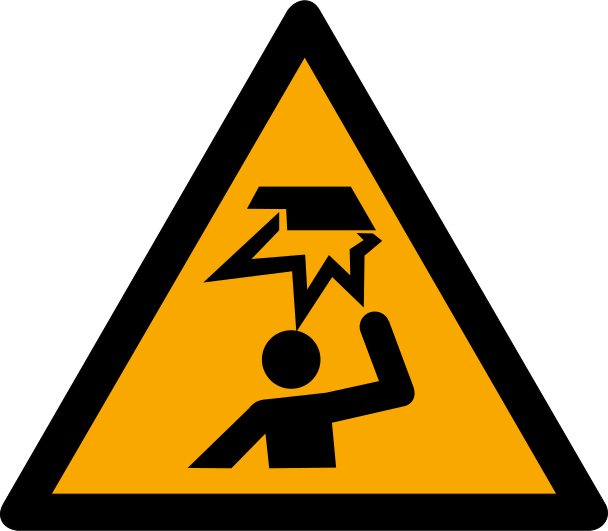
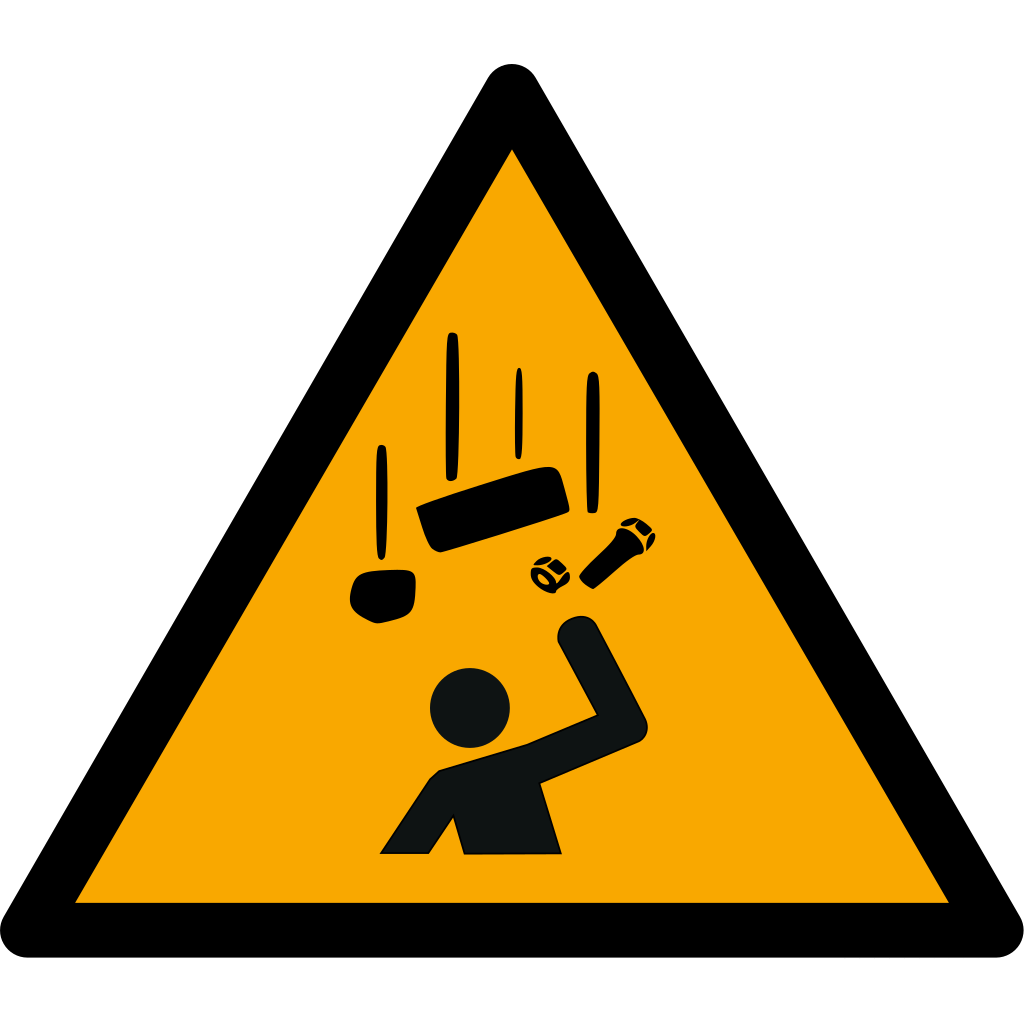
Falling objects
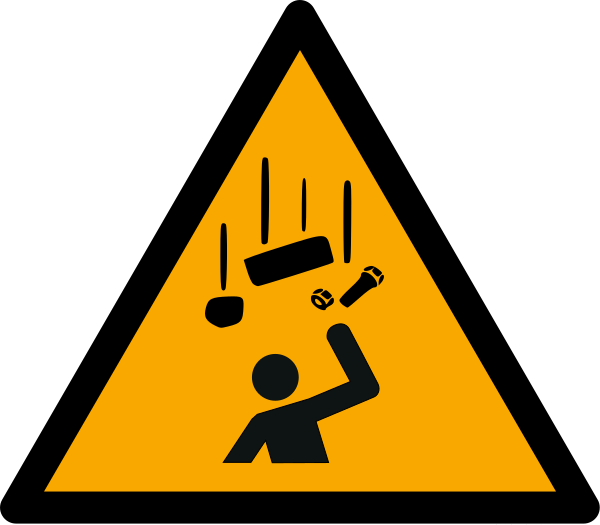
Warns of falling objects.
Understanding this sign
Yellow triangular signs draw attention to a hazard, such as electricity, moving machinery, or a hot surface.
A warning pictogram does not state the severity, safe distance, or protective measures. Read the accompanying instructions.
Reading the W035 Triangle
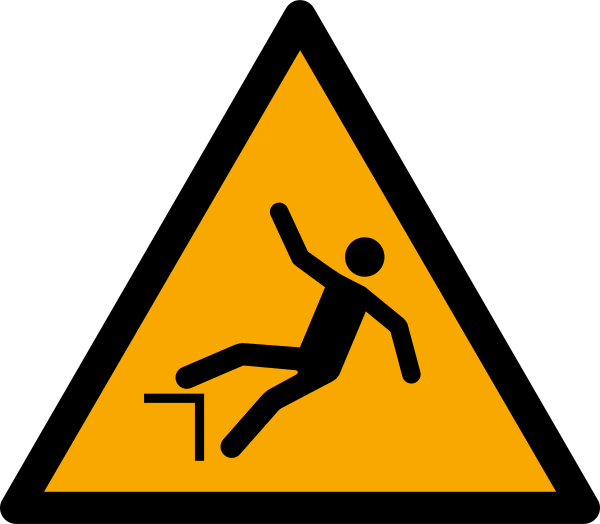
W035 warns that loose objects can drop from above at this location — tools and fittings from overhead work, loads travelling on cranes and hoists, stock dislodged from high racking, material on multi-level scaffolds, and debris at building edges during construction or demolition. The pictogram of falling blocks distinguishes it clearly from W020, which marks a fixed obstacle you might walk into, and from W008, which marks an edge you might fall over. With W035, the ground-level person is the target and gravity supplies the energy.
Even small items become dangerous from height: a dropped hand tool falling a few storeys strikes with enough energy to defeat unprotected skulls and, in many documented incidents, hard hats too. That physics drives the modern response — the goal is keeping people out from under work, not merely helmeting them, and it explains why the triangle so often appears on barriers instead of open routes.
Exclusion Zones Beat Helmets
Ranked by the ISO 12100 hierarchy, the strongest controls against falling objects act at the source: tool lanyards and tethering, toe boards and mesh infill on scaffolds and mezzanines, netting or fans under work areas, secured loads and taglines for crane lifts, and rack backstops in warehouses. Next comes separation — barricaded exclusion zones under overhead work with a single controlled entry point. PPE is the last line, which is why W035 so often marks a barrier rather than an open walkway.
In the United States, general-industry head protection is governed by 29 CFR 1910.135, which requires protective helmets where there is possible injury to the head from falling objects, while construction work applies 1926.100 and uses toe boards, screens, and debris nets under 1926.451 and related provisions. A W035 sign on an active drop zone signals that these duties are engaged, not that a warning has discharged them.
The M014 Pairing and Zone Signing
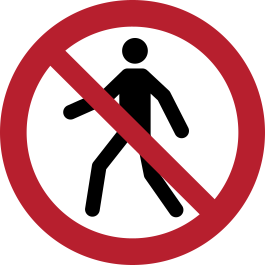
W035 almost never travels alone. Its standard companion is the blue mandatory sign M014 (wear head protection): the triangle names the hazard, the circle imposes the control, and together they mark hard-hat areas at construction gates, crane operating radii, rack aisles with high-level storage, shaft bottoms, and loading zones under gantries. Where entry is barred outright rather than conditioned on a helmet, P004 (no thoroughfare) or a barricade with W035 on it is the correct combination.
Sign the boundary, not just the epicenter. A person needs the warning before entering the drop radius, so W035 belongs on the barrier tape, fencing, or door that defines the zone, facing each approach. For temporary overhead work, hang the sign at the same time the exclusion zone goes up and remove both together — permanent triangles over long-finished work train people to ignore the symbol.
Warehouse and Crane Applications
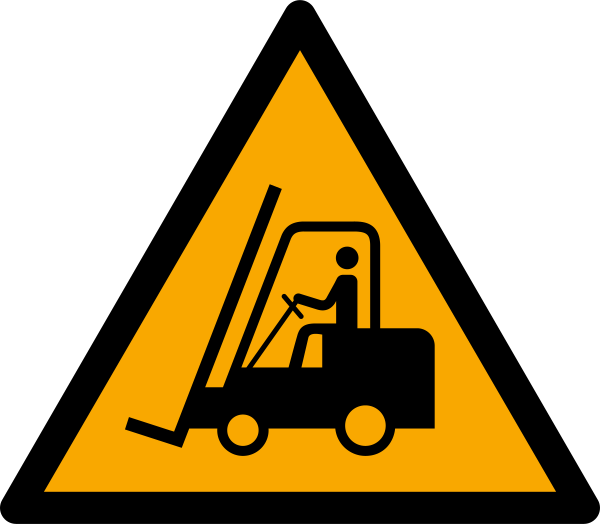
In warehouses, W035 addresses stock falling from pallet racking — a hazard controlled first by beam load ratings, pallet condition checks, backstops or netting where racking faces walkways, and rack-damage inspection regimes. The sign is typically posted at aisle ends and along pedestrian routes that pass beneath high-level storage, frequently beside W014 where lift trucks operate in the same aisles, since the truck traffic is what usually dislodges the load.
Under crane and hoist paths, site rules generally forbid standing or passing beneath a suspended load altogether; W035 along the travel route reinforces a prohibition that operators and slingers enforce in real time. On tower-crane sites, the practical exclusion is managed through lift plans and banksmen, with signage marking the fixed danger areas such as loading platforms and the zone below luffing operations.
Where you will see W035
Construction gates, crane operating radii, scaffold exclusion zones, shaft bottoms, and loading areas under gantries are the classic postings, almost always paired with the M014 hard-hat mandate. Warehouses place it at aisle ends and along pedestrian routes passing beneath high-level pallet racking, and it belongs on the barrier tape, fencing, or door defining a temporary drop zone, facing each approach, hung when overhead work starts and removed when it finishes.
Common questions about W035
What does the W035 falling objects sign mean?
It warns that items can drop from above at this spot — from overhead work, crane loads, scaffolds, or high racking. Expect hard-hat requirements or an exclusion barrier, and never linger beneath suspended loads or active overhead work. It differs from W020, which marks a fixed low obstacle you could walk into.
Does a falling objects warning sign mean hard hats are required?
Usually the requirement is posted explicitly with the blue M014 mandatory head protection sign next to the W035 triangle. The warning alone does not create a PPE rule, but where head injury from falling objects is possible, OSHA 1910.135 obliges the employer to require helmets — so in practice the two signs appear together at zone boundaries.
Is a hard hat enough protection under overhead work?
No. Helmets are the last layer after source controls — tool tethers, toe boards, netting, secured loads — and after exclusion zones that keep people out of the drop radius entirely. Heavy objects falling from height can exceed what any helmet absorbs, which is why barricaded no-entry zones under overhead work are standard practice.
Where should W035 signs be placed in a warehouse?
At the boundaries where people enter areas below high-level storage: aisle entrances, pedestrian routes passing racking faces, and staging areas where loads are lifted to upper beams. Combine them with rack netting or backstops along walkways and with the industrial vehicle warning where forklift traffic shares the aisles.
Reference details
| Symbol code | W035 |
|---|---|
| Sign family | ISO Warning Signs |
| Standard reference | ISO 7010:2019 / ISO 3864-1 ISO Online Browsing Platform: W035 |
| Screen color reference | #FFCC00. Screen colors are not a production color specification. |
| Download formats | SVG reference artwork; a 1024 × 1024 pixel PNG conversion on a white canvas. |
| Record date | · How to interpret our dates |
| Page updated |
Choosing a physical sign size
Download dimensions are not installation dimensions. Select sign size, material, placement, and lighting using the applicable standard and the actual viewing conditions. Chemical label sizing follows its own rules. Read the artwork and sizing guide.
Sources and artwork credits
- Artwork source
- Wikimedia Commons file page
- Creator credited by source
- We.weber
- License
- CC BY-SA 4.0
- Source metadata checked
SVG files are local reference copies. PNG files are raster conversions. Check the linked file history and license terms before reuse; a source-metadata check is not certification of the artwork or a workplace installation.
Report a correction to this reference