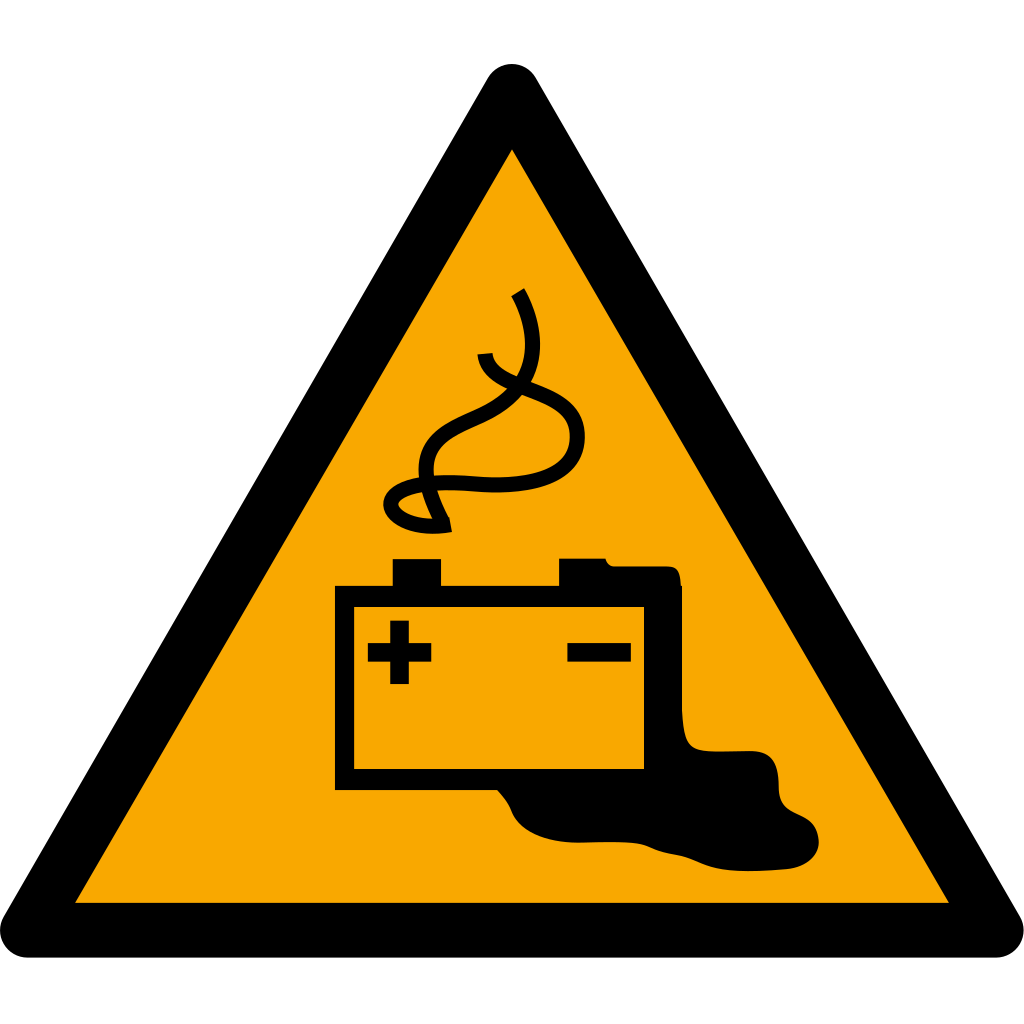
Battery charging
Warns of hazards associated with battery charging.
Understanding this sign
Yellow triangular signs draw attention to a hazard, such as electricity, moving machinery, or a hot surface.
A warning pictogram does not state the severity, safe distance, or protective measures. Read the accompanying instructions.
Why Charging Batteries Get Their Own Triangle
W026 warns of batteries being charged, and the hazard set is broader than most people expect. Lead-acid batteries on charge electrolyze water and evolve hydrogen, which is flammable from roughly 4 percent concentration in air, so a poorly ventilated charging room can accumulate an explosive atmosphere. Add sulfuric acid electrolyte that can splash during watering and inspection, high short-circuit currents across terminals, and the sheer weight of traction batteries being swapped, and a charging bay concentrates chemical, fire, electrical, and manual-handling risks in one corner of the building.
The sign therefore marks an area and an activity rather than a single machine: forklift and pallet-truck charging stations, battery rooms for standby and UPS power, golf-cart and floor-scrubber charging points, and battery-swap stations. Lithium-ion charging areas increasingly use it too, where the concern shifts from hydrogen to thermal runaway and the resulting fire behavior.
OSHA Requirements for Charging Areas
For powered industrial trucks, OSHA 29 CFR 1910.178(g) requires battery charging installations to be located in areas designated for that purpose, with facilities for flushing and neutralizing spilled electrolyte, fire protection, protection of charging apparatus from truck damage, and adequate ventilation for the fumes from gassing batteries. The related 1910.151(c) requirement for quick drenching or flushing facilities where corrosives are handled is why an eyewash station — signed E011 — belongs within easy reach of lead-acid charging.
Because hydrogen accumulation makes ignition sources the critical variable, charging areas are routinely posted with P003 — the prohibition covering smoking, flames, and every other ignition source — alongside W026. Sites add M004 for eye protection and often M009 for acid-resistant gloves during electrolyte work, plus a carboy of neutralizer and a spill kit that the signage helps workers locate quickly.
Setting Up and Signing the Bay
Post W026 at the entrance to the battery room or on the wall behind each charging position, high enough to stay visible over parked trucks. Floor marking that keeps the designated area clear of combustible storage reinforces the sign; cardboard stacked against a charger is a recurring inspection finding. Ventilation should be verified rather than assumed — hydrogen rises and pockets under flat ceilings, so extraction at high level matters more than door draft.
Distinguish W026 from the labels on the batteries themselves. The battery carries chemical hazard communication — corrosive and other GHS pictograms on lead-acid units — while W026 is workplace signage announcing that charging happens here with the risks that operation brings. Both systems apply at once, and neither substitutes for the other: a compliant battery still needs a compliant room, and auditors should check the two layers separately.
Lithium-Ion Changes the Emphasis
Sealed lithium-ion packs do not gas hydrogen in normal service, but a damaged or defective cell on charge can enter thermal runaway, venting flammable electrolyte vapor and reigniting after apparent extinguishment. Facilities charging e-bike, tool, robot, or forklift lithium packs use W026 to concentrate charging in a controlled location — away from exits, on non-combustible surfaces, with detection nearby — rather than letting packs charge scattered across benches.
The signage logic follows ISO 12100 thinking even outside machinery: the controls that matter are charger compatibility, mechanical protection of packs, and a dedicated, supervised location; the triangle then keeps ad-hoc charging from creeping back in. For either chemistry, W026 is at its most useful as the anchor of a marked, rule-bound zone rather than a lone sticker on a charger.
Where you will see W026
Forklift and pallet-truck charging stations, battery rooms for standby and UPS power, golf-cart and floor-scrubber charging points, and battery-swap stations post it at the room entrance or on the wall behind each charging position, high enough to stay visible over parked trucks. Facilities charging e-bike, tool, robot, or forklift lithium packs use it to concentrate charging in one controlled, supervised location.
Common questions about W026
What hazards does the W026 battery charging sign cover?
Hydrogen gas given off by lead-acid batteries on charge, which can form an explosive atmosphere; corrosive electrolyte splashes; high-current arcs across terminals; and, for lithium-ion packs, fire from thermal runaway. It marks designated charging areas so those risks stay confined to a controlled, properly equipped location.
What does OSHA require for forklift battery charging stations?
29 CFR 1910.178(g) requires a designated charging area with means for flushing and neutralizing spilled electrolyte, fire protection, protection of chargers from truck impact, and adequate ventilation for gassing batteries. Where electrolyte is handled, quick-flushing facilities such as an eyewash are also expected under 1910.151(c).
Does an eyewash station need to be near battery charging?
For lead-acid charging where electrolyte is checked, topped up, or could spill, yes — sulfuric acid in the eye needs flushing within seconds, and OSHA requires suitable drenching facilities where corrosives are handled. The E011 eyewash sign should make the unit findable from every charging position.
Should lithium-ion charging areas use the W026 sign?
It is increasingly common and reasonable. Although lithium packs do not gas like lead-acid batteries, charging is when a defective pack is most likely to enter thermal runaway, so concentrating charging in one marked, supervised, non-combustible area — announced by W026 — is a sound control for warehouses, workshops, and fleet depots.
Reference details
| Symbol code | W026 |
|---|---|
| Sign family | ISO Warning Signs |
| Standard reference | ISO 7010:2019 / ISO 3864-1 ISO Online Browsing Platform: W026 |
| Screen color reference | #FFCC00. Screen colors are not a production color specification. |
| Download formats | SVG reference artwork; a 1024 × 1024 pixel PNG conversion on a white canvas. |
| Record date | · How to interpret our dates |
| Page updated |
Choosing a physical sign size
Download dimensions are not installation dimensions. Select sign size, material, placement, and lighting using the applicable standard and the actual viewing conditions. Chemical label sizing follows its own rules. Read the artwork and sizing guide.
Sources and artwork credits
- Artwork source
- Wikimedia Commons file page
- Creator credited by source
- MaxxL
- License
- Public domain
- Source metadata checked
SVG files are local reference copies. PNG files are raster conversions. Check the linked file history and license terms before reuse; a source-metadata check is not certification of the artwork or a workplace installation.
Report a correction to this reference