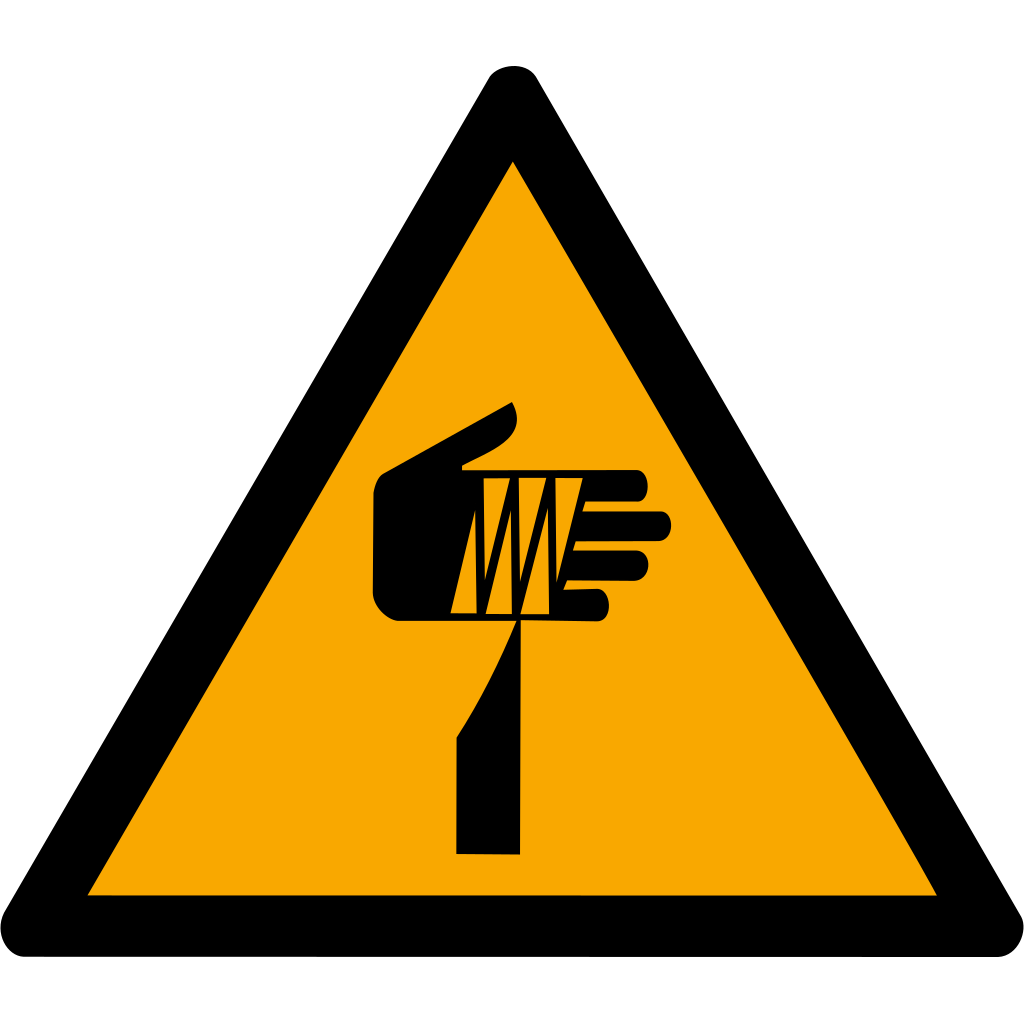
Sharp element
Warns of a sharp element.
Understanding this sign
Yellow triangular signs draw attention to a hazard, such as electricity, moving machinery, or a hot surface.
A warning pictogram does not state the severity, safe distance, or protective measures. Read the accompanying instructions.
What Counts as a Sharp Element
W022 warns of a sharp element — any edge, point, or blade capable of cutting or puncturing on contact. The ISO 7010 register keeps the definition broad on purpose: it covers exposed knife edges on cutting and slitting machinery, unfinished sheet-metal and glass edges, protruding fasteners and banding, swarf around machining centers, trimmed plastic flash, barbed fencing, and sharps in waste-handling streams. The common thread is passive injury: the hazard cuts anyone who touches it, powered or not.
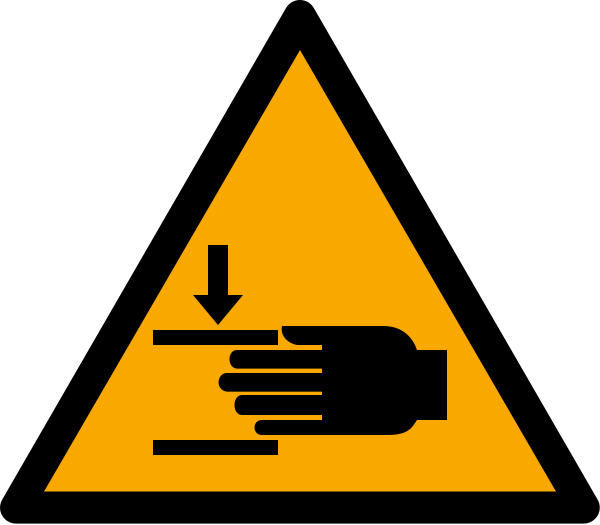
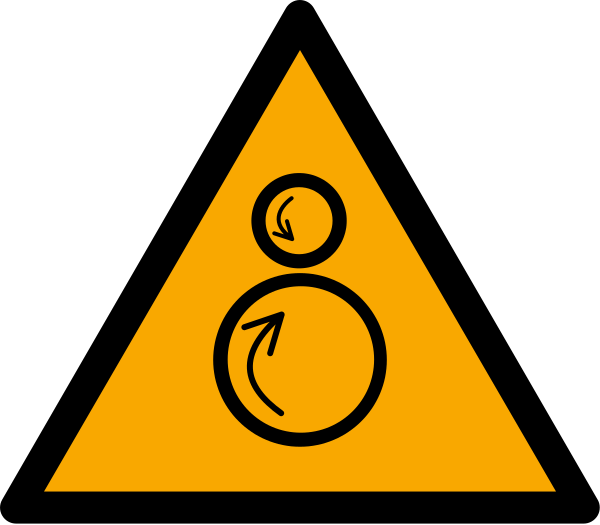
That passivity distinguishes W022 from the machinery triangles around it. W024 and W025 warn of parts that move against you; W022 warns of geometry. It earns its place where the sharp edge is inherent to the product or process — a stack of laser-cut blanks, a glazing rack, a blade magazine — and cannot simply be blunted away.
Elimination, Then Gloves, Then the Sign
Deburring, edge-rounding, corner protectors, blade covers, and sheathing dispensers remove the hazard at source, and ISO 12100's hierarchy says those measures come before any warning. On machines, OSHA 1910.212 expects points of operation with cutting actions to be guarded. Where sharp edges remain part of the work — handling blanks, changing slitter blades, sorting mixed waste — cut-resistant gloves selected to the appropriate ANSI/ISEA 105 or EN 388 cut level become the operative control.
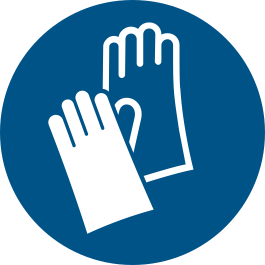
That is why the natural partner of W022 is M009, the blue mandatory sign for protective gloves, often mounted on the same carrier. The pairing converts a bare warning into an instruction: sharp edges here, gloves required. On blade-change stations, supplementary text naming the specific task (for example, use the blade tool provided) outperforms the symbol alone.
Where W022 Is Posted
Typical locations include sheet-metal and glass handling areas, guillotine and slitter blade storage, box-cutter and knife-issue points, recycling and waste sorting lines where needles or broken glass appear, packaging lines using steel strapping, and maintenance zones around fan blades or shredder internals opened for cleaning. On public-facing sites, it also marks barbed or flesh-hook fencing where legitimate access brings people close to it.
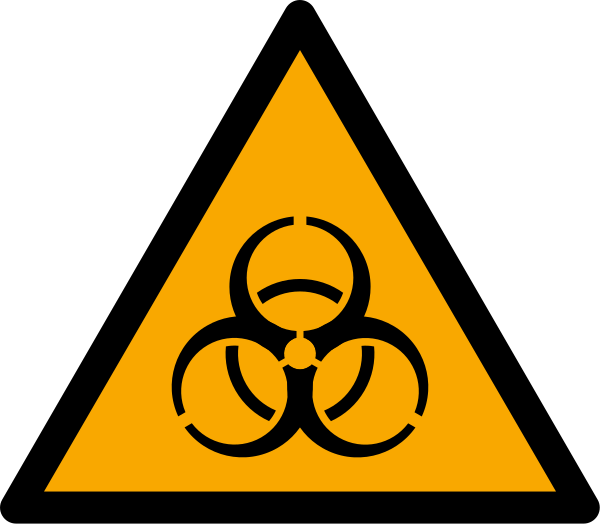
Do not stretch W022 to cover hazards with their own symbol. Biologically contaminated sharps in healthcare belong under the W009 biohazard sign and sharps-container labeling, since infection rather than laceration is the controlling risk. And where a blade moves under power at a point of operation, guard it and consider the moving-machinery warnings; a static sharp-element triangle understates a powered cutting hazard.
Where you will see W022
Sheet-metal and glass handling areas, guillotine and slitter blade storage, and box-cutter issue points are typical placements, frequently paired with the M009 gloves-required sign on the same carrier. Recycling and waste sorting lines where needles or broken glass appear, packaging lines using steel strapping, and maintenance zones around fan blades or shredder internals also carry the sign.
Common questions about W022
What does the W022 sharp element warning sign mean?
It warns that something at this location can cut or puncture skin on contact — exposed blades, sheet-metal or glass edges, protruding points, or sharp waste. Handle items only with suitable cut-resistant gloves and use any tools or handling aids provided.
Which PPE sign is usually paired with W022?
M009, the mandatory protective gloves sign. The warning identifies the laceration hazard and the blue circle mandates the control, so the two are commonly mounted together at glass racks, blade-change points, and metal-handling stations. The gloves specified should carry a cut-resistance rating appropriate to the edges being handled.
Should I use W022 for medical needles and contaminated sharps?
No. Contaminated sharps are primarily an infection hazard, so the biohazard warning W009 and regulated sharps-container labeling apply. W022 is for clean mechanical sharpness — blades, edges, and points where the injury is the cut itself rather than what the cut transmits.
Is a warning sign an acceptable control for sharp edges on a machine?
Only as the last layer. Machine cutting points must be guarded under OSHA 1910.212, and sharp edges that serve no function should be deburred or covered. W022 is appropriate for residual sharpness that cannot be engineered out, such as product edges during handling or blades exposed during changeover.
Reference details
| Symbol code | W022 |
|---|---|
| Sign family | ISO Warning Signs |
| Standard reference | ISO 7010:2019 / ISO 3864-1 ISO Online Browsing Platform: W022 |
| Screen color reference | #FFCC00. Screen colors are not a production color specification. |
| Download formats | SVG reference artwork; a 1024 × 1024 pixel PNG conversion on a white canvas. |
| Record date | · How to interpret our dates |
| Page updated |
Choosing a physical sign size
Download dimensions are not installation dimensions. Select sign size, material, placement, and lighting using the applicable standard and the actual viewing conditions. Chemical label sizing follows its own rules. Read the artwork and sizing guide.
Sources and artwork credits
- Artwork source
- Wikimedia Commons file page
- Creator credited by source
- Bloody666
- License
- CC0
- Source metadata checked
SVG files are local reference copies. PNG files are raster conversions. Check the linked file history and license terms before reuse; a source-metadata check is not certification of the artwork or a workplace installation.
Report a correction to this reference