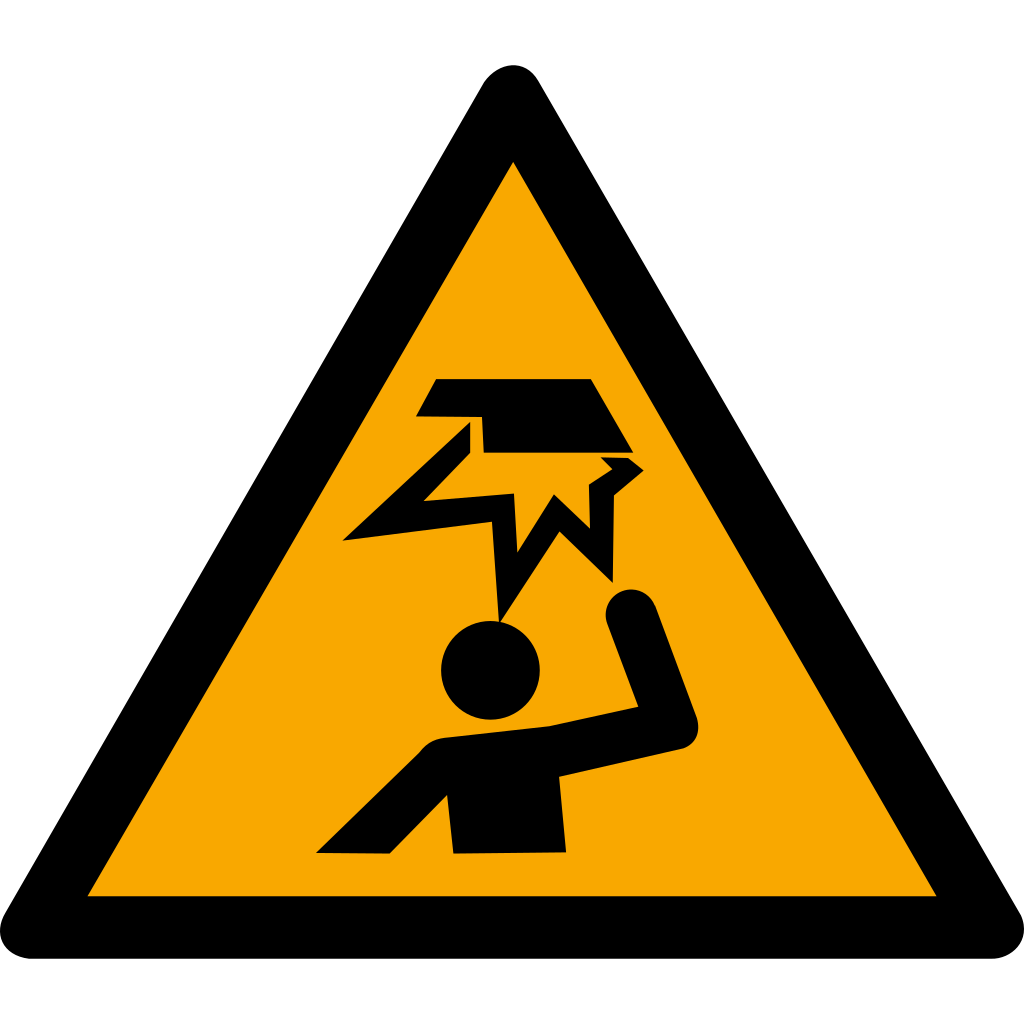
Overhead obstacle
Warns of an overhead obstacle.
Understanding this sign
Yellow triangular signs draw attention to a hazard, such as electricity, moving machinery, or a hot surface.
A warning pictogram does not state the severity, safe distance, or protective measures. Read the accompanying instructions.
What W020 Marks
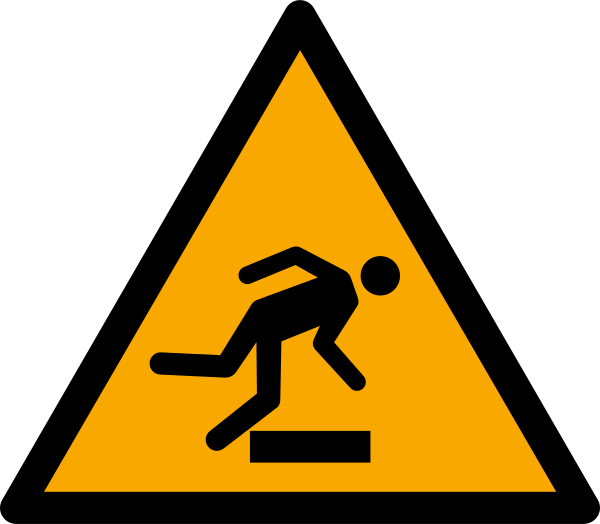
W020 is the ISO 7010 triangle for an overhead obstacle: a fixed object at head height that a walking person can strike. Its natural habitat is low beams and lintels in older buildings, pipe runs and cable trays crossing walkways, the underside of mezzanines and stairs, duct work in plant rooms, low doorways on ships and in basements, and scaffold transoms over pedestrian routes. Unlike W035, nothing here falls — the person moves into the hazard.
Head-strike incidents are rarely fatal but are among the most frequent minor injuries in cramped plant rooms and crawl spaces, and a hard knock at the wrong moment can cause a secondary fall from a ladder or stair. The sign works because it changes posture: a warned person ducks. That only happens if the triangle is seen before the obstacle, not on it at the moment of impact.
Fix the Obstacle First
The risk-reduction sequence in ISO 12100 applies to buildings as much as machines: the preferred responses to a head-height obstruction are rerouting the walkway, raising the service, or padding the edge with impact-absorbing foam profile. Yellow-and-black hazard striping per ISO 3864 conventions on the obstacle itself makes it conspicuous in peripheral vision, which a small triangle alone cannot achieve. W020 then reinforces the message at the approach.
Where head clearance on a walking-working surface is genuinely restricted and cannot be corrected, some sites also require bump caps in that zone. A bump cap protects against striking a stationary object, which is a different job from an industrial helmet rated for falling objects — so a low-clearance route marked W020 may reasonably mandate headgear even though no M014 hard-hat rule applies elsewhere in the building.
Placement and Related Signs
Mount W020 at eye level on the approach to the obstruction, ideally on both sides if the route is two-way, with supplementary text stating the clearance where that helps — for example on vehicle routes, where drivers of forklifts with raised loads need the actual height figure. On stairs passing under structure, put the sign where the person is still looking forward, before their attention shifts to the steps.
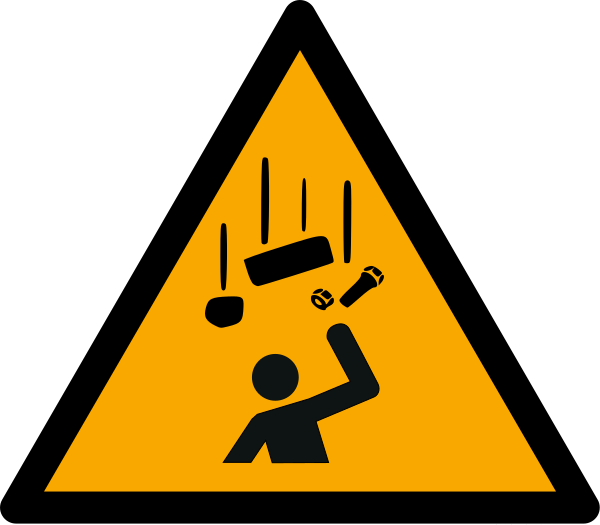
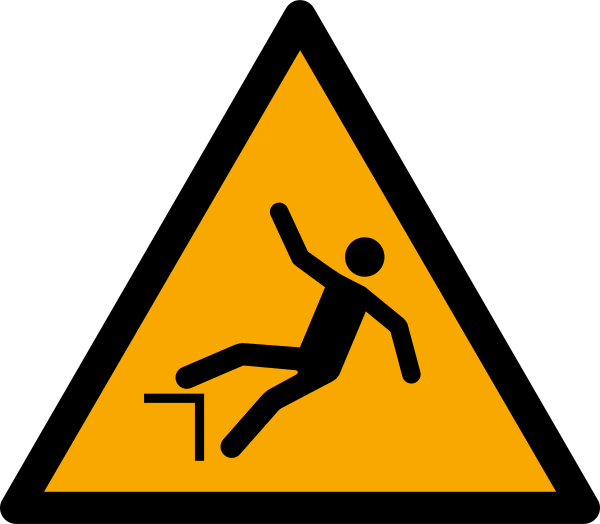
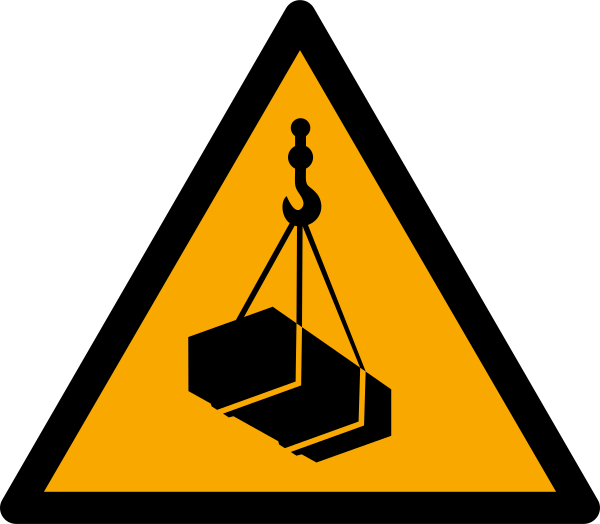
Distinguish W020 from its neighbors: W035 covers objects that may drop from above, W008 covers falls to a lower level, and the electrical clearance warnings apply where the overhead item is a live line rather than a passive obstruction. For low overhead power lines, an electricity warning is required instead of or alongside W020, because contact there injures without any impact.
Where you will see W020
Typical hosts are low beams and lintels in older buildings, pipe runs and cable trays crossing walkways, the undersides of mezzanines and stairs, ductwork in plant rooms, low doorways on ships and in basements, and scaffold transoms over pedestrian routes. Sites mount it at eye level on the approach from both directions, often paired with yellow-and-black hazard striping on the obstacle itself and a stated clearance figure on forklift routes.
Common questions about W020
What does the W020 overhead obstacle sign mean?
It warns that something fixed — a beam, pipe, duct, or low ceiling — is at head height ahead, and a person walking normally could strike it. Duck or use the marked alternative route. It does not mean objects can fall from above; that is the separate W035 sign.
Should I use W020 or W035 for a low beam?
Use W020. The beam is a stationary obstacle that people walk into, which is exactly what W020 depicts. W035 is for zones where loose objects can drop from height, such as under overhead work or racking. Using the falling-objects triangle for a fixed beam sends the wrong instruction — people look up instead of ducking.
Do low beams also need yellow and black striping?
It is strongly recommended and required by many site standards. Alternating yellow-black hazard marking on the obstacle itself is visible in peripheral vision at the moment it matters, while the W020 triangle on the approach explains the marking. Padding the edge with impact-absorbing profile is better still, because it reduces the injury even when the warning fails.
Is a hard hat required where a W020 sign is posted?
Not automatically. W020 is a warning, not a PPE mandate. However, sites with unavoidable low clearances often designate bump-cap zones there, since a bump cap is designed for striking stationary objects. A helmet requirement would be signed separately with the blue mandatory head protection sign.
Reference details
| Symbol code | W020 |
|---|---|
| Sign family | ISO Warning Signs |
| Standard reference | ISO 7010:2019 / ISO 3864-1 ISO Online Browsing Platform: W020 |
| Screen color reference | #FFCC00. Screen colors are not a production color specification. |
| Download formats | SVG reference artwork; a 1024 × 1024 pixel PNG conversion on a white canvas. |
| Record date | · How to interpret our dates |
| Page updated |
Choosing a physical sign size
Download dimensions are not installation dimensions. Select sign size, material, placement, and lighting using the applicable standard and the actual viewing conditions. Chemical label sizing follows its own rules. Read the artwork and sizing guide.
Sources and artwork credits
- Artwork source
- Wikimedia Commons file page
- Creator credited by source
- Bloody666
- License
- CC0
- Source metadata checked
SVG files are local reference copies. PNG files are raster conversions. Check the linked file history and license terms before reuse; a source-metadata check is not certification of the artwork or a workplace installation.
Report a correction to this reference