Crushing
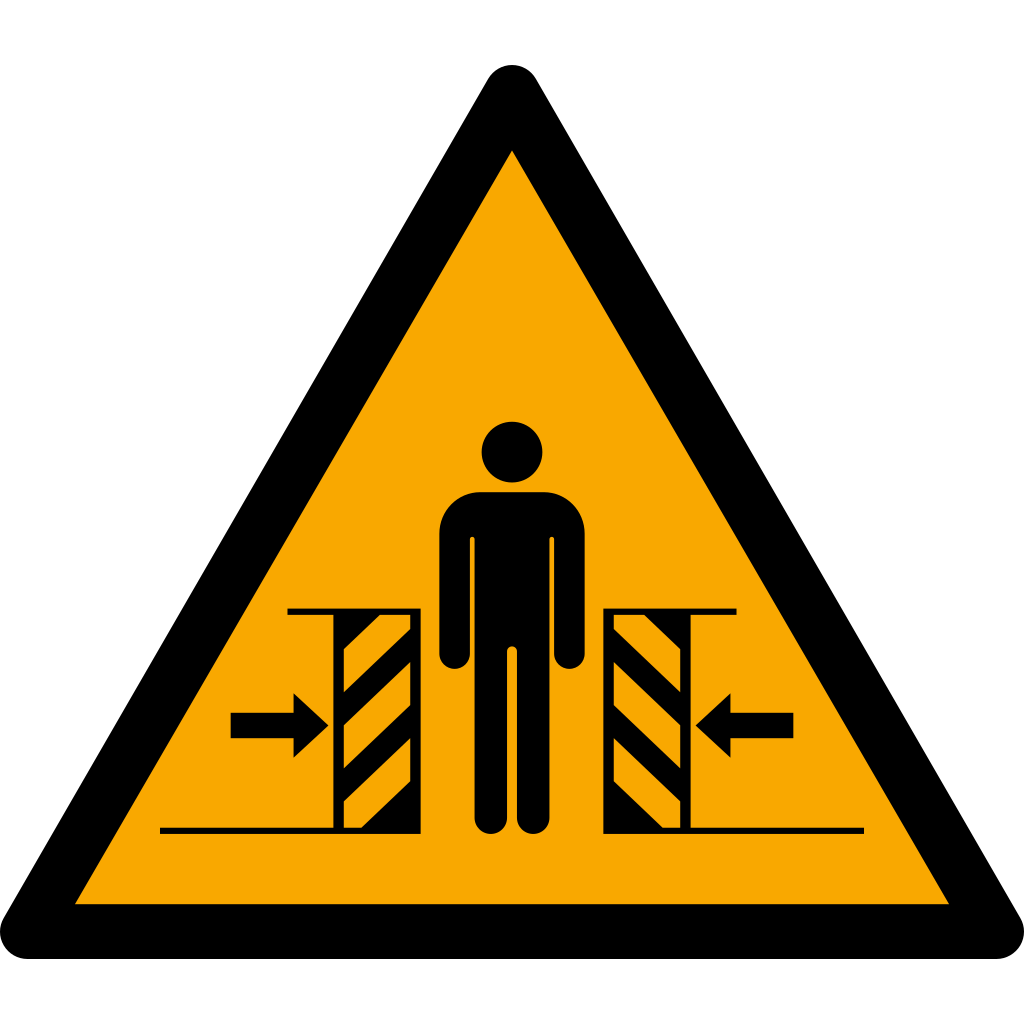
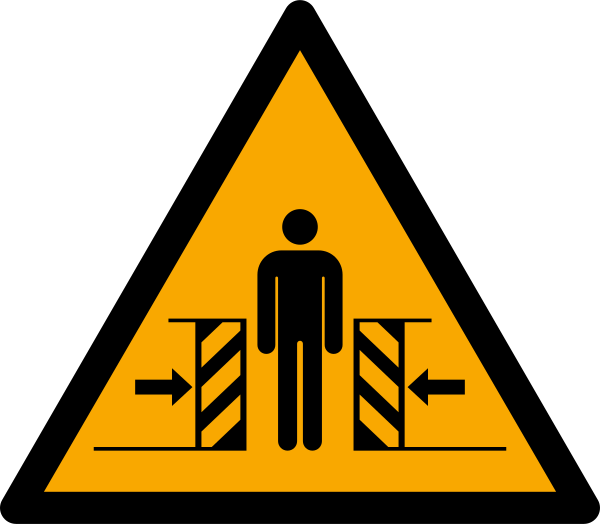
Warns of a crushing hazard.
Understanding this sign
Yellow triangular signs draw attention to a hazard, such as electricity, moving machinery, or a hot surface.
A warning pictogram does not state the severity, safe distance, or protective measures. Read the accompanying instructions.
The Hazard Behind W019
ISO 7010 registers W019 with the function of warning about moving mechanical parts, and its pictogram shows a body caught between a moving mass and a fixed surface. It flags locations where a limb or the whole torso can be pinned: under scissor-lift platforms and vehicle hoists, beside dock levelers, between a traveling gantry or transfer car and a wall, inside baler and compactor chambers, and around counterweights, tailgates, and slewing equipment.
Crushing injuries differ from cuts and entanglement in that the victim is often trapped rather than struck, and rescue itself becomes hazardous. That is why W019 typically appears at positions a person might occupy — pits, crawl spaces, travel paths — rather than only on the machine body. It tells the viewer that a space which looks passable can close.
Guarding Comes Before the Sign
Under OSHA 29 CFR 1910.212, machine hazards including nip and shear points must be controlled by guarding — barrier guards, distance, interlocked enclosures, or presence-sensing devices. A yellow triangle on an unguarded crush zone does not create compliance; inspectors treat signage as a supplement to physical protection, never a substitute for it. Fixed barriers that keep the body out of the closing zone are the expected control wherever they are feasible.
ISO 12100 frames the same logic for machine designers: eliminate the trap through design (for example, maintaining minimum gaps so a body cannot be caught), then safeguard, and only then rely on information for use. W019 is that last layer, covering residual risk such as maintenance access inside a fenced cell or the travel path of mobile equipment that cannot be fully enclosed.
Typical Installations and Companions
Post W019 on scissor-lift skirts and beneath elevating work platforms, on automated storage and retrieval aisles, at the swing radius of excavators and cranes, on powered gates that close against posts, and at rail-guided transfer vehicles in production halls. Where the crushing zone is a defined area rather than a single point — a crane slew radius, for instance — combine the triangle with floor marking or barrier chain that shows the boundary of the danger zone.
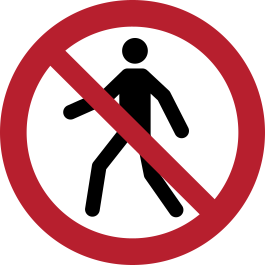
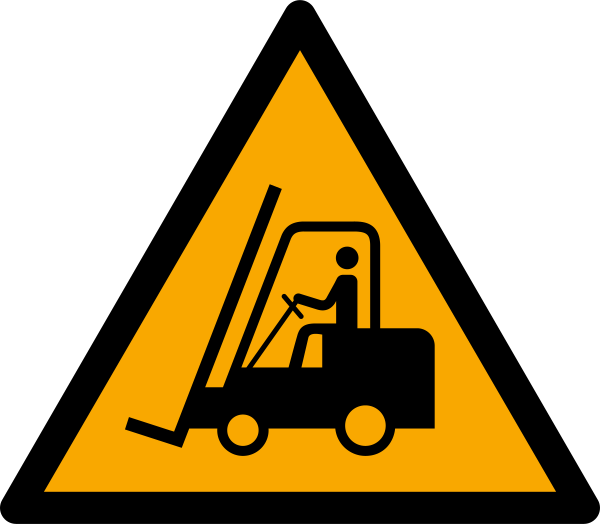
Common pairings include P004 (no thoroughfare) to keep pedestrians out of a machine travel path entirely, W014 where industrial trucks create the crush risk, and lockout instructions for anyone who must enter the zone for servicing. If the closing motion specifically threatens hands at a point of operation, the more precise W024 sign communicates that hazard better than the general W019 body-crush symbol.
W019 Versus W024
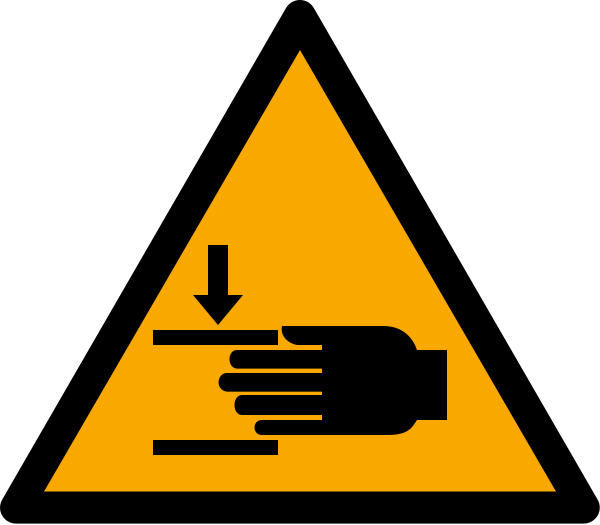
ISO 7010 deliberately provides two crushing triangles. W019 shows a whole figure being caught and suits situations where a person can be pinned bodily: platforms descending, vehicles slewing, large assemblies closing. W024 shows a hand between closing parts and suits point-of-operation hazards on presses, clamps, and doors. Choosing the sign that matches the realistic injury makes the warning concrete instead of generic.
On mobile elevating work platforms, an additional crush scenario has drawn industry attention: operators pinned between the platform rails and overhead steelwork. Machines addressing this often carry both W019 at ground level for bystanders under the platform and operator-facing decals at the controls. When specifying signage for such equipment, follow the manufacturer's marking scheme rather than removing or consolidating the labels.
Where you will see W019
Typical installations include scissor-lift skirts and the underside of elevating work platforms, dock levelers, baler and compactor chambers, automated storage and retrieval aisles, and the swing radius of excavators and cranes. It also guards powered gates that close against posts and rail-guided transfer vehicles in production halls, often combined with floor marking or barrier chain showing the danger-zone boundary.
Common questions about W019
What does the W019 crushing warning sign mean?
It warns that moving mechanical parts at that location can pin a person or limb between a moving mass and a fixed surface — under a lift platform, beside a traveling machine, inside a compactor. Keep out of the closing zone and never enter it without isolating the machine's energy supply.
Is a crushing warning sign enough to comply with OSHA machine guarding rules?
No. OSHA 1910.212 requires physical safeguarding of machine hazards; a warning sign supplements guards but cannot replace them. If a crush point is accessible during normal operation, the expected fix is a barrier, interlock, or presence-sensing device, with W019 covering the residual risk that guarding cannot remove.
When should I use W019 instead of W024?
Use W019 when a person's body or a whole limb can be caught — descending platforms, slewing vehicles, closing gates, transfer cars. Use W024 when the realistic injury is to the hands at a specific closing point, such as a press, clamp, or powered door edge. Matching the pictogram to the actual injury scenario makes the warning more effective.
Where should crushing hazard signs be placed on a scissor lift?
Follow the manufacturer's decal locations: typically on the chassis or skirt facing bystanders who might reach or step under the platform, and at the ground and platform control stations. Signs must remain legible and be replaced if damaged, since they form part of the machine's required residual-risk information.
Reference details
| Symbol code | W019 |
|---|---|
| Sign family | ISO Warning Signs |
| Standard reference | ISO 7010:2019 / ISO 3864-1 ISO Online Browsing Platform: W019 |
| Screen color reference | #FFCC00. Screen colors are not a production color specification. |
| Download formats | SVG reference artwork; a 1024 × 1024 pixel PNG conversion on a white canvas. |
| Record date | · How to interpret our dates |
| Page updated |
Choosing a physical sign size
Download dimensions are not installation dimensions. Select sign size, material, placement, and lighting using the applicable standard and the actual viewing conditions. Chemical label sizing follows its own rules. Read the artwork and sizing guide.
Sources and artwork credits
- Artwork source
- Wikimedia Commons file page
- Creator credited by source
- MaxxL
- License
- Public domain
- Source metadata checked
SVG files are local reference copies. PNG files are raster conversions. Check the linked file history and license terms before reuse; a source-metadata check is not certification of the artwork or a workplace installation.
Report a correction to this reference