Hot surface
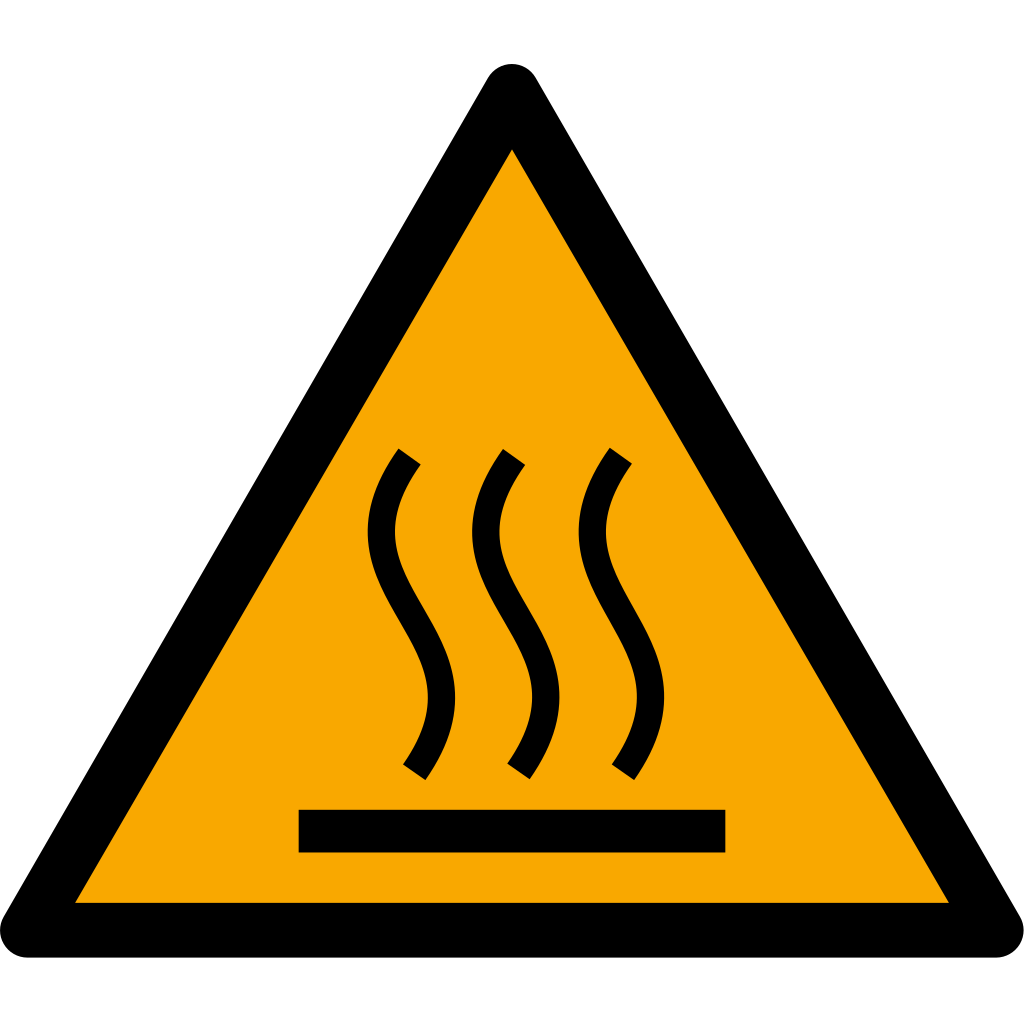
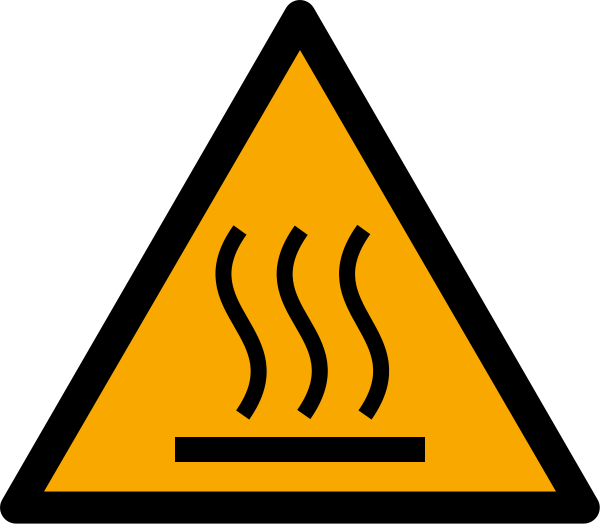
Warns of a hot surface.
Understanding this sign
Yellow triangular signs draw attention to a hazard, such as electricity, moving machinery, or a hot surface.
A warning pictogram does not state the severity, safe distance, or protective measures. Read the accompanying instructions.
What ISO 7010 W017 Warns About
W017 warns of a hot surface. Its pictogram shows a hand reaching toward a radiating hot surface, drawn in black inside the ISO 3864-1 warning triangle on a yellow field. The sign tells people that a surface may be hot enough to cause a contact burn even though there is no flame or visible glow. Many burn injuries come from touching equipment that looks harmless — pipework, heaters, exhausts, or process vessels — so the warning targets the moment before a hand or forearm makes contact.
The symbol identifies the hazard type but does not state the temperature or how long the surface stays hot. A surface can be hazardous well below the point where it looks any different, and some equipment remains dangerously hot long after it has been switched off. Where those details matter — for instance a surface that stays hot for hours after shutdown — supplementary text conveys them. On its own, W017 simply signals that touching the marked surface risks a thermal burn.
When the Hot-Surface Warning Applies
W017 is appropriate wherever accessible surfaces can reach temperatures capable of burning skin: steam and hot-water pipes, boilers, ovens, furnaces, kilns, engine and generator exhausts, hydraulic and compressor equipment, injection-moulding and extrusion machinery, and heated process vessels. It also suits surfaces that are cold in normal operation but become hot during specific cycles, such as sterilisers and autoclaves. The common factor is that a person could touch the surface in the course of normal work or passage and be injured by heat alone.
The preferred first response to a hot-surface hazard is to remove or guard it rather than only to warn. Insulation, heat shields, guarding, and routing hot equipment away from access points reduce the chance of contact more reliably than a sign. Where guarding is impractical — because the surface must dissipate heat or be accessed for operation — W017 marks the residual hazard so that people keep clear or use heat-resistant gloves. The sign works best as the visible reminder attached to a surface that has already been made as safe as the process allows.
Placing the Hot-Surface Sign
Fix W017 directly on or immediately adjacent to the hot surface, positioned where a person would naturally look before reaching in — on a guard, a housing, or the approach to a heated component. On long runs of hot pipework, repeat the sign at intervals and at any point where the pipe passes close to a walkway or work position, because a single label at one end will not warn someone who approaches the middle. The sign should survive the heat and any cleaning the surface receives without fading or peeling.
For equipment that stays hot after it is switched off, placement should be reinforced with supplementary text such as "Surface remains hot after shutdown", since the greatest risk is often to maintenance staff who assume that a stopped machine is cool. Where hot surfaces sit inside enclosures accessed only for service, the warning belongs at the access point so it is read before the guard is opened. Combining W017 with mandatory heat-resistant-glove signage is common where routine contact with warm surfaces cannot be avoided.
Distinguishing W017 From Related Signs
W017 warns specifically of heat felt through contact with a surface. It is distinct from signs warning of open flame or fire risk, and from prohibition signs banning ignition sources; a hot surface may be dangerous to touch without presenting any risk of ignition, and conversely a flammable-atmosphere warning is about combustion rather than burns. Selecting W017 keeps the message focused on the thermal-contact hazard and the correct response, which is to avoid touching the surface or to use appropriate protection.
It is also different from warnings for low temperature or cryogenic surfaces, which cause cold burns and frostbite and have their own pictogram. The two feel similar as injuries but call for opposite context, so using the right sign avoids confusion. Where a process involves both very hot and very cold surfaces in the same area, each should carry its own warning. W017 is the correct choice only where the hazard is elevated surface temperature that can burn on contact.
Where you will see W017
Steam and hot-water pipes, boilers, ovens, furnaces, kilns, engine and generator exhausts, hydraulic and compressor equipment, and injection-moulding and extrusion machinery are the typical carriers, along with sterilisers and autoclaves that run hot only during certain cycles. The sign is fixed directly on or beside the hot surface, repeated along long pipe runs near walkways, and placed at service access points for equipment that stays hot after shutdown.
Common questions about W017
What does the hot surface warning sign mean?
The hand reaching toward a radiating surface in a yellow triangle is ISO 7010 W017, warning that a surface may be hot enough to cause a contact burn without any flame or visible glow. It targets everyday equipment such as pipework, heaters, and exhausts, prompting people to keep clear or use heat-resistant protection before touching the marked surface.
Does the hot surface sign tell me how hot the surface is?
No. The pictogram only signals that touching the surface risks a thermal burn; it gives no temperature. Some surfaces are hazardous below the point where they look any different, and many stay hot long after shutdown. Add supplementary text where those details matter, such as noting that a surface remains hot after the equipment is switched off.
Is a sign enough, or should the hot surface be guarded?
Guarding or insulating a hot surface protects people more reliably than a sign and is the preferred first response. W017 is appropriate for the residual hazard where the surface must stay exposed to dissipate heat or be accessed for operation. In practice the sign works best attached to a surface that has already been made as safe as the process allows.
What is the difference between the hot surface sign and a fire warning?
W017 warns of heat felt through contact with a surface, so the risk is a burn from touching it. Fire and open-flame warnings concern combustion and ignition, not contact burns. A surface can be dangerous to touch without any fire risk, so W017 keeps the message focused on avoiding contact rather than on flammability.
Reference details
| Symbol code | W017 |
|---|---|
| Sign family | ISO Warning Signs |
| Standard reference | ISO 7010:2019 / ISO 3864-1 ISO Online Browsing Platform: W017 |
| Screen color reference | #FFCC00. Screen colors are not a production color specification. |
| Download formats | SVG reference artwork; a 1024 × 1024 pixel PNG conversion on a white canvas. |
| Record date | · How to interpret our dates |
| Page updated |
Choosing a physical sign size
Download dimensions are not installation dimensions. Select sign size, material, placement, and lighting using the applicable standard and the actual viewing conditions. Chemical label sizing follows its own rules. Read the artwork and sizing guide.
Sources and artwork credits
- Artwork source
- Wikimedia Commons file page
- Creator credited by source
- MaxxL
- License
- Public domain
- Source metadata checked
SVG files are local reference copies. PNG files are raster conversions. Check the linked file history and license terms before reuse; a source-metadata check is not certification of the artwork or a workplace installation.
Report a correction to this reference