Overhead load
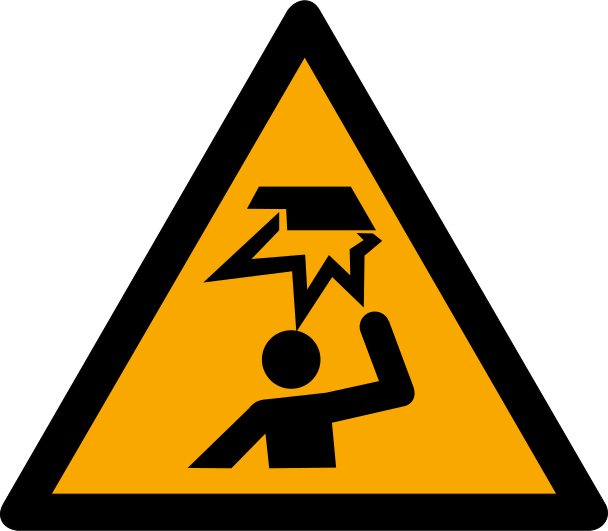
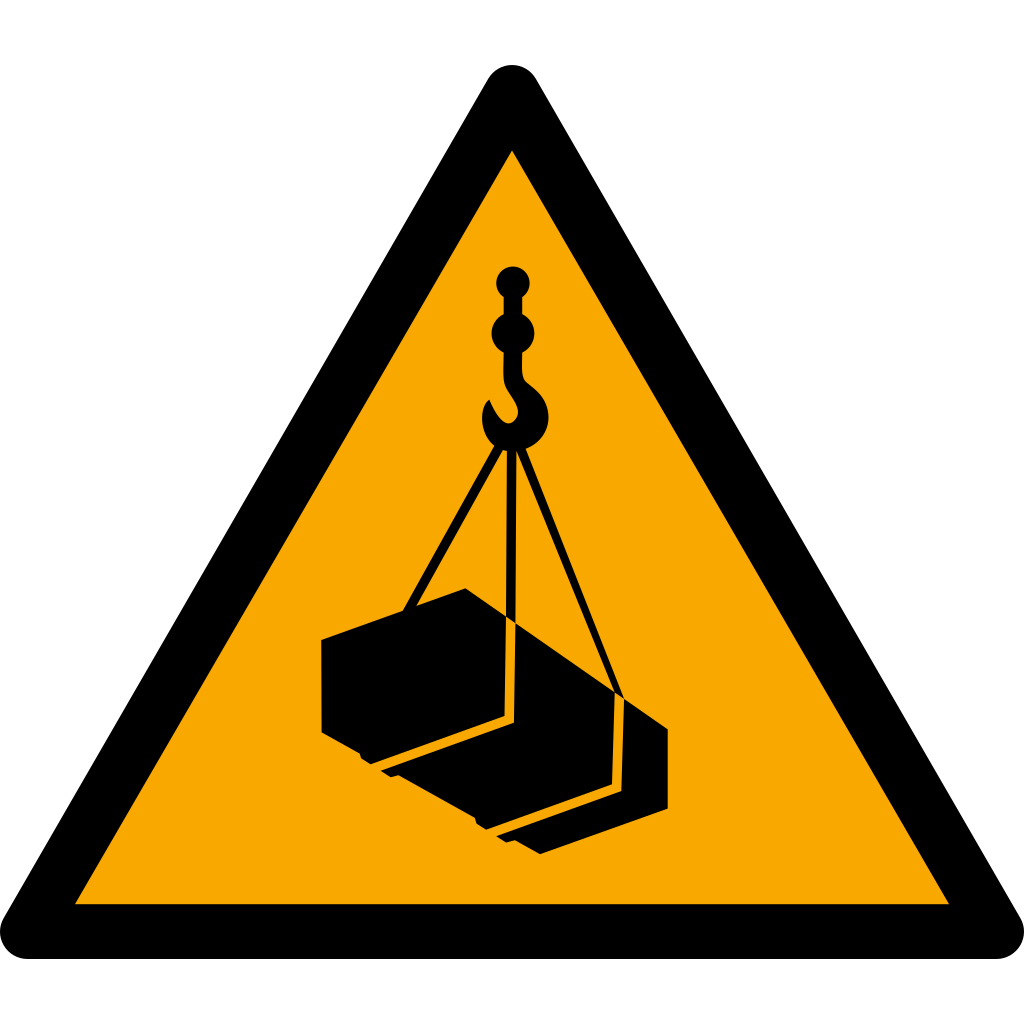
Warns of an overhead load.
Understanding this sign
Yellow triangular signs draw attention to a hazard, such as electricity, moving machinery, or a hot surface.
A warning pictogram does not state the severity, safe distance, or protective measures. Read the accompanying instructions.
What ISO 7010 W015 Warns About
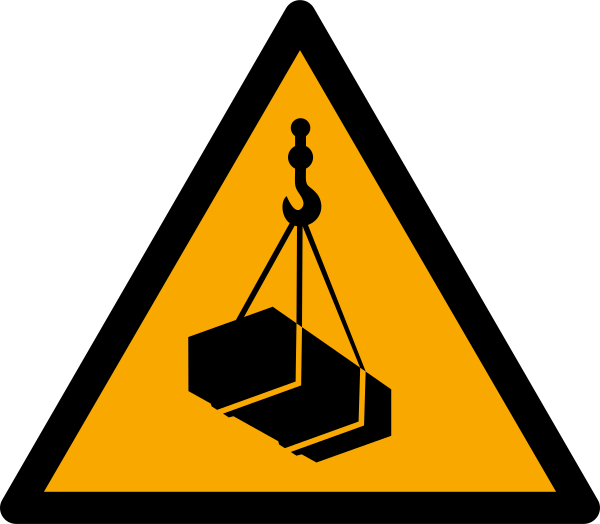
W015 warns of an overhead load. The pictogram shows a suspended load hanging above a person, drawn in black inside the ISO 3864-1 warning triangle on a yellow field. It tells people that loads may be lifted or moved overhead and that standing or passing beneath them risks being struck or crushed if a load, sling, or attachment fails. The warning applies wherever cranes, hoists, and lifting equipment carry material above areas where people may be present, and it is a prompt to keep clear of the space under a raised load.
The sign identifies the hazard but does not control the lift itself. W015 cannot secure a load, keep it from swinging, or guarantee that rigging is sound; it warns people on the ground to stay out of the danger zone below. The fundamental rule it supports is simple and long-standing: never stand or walk under a suspended load. Where lifting operations are frequent or the exclusion zone must be defined precisely, the warning is combined with barriers, marked keep-clear areas, and text that reinforces the prohibition on passing beneath loads.
Why Overhead-Load Warnings Matter
Being struck by a falling or swinging load is one of the more severe hazards in lifting operations, because the energy involved leaves little margin for error and injuries are often fatal. Safe lifting depends on trained operators, planned lifts, rated equipment, and inspected rigging, and a core principle across lifting-safety guidance is that people are kept out from under suspended loads. In the United States, OSHA's rules for overhead and gantry cranes in 29 CFR 1910.179 and related crane and rigging standards address the equipment and its safe use, and keeping personnel clear of loads is a recurring theme.
As with other warnings, W015 sits below physical and procedural controls in effectiveness. Planning the lift so loads never travel over occupied areas, using exclusion zones and banksmen or signallers, and maintaining and inspecting lifting gear prevent the incident far more reliably than a sign can. The overhead-load warning is most useful where those measures are in force and the sign marks the boundary of an area where loads may pass overhead, reminding people who might otherwise take a shortcut beneath a lift of the reason not to.
Where to Post the Overhead-Load Sign
Place W015 at the approaches to areas where lifting takes place: crane bays, loading and unloading points, construction hoisting zones, steel-erection areas, dockside and yard lifting operations, and beneath the travel paths of overhead travelling cranes. In workshops and warehouses it belongs where jib cranes or hoists move material above walkways or workstations. The sign should be seen before a person can enter the space beneath a potential load, so that the decision to keep clear is made at the boundary rather than underneath the hazard.
For fixed installations, W015 marks a permanent hazard and can be supported by painted floor markings or barriers that define the keep-clear zone under a crane's operating area. For temporary lifts, portable signage and physical exclusion barriers are set out for the duration of the operation and removed afterwards. Because loads can swing beyond the point directly below the hook, the warned and barriered area should account for the swing radius, not just the vertical drop line, so people are kept clear of the full zone a moving load can reach.
Related Signs and Lifting-Safety Context
W015 is commonly used with complementary signage that defines behaviour during lifting. A prohibition sign may forbid entry to the area beneath the crane while a lift is in progress; mandatory signs may require hard hats in the lifting zone; and text panels may state "Do not stand under suspended loads" to make the rule explicit. The warning triangle identifies the hazard, while these signs and the lift plan set out what people must do to stay safe around it.
It is useful to distinguish W015, which warns those on the ground of loads above them, from signage directed at crane operators and riggers, such as capacity charts, signalling instructions, and limits on lifting. Those govern how the lift is performed; W015 protects the people who are not part of the lift but share the space below it. In a well-run lifting operation the two align — the lift is planned to avoid people, exclusion zones are enforced, and W015 marks the edge of the area where a load could pass overhead.
Where you will see W015
Crane bays, loading and unloading points, steel-erection areas, and dockside lifting operations post W015 at their approaches so people decide to keep clear at the boundary. In workshops and warehouses it marks where jib cranes or hoists carry material above walkways, often supported by painted floor markings, barriers defining the keep-clear zone, and hard-hat mandatory signs.
Common questions about W015
What does the overhead load warning sign mean?
The suspended load above a person in a yellow triangle is ISO 7010 W015, warning that loads may be lifted or moved overhead. It alerts people that standing or passing beneath a raised load risks being struck or crushed if the load or rigging fails. Its core message is the long-standing rule never to stand or walk under a suspended load.
Why should you never stand under a suspended load?
Because a failure of the load, sling, or attachment gives almost no time to react and the forces involved are often fatal. Rigging can slip, equipment can fail, and loads can swing beyond the point directly below the hook. Keeping clear of the area under and around a raised load is a core principle of lifting safety that W015 exists to reinforce.
Where should overhead-load warning signs be placed?
Post W015 at approaches to lifting areas: crane bays, loading points, construction hoisting zones, steel-erection areas, and beneath overhead crane travel paths. The sign should be seen before a person enters the space beneath a potential load. Because loads can swing, the warned and barriered keep-clear zone should account for the swing radius, not only the vertical drop line.
Is the overhead-load sign enough on its own?
No. Signage is less effective than physical and procedural controls. Planning lifts so loads never travel over occupied areas, using exclusion zones and signallers, and inspecting lifting gear prevent incidents far more reliably. W015 is most useful where those measures are in force and the sign marks the boundary of an area where loads may pass overhead.
Reference details
| Symbol code | W015 |
|---|---|
| Sign family | ISO Warning Signs |
| Standard reference | ISO 7010:2019 / ISO 3864-1 ISO Online Browsing Platform: W015 |
| Screen color reference | #FFCC00. Screen colors are not a production color specification. |
| Download formats | SVG reference artwork; a 1024 × 1024 pixel PNG conversion on a white canvas. |
| Record date | · How to interpret our dates |
| Page updated |
Choosing a physical sign size
Download dimensions are not installation dimensions. Select sign size, material, placement, and lighting using the applicable standard and the actual viewing conditions. Chemical label sizing follows its own rules. Read the artwork and sizing guide.
Sources and artwork credits
- Artwork source
- Wikimedia Commons file page
- Creator credited by source
- MaxxL
- License
- Public domain
- Source metadata checked
SVG files are local reference copies. PNG files are raster conversions. Check the linked file history and license terms before reuse; a source-metadata check is not certification of the artwork or a workplace installation.
Report a correction to this reference