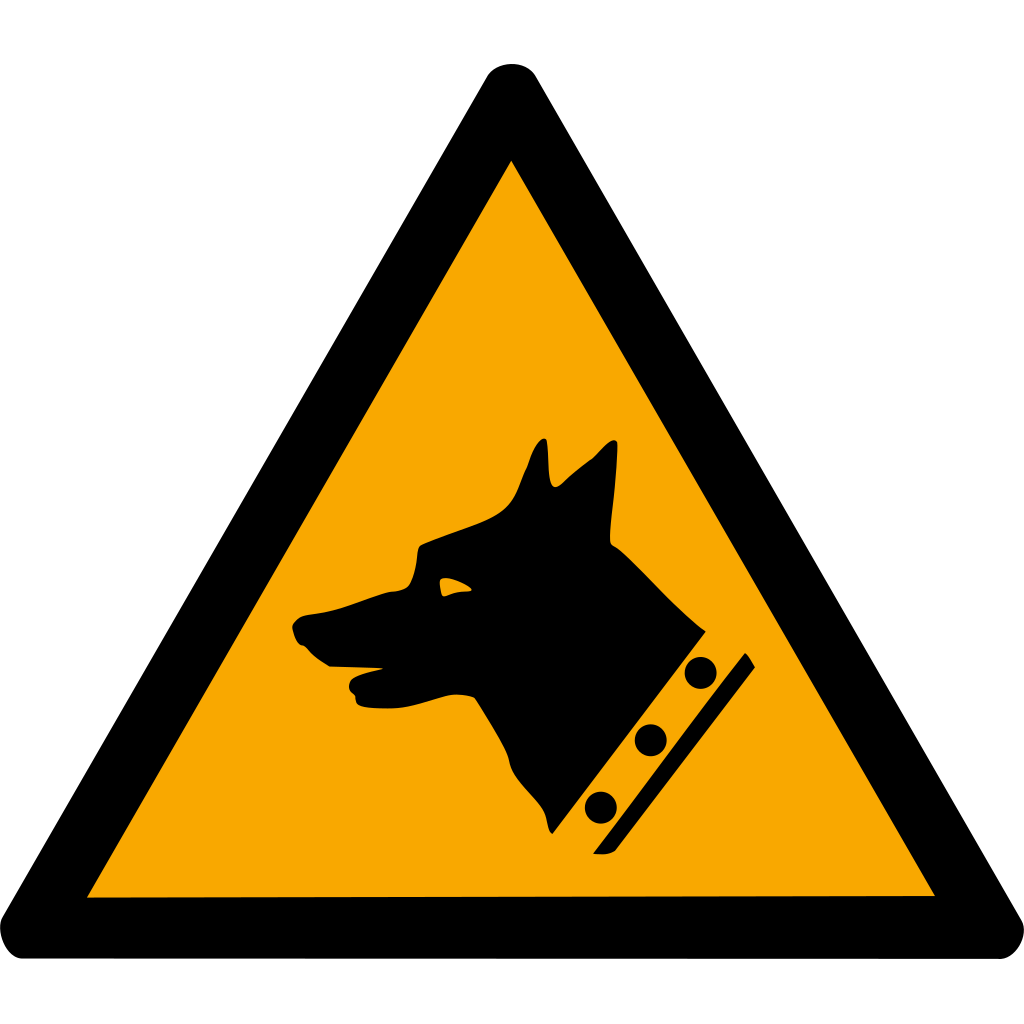
Guard dog
Warns of a guard dog.
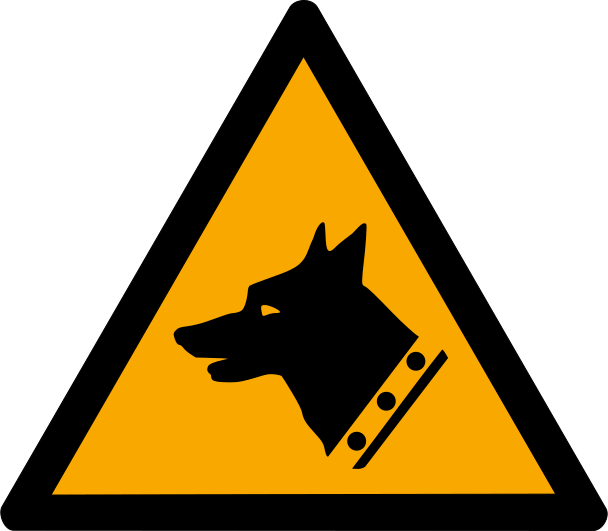
Understanding this sign
Yellow triangular signs draw attention to a hazard, such as electricity, moving machinery, or a hot surface.
A warning pictogram does not state the severity, safe distance, or protective measures. Read the accompanying instructions.
What W013 Communicates
W013 warns that a guard dog is present. The pictogram — a dog in profile inside the yellow warning triangle — tells visitors, contractors, delivery drivers, and would-be intruders that entering the area brings a risk of being confronted or bitten by a working security animal. It is the standardized, language-free equivalent of the traditional "beware of dog" board, and it belongs on gates, perimeter fencing, and doors of premises patrolled or guarded by dogs.
Unlike most workplace warning signs, W013 addresses people who are not supposed to be there at all as much as those who are. Scrap yards, vehicle compounds, construction sites secured overnight, warehouses with canine patrols, and private properties all use it. Legitimate visitors read it as an instruction to stay out or announce themselves; intruders read it as a reason to pick a different target.
Deterrence Versus a Real Dog
Many premises display guard dog signage with no dog on site, purely as a deterrent. That practice cuts both ways. A sign is cheap and may discourage casual trespass, but experienced intruders discount unaccompanied signs quickly, and a warning that is obviously false erodes trust in every other sign on the site. Security professionals generally treat signage as one layer that only works honestly — reinforcing a genuine dog patrol, alarm, or camera coverage.
Where a dog really is present, the sign carries operational weight. It supports safe systems of work for postal workers, meter readers, and emergency responders who need to enter; it justifies procedures such as calling ahead so the handler can secure the animal; and it should be posted at every practicable access point, not just the main gate, because a dog does not distinguish between an intruder and a contractor who climbed the back fence unaware.
Liability and Legal Considerations
The legal effect of a guard dog sign varies widely between jurisdictions, and owners should not assume it either protects or exposes them by default. In some legal systems, clear warning signage supports a defense against claims from trespassers or shows the occupier took reasonable precautions; in others, courts have treated prominent warnings as evidence the owner knew the animal was dangerous. Several countries additionally regulate guard dogs directly — requiring handlers, secure enclosures, or specific notices at entrances — so the sign may be mandatory regardless of its effect on liability.
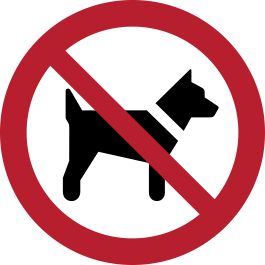
The practical advice is jurisdiction-agnostic: post W013 wherever a working dog could encounter a person, keep the dog controlled in line with local law, and treat the sign as a genuine safety communication rather than a legal shield. For workplaces, remember the audience includes employees and authorized visitors, who are owed a higher duty of care than trespassers in nearly every legal system. Note the distinction from P021, the prohibition sign meaning no dogs allowed — the two are opposites, and mixing them up reverses the message.
Where you will see W013
Scrap yards, vehicle compounds, construction sites secured overnight, and warehouses with canine patrols post it on perimeter fencing and at every practicable access point, not just the main gate. It also supports safe systems of work for postal workers, meter readers, and emergency responders, justifying procedures such as calling ahead so the handler can secure the animal before entry.
Common questions about W013
Does a beware of dog sign protect me from liability if my dog bites someone?
It depends entirely on your jurisdiction. In some places a clear warning helps establish that a trespasser assumed the risk or that you acted reasonably; in others, a prominent sign has been read as proof you knew the dog was dangerous, which can worsen your position. Signage also rarely changes your duty toward invited visitors and workers. Check local animal control and occupier liability law rather than relying on the sign.
Is it legal to put up a guard dog sign without actually having a dog?
In most places, yes — a warning sign with no dog behind it is generally lawful and is a common low-cost deterrent. Be aware of two caveats: some jurisdictions that license or regulate guard dogs prescribe when notices must or may be displayed, and a sign known to be false undermines the credibility of your genuine safety signage. Verify local rules if your area regulates security dogs.
How is the W013 guard dog sign different from the no dogs sign P021?
They are opposites. W013 is a yellow warning triangle telling people a guard dog is present and they may be attacked if they enter. P021 is a red-circle prohibition sign telling visitors they may not bring dogs onto the premises, typically at food facilities, pools, or shops. Confusing them either scares off customers or fails to warn about a real animal.
Where should guard dog warning signs be placed?
Wherever someone could get into the area the dog patrols: main gates, pedestrian entrances, rear and side access points, and along perimeter fencing at intervals where a person might climb over. The sign must be visible before entry is possible, because its entire purpose is to change the decision to enter — a warning first seen from inside the compound has already failed.
Reference details
| Symbol code | W013 |
|---|---|
| Sign family | ISO Warning Signs |
| Standard reference | ISO 7010:2019 / ISO 3864-1 ISO Online Browsing Platform: W013 |
| Screen color reference | #FFCC00. Screen colors are not a production color specification. |
| Download formats | SVG reference artwork; a 1024 × 1024 pixel PNG conversion on a white canvas. |
| Record date | · How to interpret our dates |
| Page updated |
Choosing a physical sign size
Download dimensions are not installation dimensions. Select sign size, material, placement, and lighting using the applicable standard and the actual viewing conditions. Chemical label sizing follows its own rules. Read the artwork and sizing guide.
Sources and artwork credits
- Artwork source
- Wikimedia Commons file page
- Creator credited by source
- Bloody666
- License
- CC0
- Source metadata checked
SVG files are local reference copies. PNG files are raster conversions. Check the linked file history and license terms before reuse; a source-metadata check is not certification of the artwork or a workplace installation.
Report a correction to this reference