Electricity
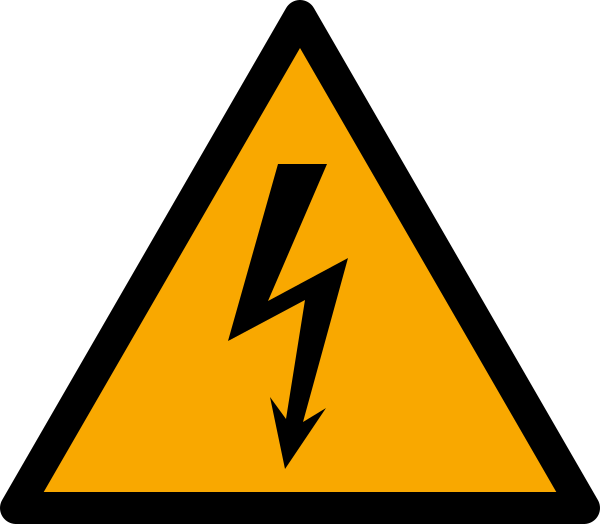
Warns of an electrical hazard. The pictogram does not specify voltage or whether equipment is energized.
Understanding this sign
Yellow triangular signs draw attention to a hazard, such as electricity, moving machinery, or a hot surface.
A warning pictogram does not state the severity, safe distance, or protective measures. Read the accompanying instructions.
What ISO 7010 W012 Warns About
W012 warns of electricity: the risk of electric shock, arc, or burn from live parts. It uses the ISO 3864-1 warning format — a black lightning-bolt arrow inside a black triangular band on a yellow field — and is the internationally recognised replacement for older national electrical-hazard symbols. The sign tells a person that energised conductors or equipment may be present and that contact could be fatal, so the area or enclosure should not be opened or entered without the right authorisation and precautions.
The sign marks the presence of an electrical hazard; it does not quantify it. W012 says nothing about voltage level, whether the circuit is currently energised, or what protective equipment is required. That boundary matters because a small control panel and a medium-voltage switchroom can wear the same pictogram while presenting very different levels of danger. Supplementary text or additional labelling is what turns the general electrical warning into actionable information.
How W012 Relates to US Electrical Rules
In the United States, electrical safety in the workplace is governed largely by OSHA's electrical standards in 29 CFR 1910 Subpart S and by consensus standards such as NFPA 70 (the National Electrical Code) and NFPA 70E for electrical safety in the workplace. OSHA generally requires that energised equipment and enclosures be marked to warn qualified and unqualified persons of the hazard, and an ISO-style W012 symbol is a common way to satisfy that general warning function alongside ANSI Z535 signage.
It is important not to confuse W012 with an arc-flash label. W012 is a generic electrical-hazard warning. An arc-flash label under NFPA 70E is a specific equipment label that states the calculated incident energy or the arc-flash boundary and the personal protective equipment required, so that workers can select the correct arc-rated clothing. A facility may use both: W012 to warn generally, and a detailed arc-flash and shock-hazard label on the equipment to convey the engineered risk data.
Where to Place the Electricity Warning
Post W012 on the outside of anything that could expose a person to live parts: switchgear and distribution boards, transformer enclosures, motor control centres, junction boxes, cable pits, and the doors of electrical rooms. On plant and machinery, apply it to covers and access panels that guard energised terminals so the warning is seen before the guard is removed. In substations and yards it belongs on fences and gates so that the hazard is announced at the boundary, not only at the equipment.
Placement should give the reader time to react before reaching the danger. Where high voltage is involved, W012 is normally reinforced with supplementary text stating the voltage and a prohibition such as "Authorised personnel only" or "Danger of death", and with lock-out points that physically prevent unauthorised access. A single generic sticker on a large installation is rarely enough; each separately accessible enclosure that can expose live parts should carry its own warning.
W012 and Related Electrical Signage
W012 is the warning half of a larger electrical-signage picture. Where access must be actively forbidden, a prohibition sign is added; where a mandatory action such as "isolate before working" applies, a blue mandatory sign is used. For high-voltage installations, many countries pair W012 with a specific high-voltage warning wording, because the generic lightning symbol alone does not tell the reader that lethal voltages, induced charges, and step-and-touch potentials are involved.
The lightning-bolt pictogram also appears in contexts that are not the ISO 7010 safety sign, such as manufacturer markings on consumer equipment and IEC symbols on rating plates. Those are product markings governed by different standards, not workplace warning signs, and they do not substitute for site signage. When the goal is to warn people at a location that live electrical parts are present, the yellow-triangle W012 safety sign — sized and placed for the viewing distance — is the correct instrument.
A warning, not an electrical assessment
The electricity warning does not state voltage, incident energy, an arc-flash boundary, or whether equipment is energized. Those details must come from equipment information, the electrical assessment, and the applicable work procedure.
US workplace context
OSHA 1910.335 requires safety signs, symbols, or tags where necessary to warn employees about electrical hazards that may endanger them. The same section addresses protective equipment and barriers. Displaying a W012 image alone does not demonstrate that all of those requirements have been met.
The application notes above were checked against the linked public sources on . Jurisdiction-specific notes are identified in the text.
Where you will see W012
Facilities fix it to switchgear, distribution boards, transformer enclosures, motor control centres, junction boxes, and electrical room doors. On machinery it marks covers and access panels guarding energised terminals, while substations and yards carry it on perimeter fences and gates. High-voltage installations usually reinforce it with voltage text, authorised-personnel-only wording, and lockout points.
Common questions about W012
Is the W012 electricity sign the same as an arc-flash label?
No. W012 is a generic warning that an electrical hazard is present. An arc-flash label under NFPA 70E is a specific equipment label that lists the incident energy or arc-flash boundary and the required arc-rated PPE. Facilities often use both: the W012 symbol as a general warning and a detailed arc-flash and shock-hazard label on the equipment itself.
Does OSHA require an electrical warning sign?
OSHA's electrical standards in 29 CFR 1910 Subpart S generally require that energised equipment and enclosures be marked to warn of the hazard. An ISO-style W012 symbol is a common way to provide that warning, frequently combined with ANSI Z535 text signage. Check the specific requirement for your equipment, since detailed labelling such as arc-flash information is driven by NFPA 70E.
Does W012 tell me the voltage?
No. The pictogram only signals that an electrical hazard exists; it carries no information about voltage level or whether the circuit is live. For high-voltage installations, add supplementary text stating the voltage and access restrictions, and provide arc-flash and shock-hazard labelling where required so workers can choose the correct precautions.
What does the lightning bolt in the triangle mean?
The black lightning-bolt arrow inside a yellow triangle is the ISO 7010 W012 symbol warning of electricity — the risk of shock, arc, or burn from live parts. It is the internationally standardised electrical-hazard warning and is meant to prompt caution before opening enclosures or entering electrical rooms.
Reference details
| Symbol code | W012 |
|---|---|
| Sign family | ISO Warning Signs |
| Standard reference | ISO 7010:2019 / ISO 3864-1 ISO Online Browsing Platform: W012 |
| Screen color reference | #FFCC00. Screen colors are not a production color specification. |
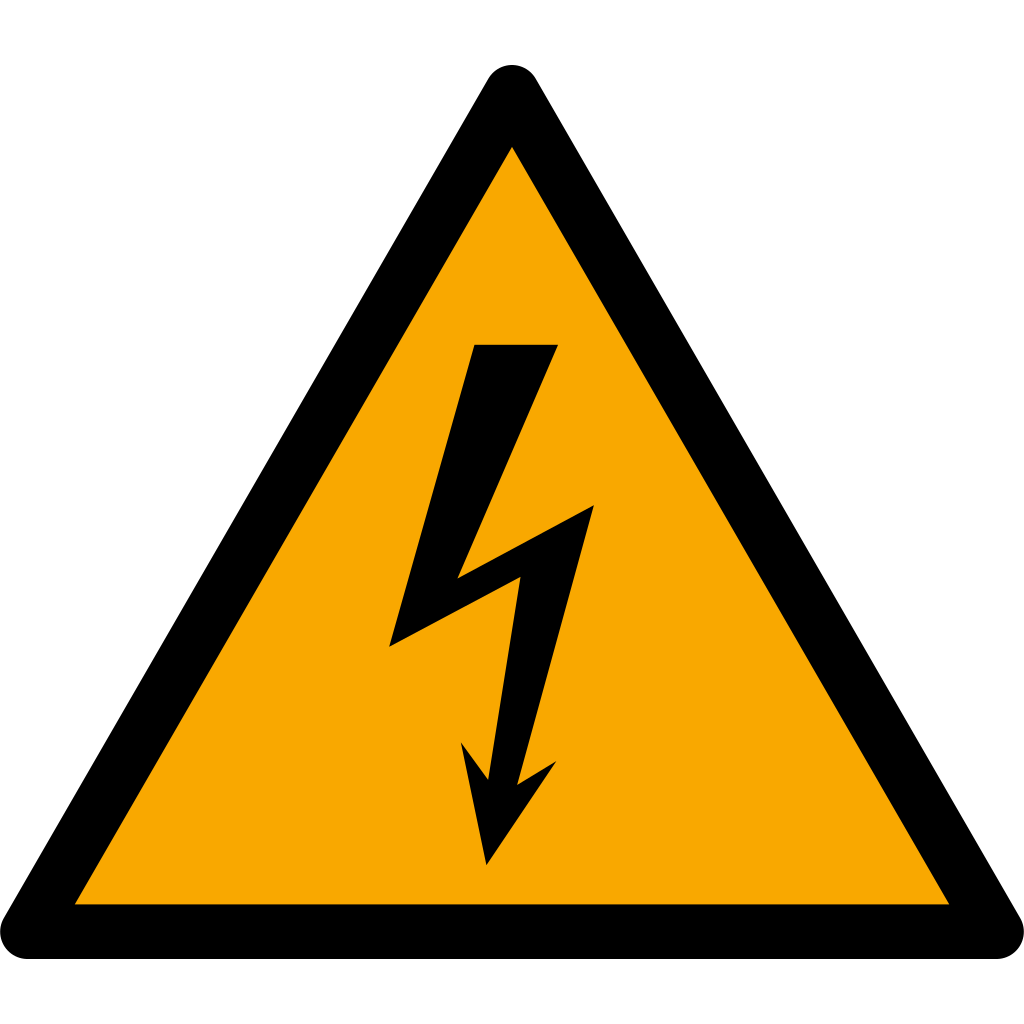
| Download formats | SVG reference artwork; a 1024 × 1024 pixel PNG conversion on a white canvas. |
| Record date | · How to interpret our dates |
| Page updated |
Choosing a physical sign size
Download dimensions are not installation dimensions. Select sign size, material, placement, and lighting using the applicable standard and the actual viewing conditions. Chemical label sizing follows its own rules. Read the artwork and sizing guide.
Sources and artwork credits
- Artwork source
- Wikimedia Commons file page
- Creator credited by source
- MaxxL
- License
- Public domain
- Source metadata checked

SVG files are local reference copies. PNG files are raster conversions. Check the linked file history and license terms before reuse; a source-metadata check is not certification of the artwork or a workplace installation.
Report a correction to this reference