Low temperature/Freezing conditions
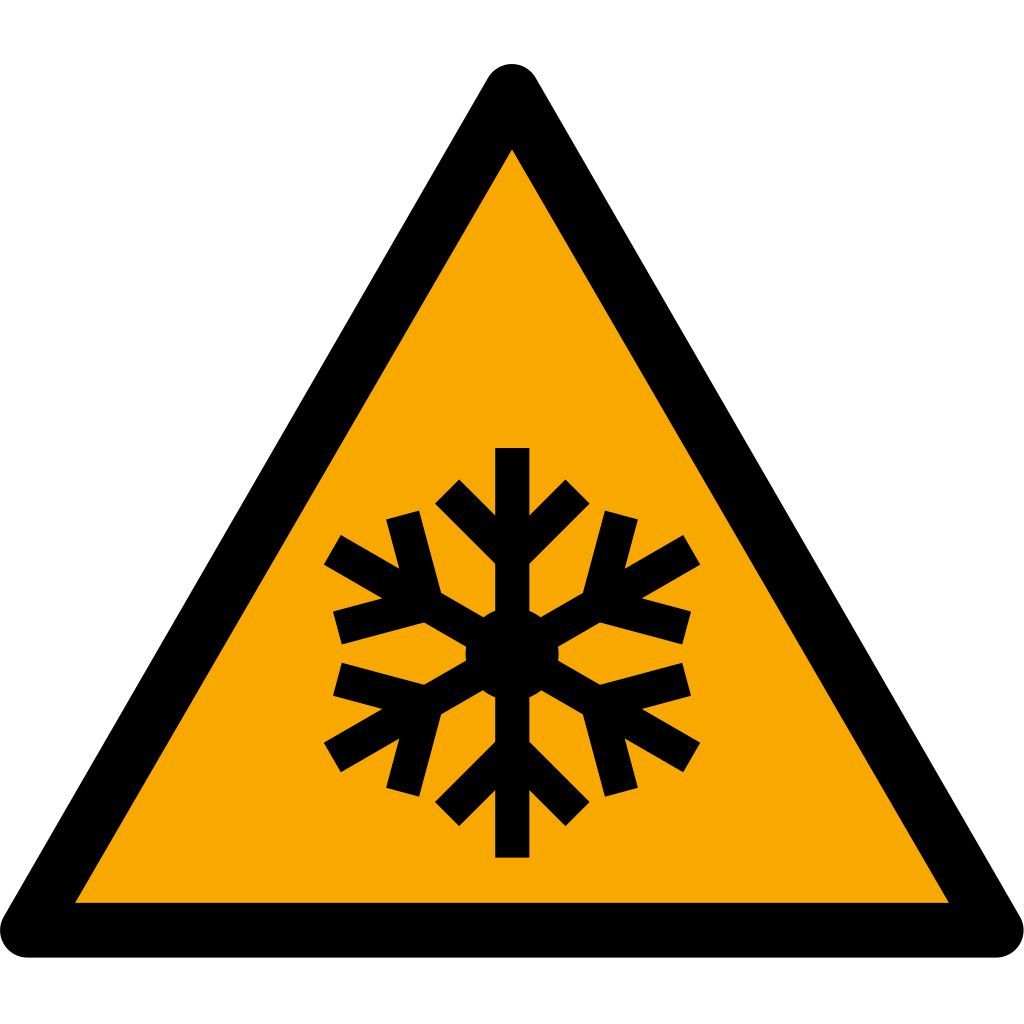
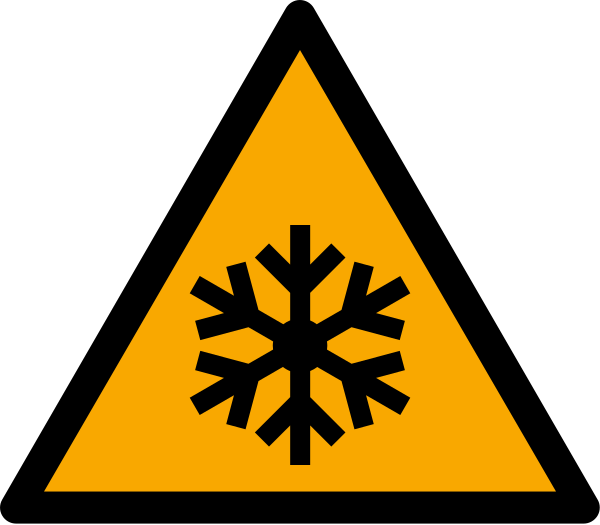
Warns of low temperatures or freezing conditions.
Understanding this sign
Yellow triangular signs draw attention to a hazard, such as electricity, moving machinery, or a hot surface.
A warning pictogram does not state the severity, safe distance, or protective measures. Read the accompanying instructions.
What the Snowflake Triangle Means
W010 warns of low temperature or freezing conditions. The snowflake pictogram in a yellow triangle covers two related but distinct dangers: cold environments that a person works inside, such as blast freezers and cold rooms, and cold substances or surfaces that a person might touch, such as cryogenic pipework, liquid nitrogen dewars, and refrigeration plant. Both can injure quickly, but they injure in different ways and call for different precautions.
Environmental cold causes hypothermia and frostbite over minutes to hours, degrades manual dexterity, and slows decision-making — a genuine problem for anyone working alone in a freezer store. Contact cold is faster: skin touching a surface chilled by liquid nitrogen at -196 °C freezes almost instantly, and bare skin can bond to deeply frozen metal. A single W010 sign cannot say which mechanism applies, so supplementary text stating the temperature or the substance is strongly recommended.
Cryogenic Liquids and Cold Plant
The densest cluster of W010 signage is around cryogenics: liquid nitrogen, oxygen, argon, and helium storage tanks, filling points, transfer lines, and the laboratories and IVF clinics that use dewars daily. Cold burns from splashes and uninsulated fittings are the immediate risk; insulated gloves rated for cryogenic contact, face shields, and closed footwear are the standard response the sign should trigger.
Cold also attacks materials. Carbon steel, many plastics, and rubber become brittle at cryogenic temperatures, so hoses, valves, and vessels not rated for the service can fracture without warning. Note what W010 does not cover: evaporating nitrogen or argon displaces oxygen, and asphyxiation in poorly ventilated cryogenic stores kills more people than cold burns do. That hazard needs its own controls — oxygen depletion monitoring and ventilation — and its own signage, because a snowflake says nothing about breathable air.
Cold Rooms, Freezers, and Winter Work
Food logistics is the other major user. Post W010 at entrances to walk-in freezers, blast chillers, cold storage warehouses, and refrigerated vehicle bodies so workers know to don thermal clothing before entry rather than after they feel cold. Deep-freeze warehouses operating around -25 °C typically limit continuous exposure time and require insulated suits, gloves, and headwear; the sign at the door is the cue that those site rules are in force.
Facilities also use W010 outdoors for freezing conditions: loading ramps and walkways subject to ice formation, condenser plant that frosts over, and test chambers that simulate arctic climates. Where the practical hazard is slipping on ice rather than the cold itself, W011 (slippery surface) communicates the risk more precisely, and many sites post both during winter months.
Making the Warning Effective
Place the sign where the protective decision happens — at the freezer door, on the dewar storage cage, at the cryogenic filling point — not deep inside the cold zone where the viewer is already exposed. Because W010 spans everything from a chilly warehouse to liquid helium, effective installations add a supplementary panel: the operating temperature, the substance involved, and the required PPE turn a generic snowflake into an actionable instruction.
Pairing signs completes the message. Common companions are M009 (wear protective gloves) or a thermal clothing mandatory sign at cold store entrances, W011 where meltwater or frost creates slip risk, and gas cylinder or asphyxiant warnings in cryogenic areas. Emergency planning belongs alongside the signage too: freezer doors need internal release handles and alarms, since the sign protects people going in but not a worker trapped inside.
Where you will see W010
Cryogenics generates the densest cluster of W010 signage: liquid nitrogen, oxygen, argon, and helium tanks, filling points, and transfer lines, plus the laboratories and IVF clinics handling dewars daily. Food logistics posts it at entrances to walk-in freezers, blast chillers, cold storage warehouses, and refrigerated vehicle bodies, while outdoor uses include icy loading ramps, frosting condenser plant, and arctic-climate test chambers.
Common questions about W010
What does the snowflake warning sign mean?
It is ISO 7010 W010, warning of low temperature or freezing conditions. Depending on where it is posted, it can mean a cold working environment such as a walk-in freezer, a cryogenic substance such as liquid nitrogen, or extremely cold plant and pipework that must not be touched with bare skin. Supplementary text usually clarifies which hazard applies and what protection is required.
Is W010 the right sign for liquid nitrogen storage?
It is the correct ISO warning for the cold-contact hazard — splashes and uninsulated fittings at -196 °C cause immediate cold burns. But liquid nitrogen areas have a second, often deadlier hazard: evaporating gas can displace oxygen and asphyxiate people in confined or poorly ventilated rooms. W010 does not communicate that, so cryogenic stores should also carry asphyxiation warnings and, where assessed as necessary, oxygen depletion monitors.
What is the difference between a cold-surface hazard and a cold-environment hazard?
A cold surface injures on contact: skin touching cryogenic pipework or deeply frozen metal can freeze or bond within seconds, so the control is insulation and rated gloves. A cold environment injures through exposure: working in a blast freezer causes frostbite and hypothermia over time, so the controls are thermal clothing, limited exposure durations, and warm-up breaks. W010 is used for both, which is why supplementary text matters.
Where should low temperature warning signs be posted?
At the decision point before exposure: on freezer and cold room doors, at cryogenic tank compounds and filling stations, on dewar storage cages, and on access panels to refrigeration plant. The goal is for workers to see the warning while they can still put on thermal or cryogenic PPE, not after they are already inside the cold zone.
Reference details
| Symbol code | W010 |
|---|---|
| Sign family | ISO Warning Signs |
| Standard reference | ISO 7010:2019 / ISO 3864-1 ISO Online Browsing Platform: W010 |
| Screen color reference | #FFCC00. Screen colors are not a production color specification. |
| Download formats | SVG reference artwork; a 1024 × 1024 pixel PNG conversion on a white canvas. |
| Record date | · How to interpret our dates |
| Page updated |
Choosing a physical sign size
Download dimensions are not installation dimensions. Select sign size, material, placement, and lighting using the applicable standard and the actual viewing conditions. Chemical label sizing follows its own rules. Read the artwork and sizing guide.
Sources and artwork credits
- Artwork source
- Wikimedia Commons file page
- Creator credited by source
- MaxxL i The source code of this SVG is valid . This vector image was created with Inkscape by v .
- License
- Public domain
- Source metadata checked
SVG files are local reference copies. PNG files are raster conversions. Check the linked file history and license terms before reuse; a source-metadata check is not certification of the artwork or a workplace installation.
Report a correction to this reference