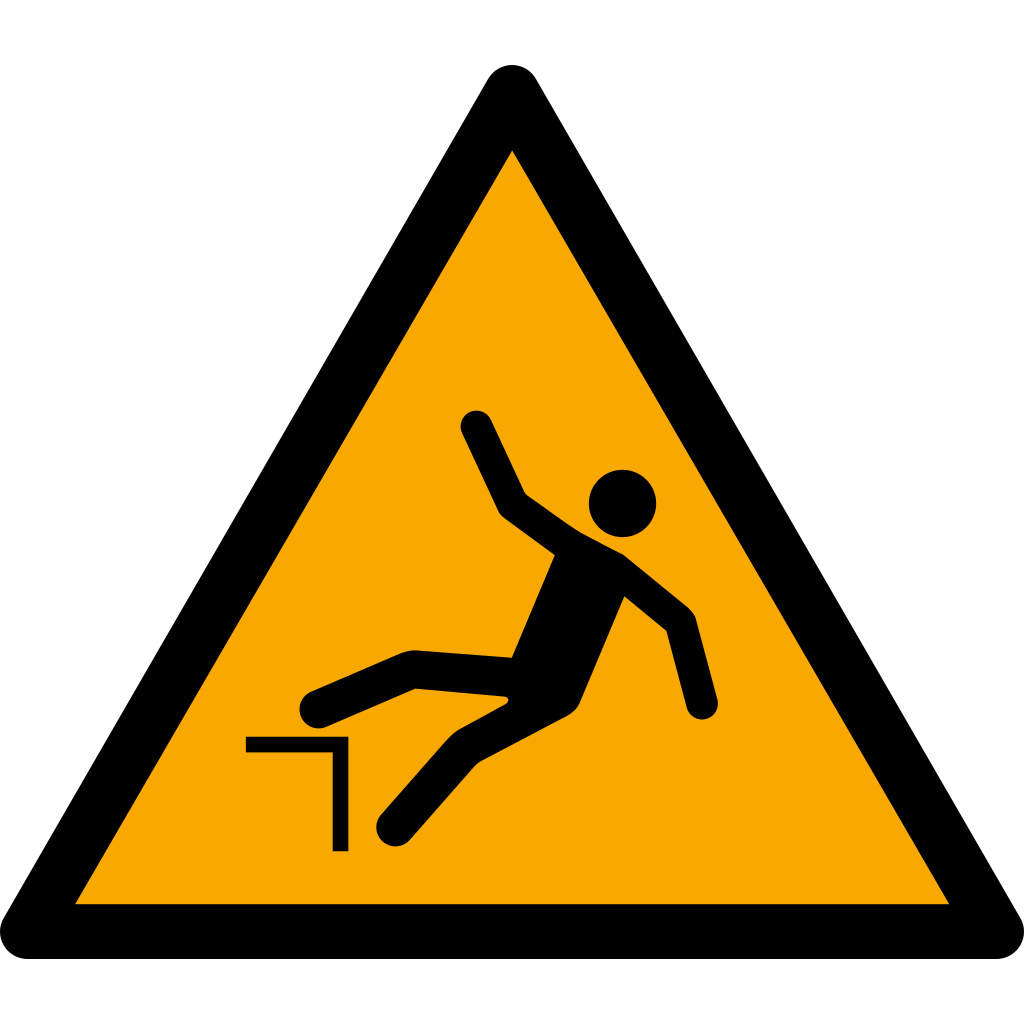
Drop (fall)
Warns of a drop or fall hazard.

Understanding this sign
Yellow triangular signs draw attention to a hazard, such as electricity, moving machinery, or a hot surface.
A warning pictogram does not state the severity, safe distance, or protective measures. Read the accompanying instructions.
What the Drop Sign Warns Of
W008 warns that a person can fall from a height: an unprotected edge, an abrupt change in floor level, an open pit, or a platform without a complete barrier. The pictogram — a figure pitching forward off an edge inside the yellow warning triangle — is aimed at the pedestrian who does not realize the drop is there, which is exactly the situation in poorly lit warehouses, on flat roofs, and behind doors that open onto loading docks.
Its scope is narrower than casual usage suggests. W008 is about a person falling; the hazard of objects falling onto people below has its own symbol, W035, and a same-level trip over an obstacle is W007. Slippery floors take W011. Conflating these dilutes each message: a worker who reads yellow triangles as generic "be careful" signage has effectively been trained by inconsistent signing to ignore all of them.
A Sign Is Not Fall Protection
No regulator treats a warning triangle as a substitute for physical fall protection. In U.S. general industry, OSHA's walking-working surfaces rule (29 CFR 1910.28) requires protection — guardrails, safety nets, personal fall arrest, or equivalent systems — at unprotected edges 4 feet or more above a lower level; in construction, 29 CFR 1926.501 sets the threshold at 6 feet. W008 marks the residual risk and reinforces controls; it cannot legally replace them.
European employers work under the same logic through the framework of risk assessment and, in the UK, the Work at Height Regulations 2005, which require avoiding work at height where possible and preventing falls with collective measures before relying on warnings or personal equipment. The legitimate roles for W008 are therefore at controlled-access zones, temporary conditions such as removed grating or open hatches, and edges that are protected but still dangerous to approach carelessly.
Locations Where W008 Earns Its Place
Loading docks are the highest-value location: dock edges sit at roughly vehicle-bed height, doors are often open with no trailer present, and drivers and warehouse staff move quickly around them. Other strong candidates include mezzanine pallet gates, roof access points leading to unguarded areas, inspection and vehicle service pits, tank and silo tops, stage and orchestra pit edges, retaining walls on sites, and excavations that pedestrians can approach.
Mount the sign where the approach happens, at eye level on the path toward the edge, rather than on the vertical face of the drop where only someone already at the edge can read it. For hatches and floor openings that are opened intermittently, portable stands or barrier-mounted W008 signs deployed with the task work better than a permanent sign that is true only occasionally — permanently posted warnings about intermittent hazards decay quickly into background noise.
Choosing Between W008 and Its Neighbors
Run the hazard through a simple question: who or what falls? A person falling to a lower level is W008. Material falling onto a person below — beneath cranes, racking, or scaffold — is W035. A person stumbling over something at floor level is W007, and losing footing on a slick surface is W011. On a construction site all four can be genuinely present, and signing each hazard with its own symbol is what makes the board legible.
W008 also pairs naturally with mandatory and prohibition signs rather than working alone. At a roof hatch, it commonly appears with M018 (safety harness must be worn) where fall arrest is the control; at a fragile roof or an unguarded edge under repair, it appears with access-prohibition signage and physical barriers. The triangle explains why the blue circle or red circle next to it must be obeyed.
Where you will see W008
Loading dock edges are the highest-value placement, where doors stand open at vehicle-bed height with no trailer present. Warehouses and factories also post it at mezzanine pallet gates, roof access points, inspection and vehicle service pits, tank and silo tops, and around site excavations, often paired with M018 harness signage at roof hatches.
Common questions about W008
What does the W008 falling person sign mean?
It warns of a drop — a place where a person can fall from an edge or opening to a lower level, such as a loading dock, mezzanine edge, open pit, or roof perimeter. It refers to people falling, not to objects falling from above, which is covered by the separate W035 sign.
Can I use a warning sign instead of a guardrail at an open edge?
No. Fall protection rules such as OSHA 29 CFR 1910.28 (general industry, 4-foot threshold) and 1926.501 (construction, 6-foot threshold) require physical protection — guardrails, nets, or fall arrest — at unprotected edges. A W008 sign supplements those controls by alerting people to the hazard; it never satisfies the requirement on its own.
What is the difference between W008 and the falling objects sign?
W008 shows a person falling off an edge and warns that you could fall. W035 warns that objects could fall on you from above, for example under crane paths, high racking, or scaffolding. They describe opposite directions of the same physics and are not interchangeable.
Where should drop warning signs be posted at a loading dock?
On the approach to the edge and beside each dock door, at eye level, so people read the warning before reaching the drop. Pair the sign with physical edge protection such as dock gates, chains, or barriers when no trailer is at the door — the dock edge is a permanent drop of around 1.2 m, and signage alone will not stop a distracted pedestrian or a pallet truck.
Reference details
| Symbol code | W008 |
|---|---|
| Sign family | ISO Warning Signs |
| Standard reference | ISO 7010:2019 / ISO 3864-1 ISO Online Browsing Platform: W008 |
| Screen color reference | #FFCC00. Screen colors are not a production color specification. |
| Download formats | SVG reference artwork; a 1024 × 1024 pixel PNG conversion on a white canvas. |
| Record date | · How to interpret our dates |
| Page updated |
Choosing a physical sign size
Download dimensions are not installation dimensions. Select sign size, material, placement, and lighting using the applicable standard and the actual viewing conditions. Chemical label sizing follows its own rules. Read the artwork and sizing guide.
Sources and artwork credits
- Artwork source
- Wikimedia Commons file page
- Creator credited by source
- Maxxl2
- License
- Public domain
- Source metadata checked
SVG files are local reference copies. PNG files are raster conversions. Check the linked file history and license terms before reuse; a source-metadata check is not certification of the artwork or a workplace installation.
Report a correction to this reference