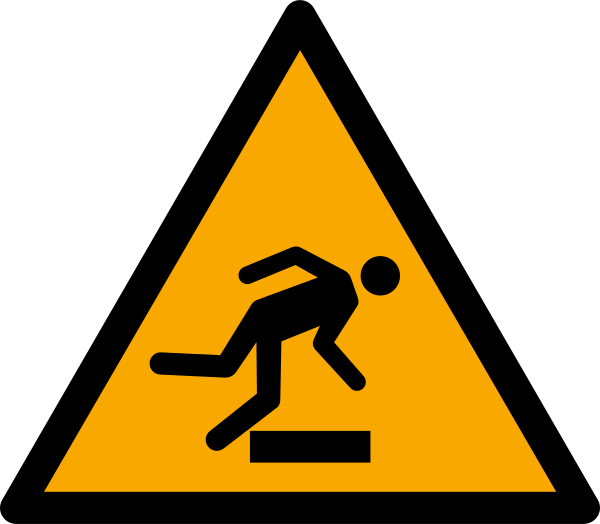
Floor-level obstacle
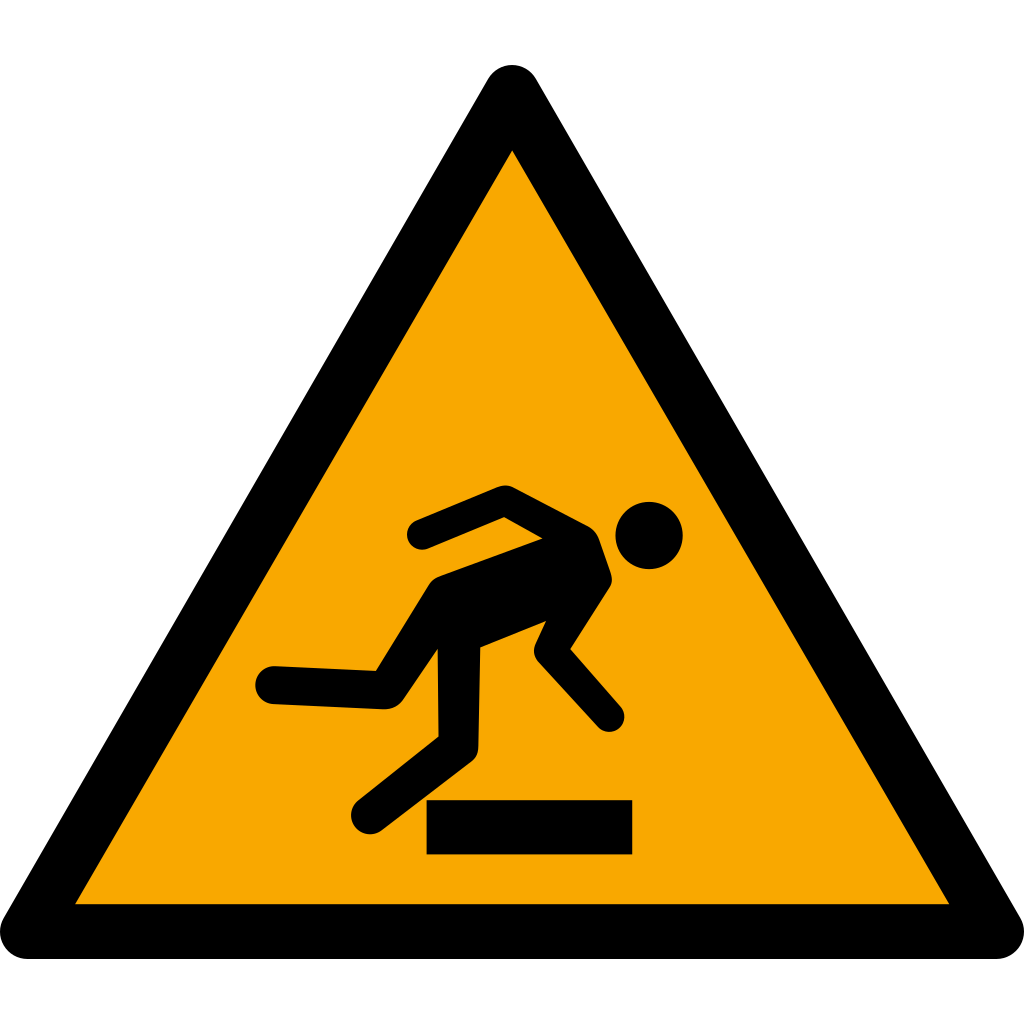
Warns of an obstacle at floor level.
Understanding this sign
Yellow triangular signs draw attention to a hazard, such as electricity, moving machinery, or a hot surface.
A warning pictogram does not state the severity, safe distance, or protective measures. Read the accompanying instructions.
The Hazard W007 Marks
W007 warns of an obstacle at floor level — something a walking person can catch a foot on. The pictogram, a figure stumbling over a block inside the standard yellow warning triangle, covers raised thresholds, ramps and steps that are easy to miss, floor-mounted rails and duct covers, machine anchor bolts, hose and cable runs, and permanent changes in floor height that cannot be engineered away.
Trips are among the most common causes of workplace injury precisely because the hazard is mundane: a few centimeters of unexpected elevation is enough to break a wrist or a hip. W007 exists for the cases where the obstacle is a fixed feature of the building or process. It is a way of transferring attention to a permanent condition, and it works best when combined with high-visibility floor marking such as yellow-and-black hatching on the obstacle itself.
A Sign Is Not Housekeeping
Regulators treat trip hazards primarily as a housekeeping duty, not a signage problem. OSHA's walking-working surfaces rule (29 CFR 1910.22) requires employers to keep walkways clean, orderly, and free of hazards such as sharp or protruding objects and loose boards — obligations that no warning sign can discharge. If a pallet, tool, or temporary cable is blocking a route, the compliant response is to remove or reroute it, not to post W007 beside it.
The legitimate role of the sign is therefore narrow: permanent or unavoidable floor-level features. A raised inspection hatch frame, a kerb inside a production hall, or a door threshold between floor levels can all justify W007. Inspectors are rightly skeptical of facilities that use warning triangles as a substitute for clearing routes, because a sign left next to a removable obstruction documents that the employer knew about the hazard and chose not to fix it.
Choosing Between W007 and Its Neighbors
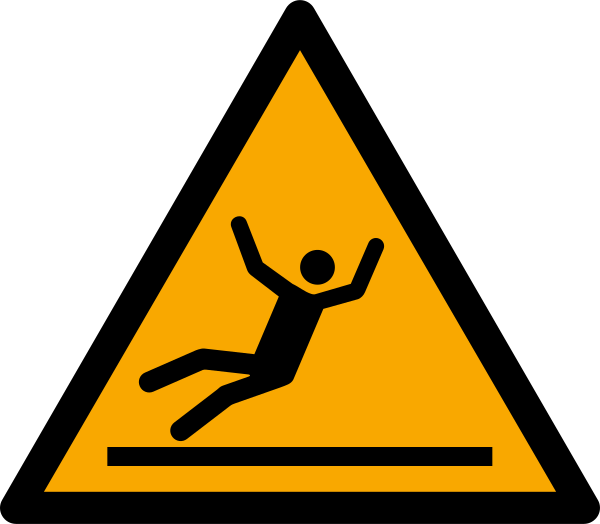
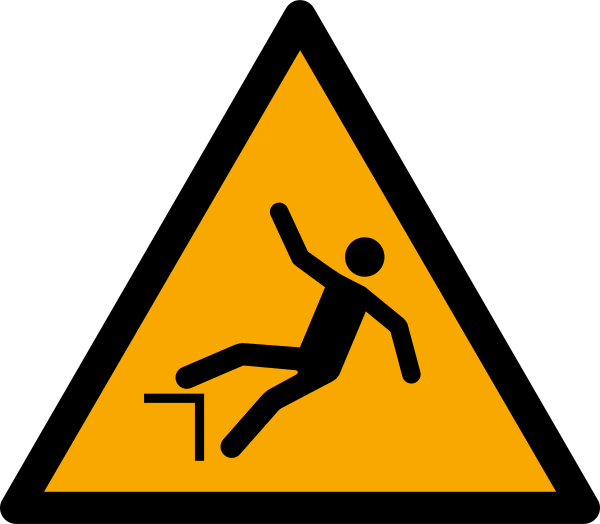
Three ISO 7010 signs divide up pedestrian floor hazards. W007 covers tripping over something at floor level. W011 covers slipping on the surface itself — wet, icy, or polished floors. W008 covers falling to a lower level, such as an unguarded edge, pit, or dock. Picking the correct one matters because each prompts a different protective behavior: step over, slow down, or stay back from the edge.
For temporary conditions, freestanding A-frame floor stands carrying the relevant triangle are more appropriate than wall-mounted signs, since the hazard moves with the work. Cable protectors, ramp edges, and threshold plates in safety yellow reduce the hazard directly and often make the sign unnecessary — under the hierarchy of controls, marking and warning come last, after elimination and engineering measures such as recessing the obstacle or leveling the transition.
Where you will see W007
Production halls post it at raised inspection hatch frames, internal kerbs, and door thresholds between floor levels, often combined with yellow-and-black hatching on the obstacle itself. It also marks floor-mounted rails, machine anchor bolts, and permanent hose or cable runs, while temporary trip hazards are handled with A-frame floor stands rather than wall-mounted signs.
Common questions about W007
When should I use the W007 trip hazard sign instead of just removing the obstacle?
Only when the obstacle genuinely cannot be removed or engineered out — a permanent threshold, a floor-mounted rail, a raised hatch frame, or a level change dictated by the building. If the obstruction is movable, such as stored materials, cables, or equipment left in a walkway, regulators expect you to clear it. A warning sign next to a removable hazard tends to prove knowledge of the problem rather than control of it.
What is the difference between W007, W008, and W011?
W007 warns of a floor-level obstacle you could trip over. W011 warns of a slippery surface, where the floor itself causes loss of traction. W008 warns of a drop or fall to a lower level, such as an open edge or pit. Trip, slip, and fall-from-height are distinct hazards with distinct signs, and each triangle tells the viewer to react differently.
Does OSHA require signs for trip hazards?
OSHA does not prescribe a specific trip hazard sign. Its walking-working surfaces standard (29 CFR 1910.22) requires walkways to be kept free of hazards in the first place, so the primary duty is elimination and housekeeping. Where a permanent obstacle remains, warning measures such as an ISO W007 sign or an ANSI Z535 caution sign plus floor marking are accepted ways to communicate the residual risk.
Should I mark the obstacle itself as well as posting a sign?
Yes. A wall sign alone is easy to overlook while walking, so pair W007 with contrast marking directly on the hazard — yellow-and-black hatched tape or paint on the threshold, kerb, or rail — and adequate lighting. The sign explains the hazard; the floor marking makes it visible at the exact moment a person's foot approaches it.
Reference details
| Symbol code | W007 |
|---|---|
| Sign family | ISO Warning Signs |
| Standard reference | ISO 7010:2019 / ISO 3864-1 ISO Online Browsing Platform: W007 |
| Screen color reference | #FFCC00. Screen colors are not a production color specification. |
| Download formats | SVG reference artwork; a 1024 × 1024 pixel PNG conversion on a white canvas. |
| Record date | · How to interpret our dates |
| Page updated |
Choosing a physical sign size
Download dimensions are not installation dimensions. Select sign size, material, placement, and lighting using the applicable standard and the actual viewing conditions. Chemical label sizing follows its own rules. Read the artwork and sizing guide.
Sources and artwork credits
- Artwork source
- Wikimedia Commons file page
- Creator credited by source
- Maxxl2
- License
- Public domain
- Source metadata checked
SVG files are local reference copies. PNG files are raster conversions. Check the linked file history and license terms before reuse; a source-metadata check is not certification of the artwork or a workplace installation.
Report a correction to this reference