Magnetic field
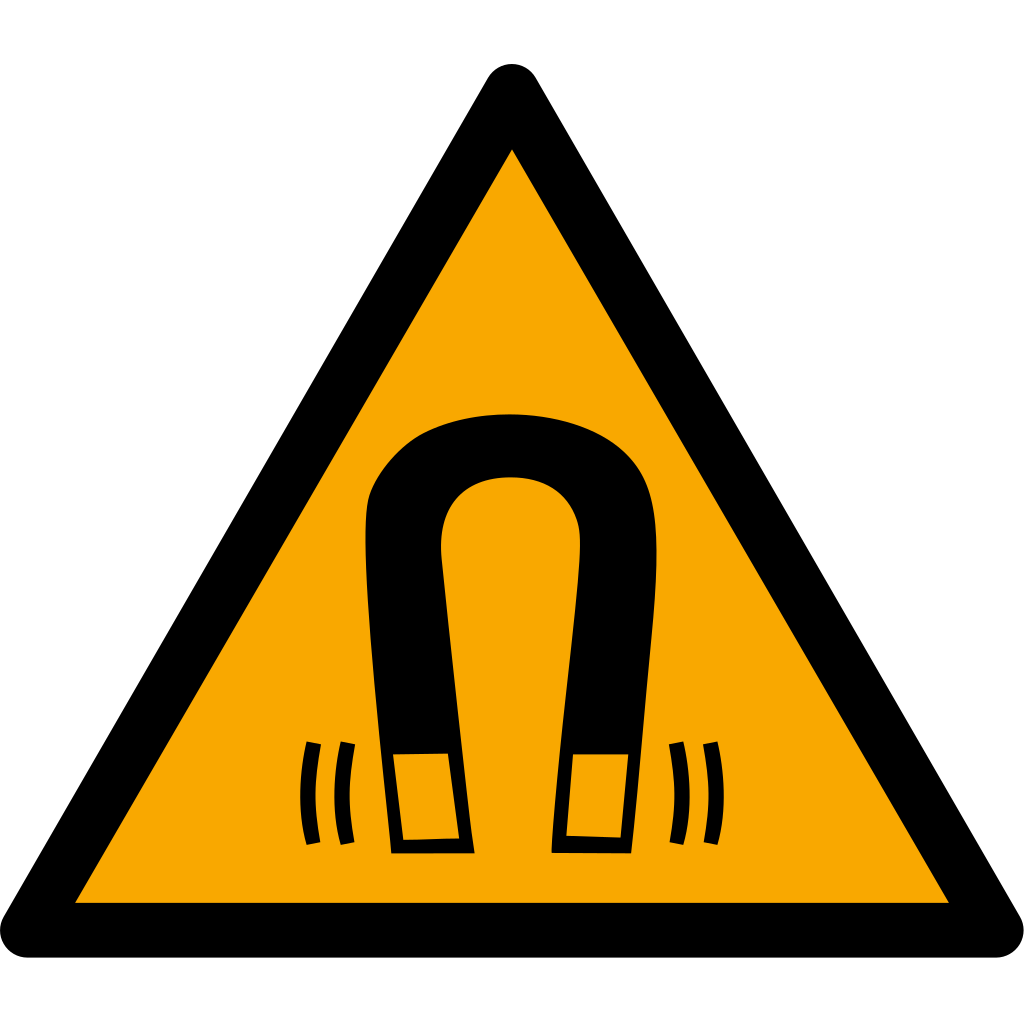
Warns of a magnetic field.
Understanding this sign
Yellow triangular signs draw attention to a hazard, such as electricity, moving machinery, or a hot surface.
A warning pictogram does not state the severity, safe distance, or protective measures. Read the accompanying instructions.
The Hazard W006 Announces
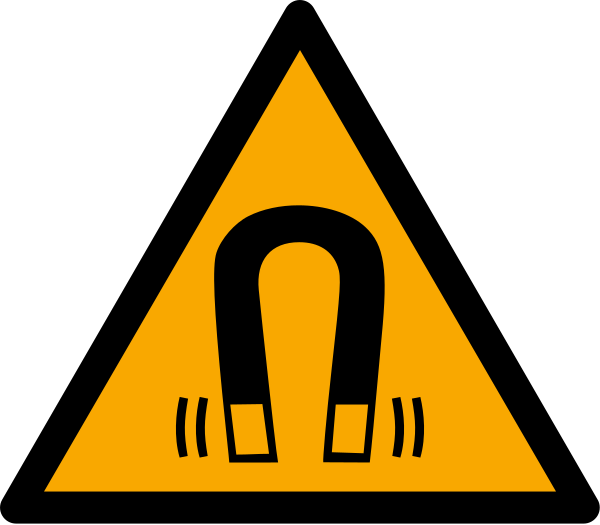
W006 warns of a strong static magnetic field. Unlike most workplace hazards, a powerful magnet acts at a distance and without warning senses: it can turn loose ferromagnetic objects — gas cylinders, tools, floor buffers, scissors — into projectiles, and it can disrupt pacemakers, implantable defibrillators, insulin pumps, and other electronic or ferromagnetic implants in people who simply walk too close. The pictogram, a black magnet shape inside the yellow ISO 3864-1 warning triangle, marks the point beyond which those effects become credible.
A detail that changes behavior once understood: superconducting magnets, including MRI scanners, remain at full field even when the facility is closed and the console is off. The magnet is always on. W006 signage therefore has to work around the clock and on people who are not scanner staff — cleaners, security guards, firefighters, and maintenance contractors are the groups most often involved in magnet-room projectile incidents.
W006 in MRI Suites and the ACR Zone Model
In medical imaging, W006 fits into the four-zone access model described in the American College of Radiology's MR safety guidance. Zones I and II are public and reception areas; Zone III is the restricted control area where the fringe field and unscreened access become a concern; Zone IV is the magnet room itself. Warning signage belongs at the Zone III boundary and on the Zone IV door, alongside access controls, so that no unscreened person or ferromagnetic object crosses in unnoticed.
Historically, facilities have also marked the 0.5 mT (5 gauss) fringe-field contour, the conventional exclusion boundary for cardiac pacemaker wearers. Modern actively shielded magnets pull that contour close to the scanner, which can create false confidence in adjacent rooms and above or below the magnet — the field extends in three dimensions, and the 5 gauss line on the floor plan says nothing about the ceiling void or the floor beneath.
Strong Magnets Outside the Hospital
Research and industry use fields that rival or exceed clinical MRI. NMR spectrometers in chemistry labs, magnetizing and demagnetizing equipment, magnetic particle inspection benches, lifting magnets in scrapyards and steel mills, magnetic chucks and separators, and the magnet systems of particle accelerators and fusion research devices all justify W006 at the approach to the field. Laboratories with superconducting NMR magnets should also sign adjacent rooms if the fringe field reaches through walls or floors.
Placement should follow the measured field, not the equipment outline. Post the sign where a person carrying a steel tool or wearing an implant first enters the region of concern, and back it up with physical demarcation — floor lines, barriers, or interlocked doors — because a yellow triangle cannot stop a running floor buffer once the magnet has hold of it. Site-specific text stating the field strength and the exclusion rules makes the triangle far more useful.
Warning Triangle Versus Prohibition Circles: W006, P007, P014
ISO 7010 splits the magnet-room message across three signs, and they are not interchangeable. W006 is a warning: it tells everyone that a strong magnetic field exists. P007 is a prohibition barring entry to people with active implanted cardiac devices such as pacemakers. P014 is a separate prohibition barring entry to people with metallic implants of any kind. The warning describes the hazard; the prohibitions state who must stay out because of it.
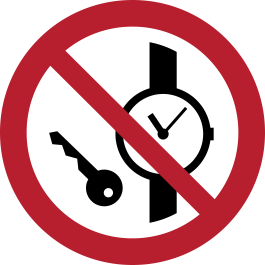
At an MRI Zone IV door or an NMR magnet enclosure, the standard practice is to post them together: W006 for the field, P007 and P014 for implant wearers, and frequently P008 (no metallic articles or watches) for loose ferromagnetic objects and magnetic media. Using W006 alone leaves implant wearers to infer their own exclusion, while posting only the prohibition circles fails to explain the projectile hazard to everyone else.
Where you will see W006
MRI facilities post W006 at the Zone III boundary and on the Zone IV magnet room door under the ACR access model, alongside the P007 and P014 implant prohibitions. Beyond hospitals, it guards NMR spectrometers in chemistry labs, magnetic particle inspection benches, lifting magnets in scrapyards and steel mills, magnetic chucks and separators, and the magnet systems of particle accelerators and fusion research devices, placed where the measured field first becomes a concern.
Common questions about W006
What does the magnetic field warning sign mean on an MRI door?
It marks the boundary of a strong static magnetic field that is present at all times, even when the scanner is not imaging. Beyond that door, ferromagnetic objects can be pulled violently toward the magnet and implanted medical devices can malfunction. Entry is limited to screened people, and ferromagnetic equipment such as standard oxygen cylinders, stretchers, and tools must stay outside.
Is the MRI magnet off when the machine is not scanning?
No. Superconducting MRI magnets stay at full field continuously — overnight, on weekends, and during power failures. This is why the warning signage and access controls must be permanent, and why emergency responders need MRI-specific training before entering a magnet room during an incident.
What is the difference between the W006 sign and the P007 pacemaker sign?
W006 is a yellow warning triangle telling everyone a strong magnetic field is present. P007 is a red-and-white prohibition circle telling one specific group — people with active implanted cardiac devices such as pacemakers — that they must not enter. P014 extends the prohibition to metallic implants generally. High-field areas normally display the warning and the relevant prohibitions together.
How close to a strong magnet is it safe to go with a pacemaker?
The conventional exclusion boundary for pacemaker wearers is the 0.5 mT (5 gauss) fringe-field contour, and facilities are expected to keep unscreened implant wearers outside it. The actual safe distance depends on the magnet's shielding and the specific implant, so the facility's field map and the device manufacturer's guidance govern — never estimate by eye, because the field is invisible and extends in three dimensions.
Reference details
| Symbol code | W006 |
|---|---|
| Sign family | ISO Warning Signs |
| Standard reference | ISO 7010:2019 / ISO 3864-1 ISO Online Browsing Platform: W006 |
| Screen color reference | #FFCC00. Screen colors are not a production color specification. |
| Download formats | SVG reference artwork; a 1024 × 1024 pixel PNG conversion on a white canvas. |
| Record date | · How to interpret our dates |
| Page updated |
Choosing a physical sign size
Download dimensions are not installation dimensions. Select sign size, material, placement, and lighting using the applicable standard and the actual viewing conditions. Chemical label sizing follows its own rules. Read the artwork and sizing guide.
Sources and artwork credits
- Artwork source
- Wikimedia Commons file page
- Creator credited by source
- Maxxl2
- License
- Public domain
- Source metadata checked
SVG files are local reference copies. PNG files are raster conversions. Check the linked file history and license terms before reuse; a source-metadata check is not certification of the artwork or a workplace installation.
Report a correction to this reference