Laser beam
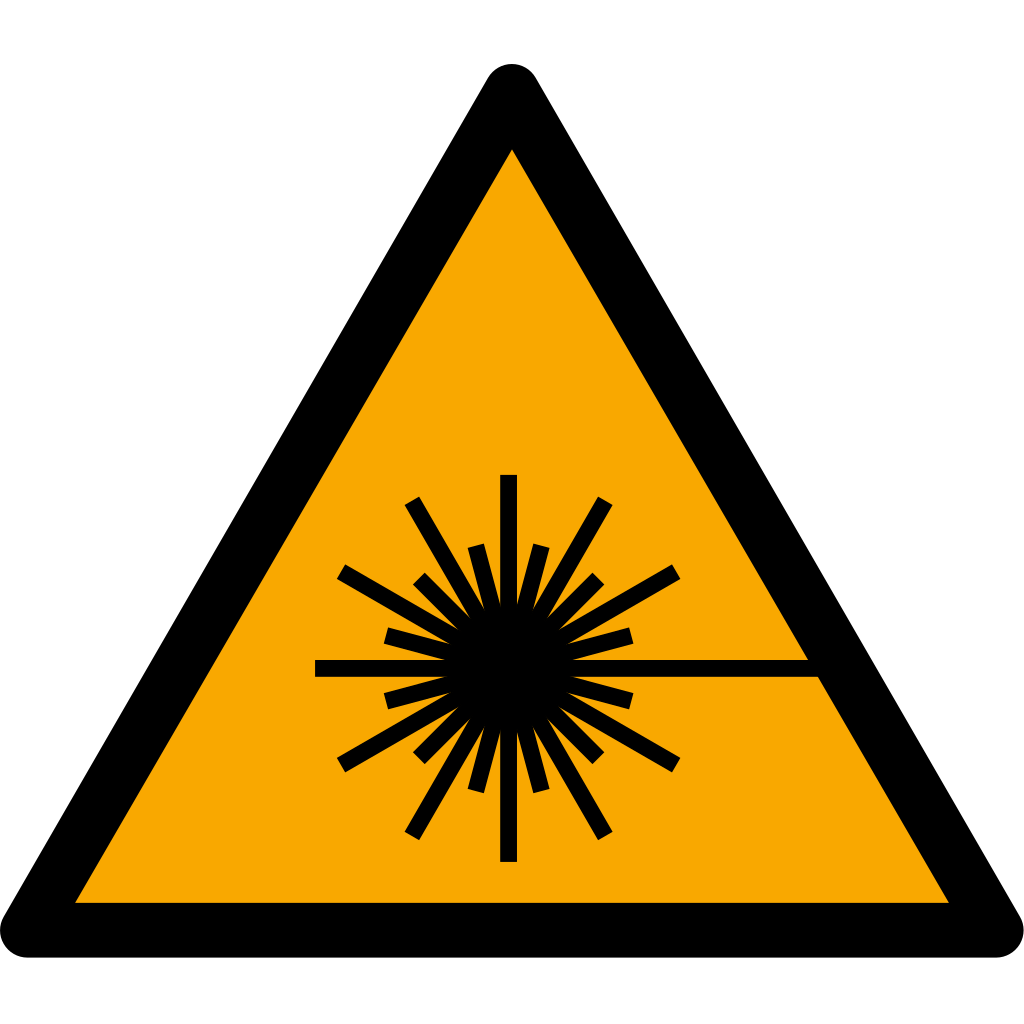
Warns of a laser beam.
Understanding this sign
Yellow triangular signs draw attention to a hazard, such as electricity, moving machinery, or a hot surface.
A warning pictogram does not state the severity, safe distance, or protective measures. Read the accompanying instructions.
What ISO 7010 W004 Warns About
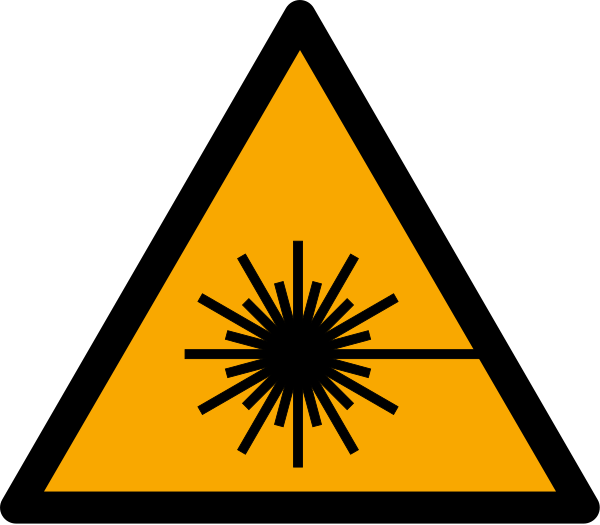
W004 warns of a laser beam. Its pictogram is a stylised burst of radiating lines depicting a beam striking a point, rendered in black inside the ISO 3864-1 warning triangle on a yellow field. The sign alerts anyone nearby that laser radiation is present and that the beam — or its reflection — can injure the eyes or skin. Because laser light can be invisible and can travel long distances with little divergence, the warning is about a hazard that may not be perceptible until damage has already occurred.
The symbol identifies that a laser hazard exists but does not state how dangerous the beam is. A supermarket barcode scanner and a kilowatt cutting laser could, in principle, both be marked, yet they present vastly different risks. That gap is filled by the laser classification system and by supplementary text: W004 announces the hazard type, while the class label and accompanying wording tell the reader whether the beam is essentially safe, hazardous only on prolonged viewing, or capable of causing instant injury and fire.
Laser Classes and the Standards Behind Them
Lasers are classified by the risk their emission poses, under the international standard IEC 60825-1 and, in the United States, the ANSI Z136.1 safe-use standard. The scheme runs from Class 1 and 1M (safe under normal use), through Class 2 and 2M (visible beams where the blink reflex offers some protection) and Class 3R (low risk of injury), to Class 3B and Class 4, where direct or reflected beams can cause immediate eye injury and, for Class 4, skin burns and fire. The class dictates the controls, protective eyewear, and signage required.
Because of this, laser signage does more than display W004. Under ANSI Z136.1 in the US, laser warning signs carry a signal word appropriate to the class — for example, CAUTION for lower-hazard beams and DANGER for Class 3B and Class 4 — along with the laser type, wavelength, maximum output, and the class itself. The W004 pictogram is the recognisable hazard symbol on those signs, but the class-specific wording is what tells workers which precautions and eyewear apply at that particular installation.
Where to Post the Laser Warning
Place W004 at entrances to rooms and enclosures containing higher-class lasers, on the housings of laser equipment, at the boundaries of a laser controlled area, and on beam enclosures and delivery systems. In manufacturing it belongs on cutting, welding, marking, and additive-manufacturing cells; in laboratories, on optical benches and interlocked laser rooms; in healthcare, on surgical, dermatological, and ophthalmic laser suites. The aim is that no one enters the beam path or opens an enclosure without first being warned that laser radiation may be present.
For Class 3B and Class 4 systems, signage is normally combined with engineering controls: interlocked doors, illuminated warning signs or beacons that light when the laser is energised, beam stops, and controlled-area access. A static W004 sign warns of the potential hazard, while an activated warning light indicates that the beam is actually live. Entry signage should also state the eyewear required for the specific wavelength, because protective goggles are wavelength-specific and the wrong pair offers no protection against a beam it was not designed to block.
Distinguishing the Laser Warning
Laser radiation is non-ionising, so W004 is distinct from the W003 ionising-radiation trefoil; the two describe fundamentally different hazards and require different protection. It is also separate from general optical-radiation warnings for intense visible or ultraviolet sources. Using the correct pictogram matters because the response to a laser hazard — controlled beam paths, wavelength-matched eyewear, and reflection control — is specific to lasers and would not follow from a generic radiation sign.
W004 is best understood as the visible marker of a documented laser-safety programme rather than a complete instruction. The pictogram alone does not tell a worker the class, wavelength, or eyewear, so it should always sit alongside the class label and controlled-area information required by IEC 60825-1 or ANSI Z136.1. Where a laser is embedded in a product that is safe in normal use, the housing may still carry internal warnings for service access, reflecting that the hazard appears only when protective enclosures are opened.
Where you will see W004
Entrances to interlocked laser rooms and controlled areas, equipment housings, and beam enclosures and delivery systems all carry the triangle. Manufacturing sites apply it to laser cutting, welding, marking, and additive-manufacturing cells; laboratories mark optical benches, and hospitals sign surgical, dermatological, and ophthalmic laser suites. For Class 3B and 4 systems it typically accompanies interlocked doors, illuminated beacons, and wavelength-specific eyewear instructions.
Common questions about W004
What does the laser warning sign mean?
The radiating black burst in a yellow triangle is ISO 7010 W004, warning of a laser beam. It indicates that laser radiation is present and that the beam or its reflection can injure the eyes or skin. Because laser light can be invisible and travel far, the sign prompts caution before entering a beam path or opening a laser enclosure.
How do laser classes relate to the W004 sign?
Lasers are classified under IEC 60825-1 and ANSI Z136.1 from Class 1 (safe in normal use) up to Class 3B and Class 4, where beams cause immediate eye injury and, for Class 4, skin burns and fire. The W004 pictogram warns of the hazard, while the class label and accompanying text tell workers which controls and protective eyewear apply.
Why do laser signs say CAUTION or DANGER?
Under ANSI Z136.1 in the US, laser warning signs carry a signal word matched to the laser class — typically CAUTION for lower-hazard beams and DANGER for Class 3B and Class 4 — along with the laser type, wavelength, and maximum output. The signal word and data tell the reader how serious the specific beam is beyond what the W004 symbol shows alone.
Is a laser hazard the same as radioactive radiation?
No. Laser radiation is non-ionising and is warned by W004, whereas ionising radiation from radioactive materials and x-ray equipment is warned by the W003 trefoil. They are different hazards needing different protection — wavelength-matched eyewear and beam control for lasers versus shielding and dose limits for ionising radiation — so the correct pictogram must be used.
Reference details
| Symbol code | W004 |
|---|---|
| Sign family | ISO Warning Signs |
| Standard reference | ISO 7010:2019 / ISO 3864-1 ISO Online Browsing Platform: W004 |
| Screen color reference | #FFCC00. Screen colors are not a production color specification. |
| Download formats | SVG reference artwork; a 1024 × 1024 pixel PNG conversion on a white canvas. |
| Record date | · How to interpret our dates |
| Page updated |
Choosing a physical sign size
Download dimensions are not installation dimensions. Select sign size, material, placement, and lighting using the applicable standard and the actual viewing conditions. Chemical label sizing follows its own rules. Read the artwork and sizing guide.
Sources and artwork credits
- Artwork source
- Wikimedia Commons file page
- Creator credited by source
- Maxxl2
- License
- Public domain
- Source metadata checked
SVG files are local reference copies. PNG files are raster conversions. Check the linked file history and license terms before reuse; a source-metadata check is not certification of the artwork or a workplace installation.
Report a correction to this reference