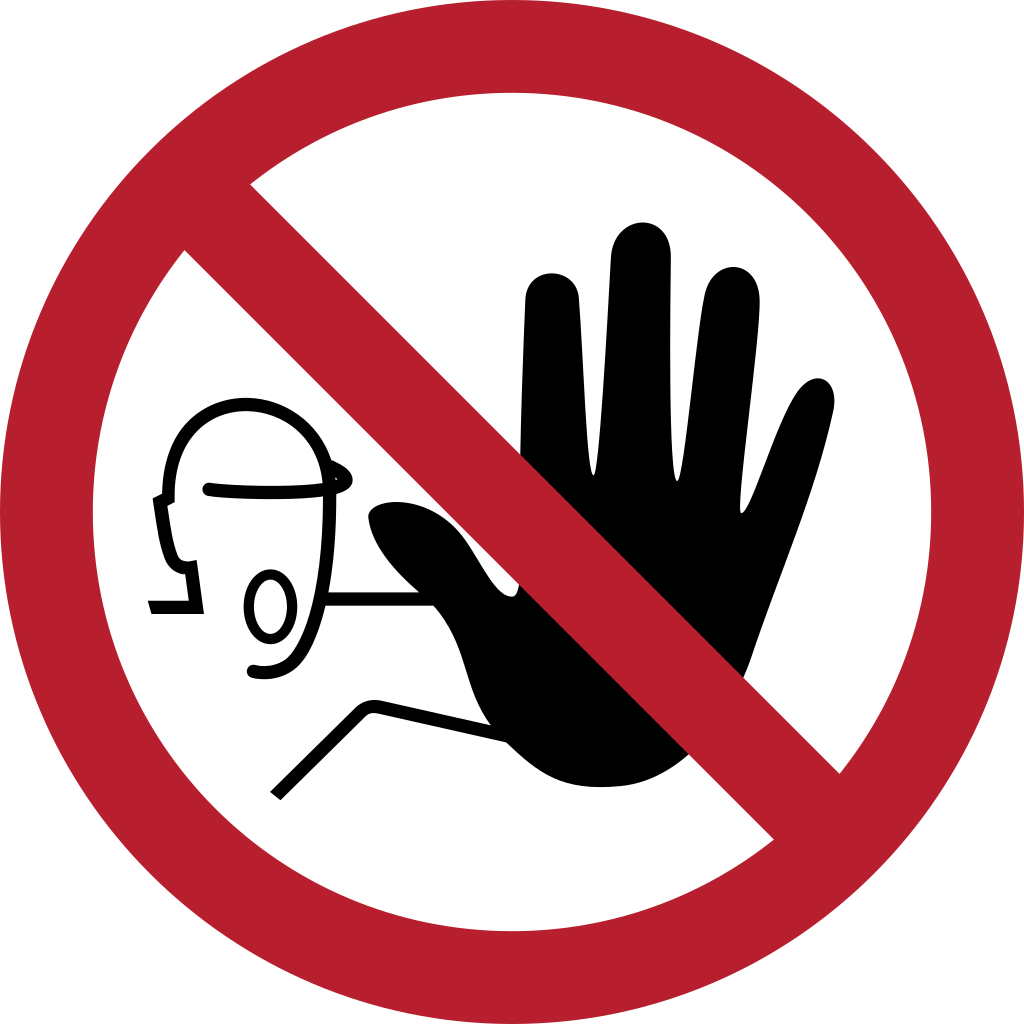
No access for unauthorized persons
Access by unauthorized persons is prohibited.

Understanding this sign
Red circular signs with a diagonal bar identify an action that must not be taken in the marked area.
Check what object or action the symbol prohibits. A prohibition sign does not identify all the hazards in an area.
What ISO 7010 P080 Prohibits
P080 restricts entry to an area based on authorization status: people the site has cleared may pass, everyone else may not. It is the symbolic equivalent of the classic text sign reading AUTHORIZED PERSONNEL ONLY, expressed in the ISO 3864-1 red-circle prohibition format so it works across languages on multinational sites and for visitors who cannot read the local text.
Crucially, the sign does not define who is authorized — the facility does. Authorization might mean completed training, a valid work permit, an issued badge, or an escort requirement. P080 is therefore only as strong as the documented access policy behind it, and it is normally combined with a supplementary text panel stating the criterion, such as PERMIT HOLDERS ONLY or REPORT TO SECURITY.
P080 Versus P004 No Thoroughfare
These two are commonly confused because both show a person struck through. P004 (no thoroughfare) blocks pedestrian passage along a route for everybody — no exceptions, because the route itself is the problem: a forklift lane, a blind corner, a path under suspended loads. P080 filters by status rather than blocking a route; the area remains a normal workplace for those with clearance.
The test when specifying signage is simple: if a trained employee with every permit in the building still should not walk there, use P004. If the space is fine for the electrician with switching authority but off-limits to the office visitor, use P080. Using P004 on a staffed switchroom door technically prohibits the electrician too, which trains people to ignore signs.
Where Facilities Post It
Typical P080 locations are electrical switchrooms and substations, plant and boiler rooms, roof access doors, server and telecom rooms, chemical and gas cylinder stores, laboratories with biological or radiological controls, construction site gates, and back-of-house zones in retail, hospitality, and healthcare. Anywhere a hazard, a security concern, or a hygiene regime justifies limiting entry to a defined group is a candidate.
The sign works best mounted at eye level on the door or gate that physically enforces the rule, and repeated at secondary entrances people forget about — roof hatches, dock doors, service corridors. Where the restriction is hazard-driven, pairing P080 with the relevant warning sign (for example W012 for electrical rooms) tells cleared entrants what they are walking into.
Making the Restriction Hold Up
In the EU, prohibition signage at work falls under Directive 92/58/EEC, which mandates the red circular format P080 uses; the directive requires signs wherever risks cannot be adequately reduced by other means, so an access restriction identified in a risk assessment should be signed. In North America, facilities often mount the ISO symbol alongside an ANSI Z535-style text sign to satisfy expectations for worded postings.
A sign alone is a weak barrier, and inspectors and courts tend to look past it to the system: is there a lock, a badge reader, or at least a latched gate; is authorization recorded; are contractors inducted before receiving access. P080 marks the boundary of that system for the people approaching it — it cannot substitute for the system itself.
Where you will see P080
Electrical switchrooms and substations, plant and boiler rooms, roof access doors, server and telecom rooms, chemical and gas cylinder stores, and controlled laboratories are typical postings, along with construction site gates and back-of-house zones in retail, hospitality, and healthcare. It works best mounted at eye level on the enforcing door and repeated at forgotten secondary entrances such as roof hatches, dock doors, and service corridors.
Common questions about P080
How is P080 different from the P004 no-thoroughfare sign?
P004 (no thoroughfare) stops all pedestrian traffic on a route — nobody may walk through, regardless of role, because the passage itself is hazardous. P080 restricts an area by authorization: cleared personnel may enter and everyone else may not. Choose P004 for lanes and passages closed to people entirely, and P080 for rooms and zones open only to a defined group.
Who counts as an authorized person under a P080 sign?
Whoever the facility's access policy says. The pictogram itself carries no definition, so the employer must decide the criterion — specific training, a permit, a badge, or escorted status — document it, and ideally state it on a supplementary text panel under the symbol. Without that policy, the sign has no enforceable meaning.
Is an authorized-personnel-only sign legally required?
It can be, indirectly. EU workplace signage rules under Directive 92/58/EEC require appropriate safety signs where a risk assessment identifies residual risk, and many national electrical, chemical, and radiation regulations require restricted areas to be marked. The sign is usually the visible part of a broader legal duty to control access, rather than a standalone requirement.
Can P080 replace a text sign saying Authorized Personnel Only?
In ISO-aligned jurisdictions, yes — the symbol is the standardized form and needs no translation. In the United States and Canada, where worded signs remain the norm, the safest approach is a combination sign: the P080 symbol plus text, which communicates to non-readers of English while still matching what local inspectors expect to see.
Reference details
| Symbol code | P080 |
|---|---|
| Sign family | ISO Prohibition Signs |
| Standard reference | ISO 7010:2019 / ISO 3864-1 ISO Online Browsing Platform: P080 |
| Screen color reference | #FF0000. Screen colors are not a production color specification. |
| Download formats | SVG reference artwork; a 1024 × 1024 pixel PNG conversion on a white canvas. |
| Record date | · How to interpret our dates |
| Page updated |
Choosing a physical sign size
Download dimensions are not installation dimensions. Select sign size, material, placement, and lighting using the applicable standard and the actual viewing conditions. Chemical label sizing follows its own rules. Read the artwork and sizing guide.
Sources and artwork credits
- Artwork source
- Wikimedia Commons file page
- Creator credited by source
- Clemenspool
- License
- CC0
- Source metadata checked
SVG files are local reference copies. PNG files are raster conversions. Check the linked file history and license terms before reuse; a source-metadata check is not certification of the artwork or a workplace installation.
Report a correction to this reference