No ice skating
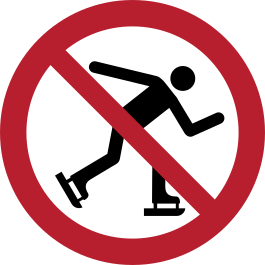
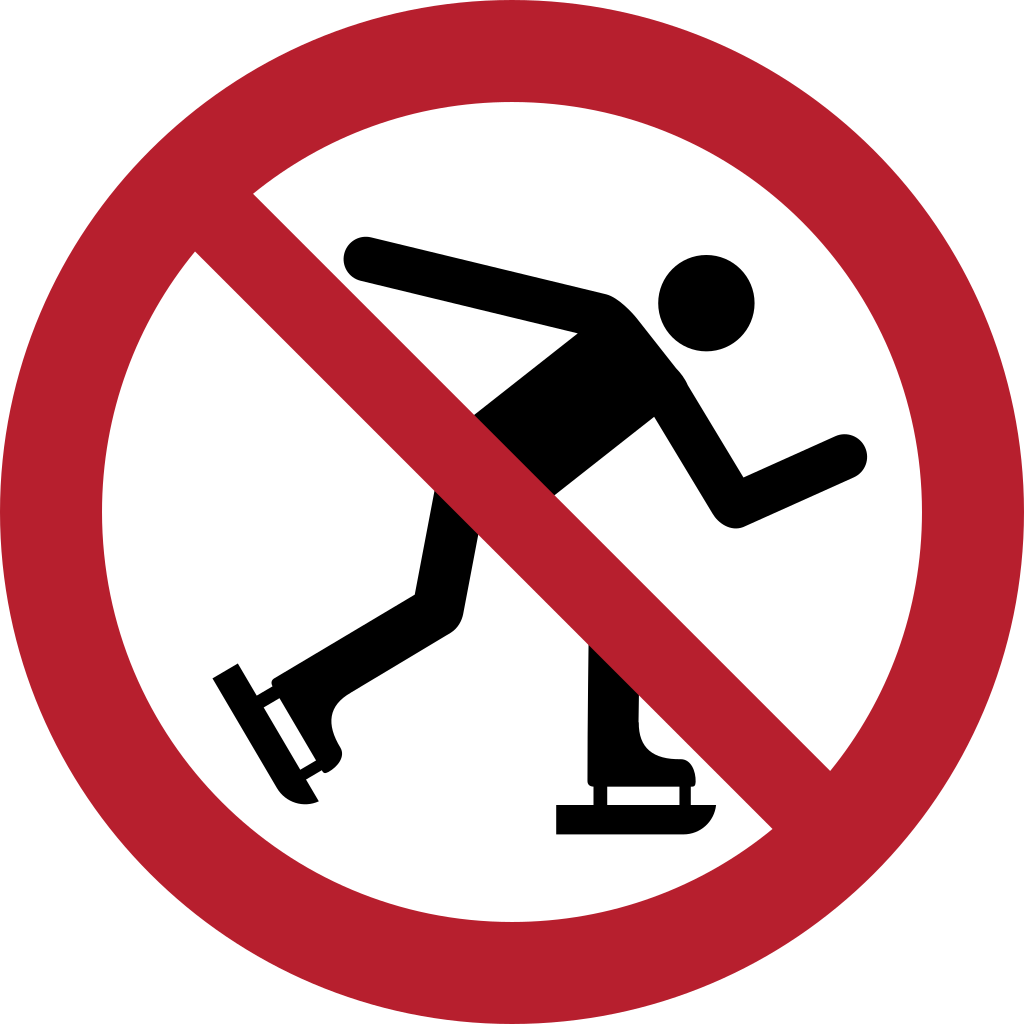
Ice skating is prohibited.
Understanding this sign
Red circular signs with a diagonal bar identify an action that must not be taken in the marked area.
Check what object or action the symbol prohibits. A prohibition sign does not identify all the hazards in an area.
What ISO 7010 P079 Means
P079 prohibits ice skating in the posted zone. The ISO 7010 register records the referent as No ice skating and the function as prohibiting ice skating; the pictogram shows a skater crossed out by the red circular band and slash defined in ISO 3864-1. It joined the standard with the other recreation prohibitions, giving parks departments, waterway authorities, and rink operators a wordless symbol in place of local-language boards.
The most consequential use of the sign is on natural ice. A frozen lake, pond, canal, or reservoir looks uniform from the bank while varying wildly in bearing capacity, and the authority responsible for the water often cannot verify thickness across the whole surface. P079 lets that authority prohibit skating outright rather than leave visitors to judge the ice themselves.
Thin Ice and Other Reasons for the Ban
Ice strength depends on far more than air temperature. Currents, inflows and outflows, springs, aeration systems, and water-level changes under reservoirs all thin ice locally; snow cover insulates the surface and hides weak zones; and early- or late-season ice can be half the thickness a few meters from where it was measured. Authorities that cannot monitor these variables post P079 as a standing rule, and a person who breaks through faces cold-water incapacitation within minutes, well before rescue typically arrives.
Not every posting is about drowning. Skating may be banned on stormwater and treatment ponds for water-quality and access-control reasons, on canals kept open for navigation, in wildlife refuges during wintering season, and on sections of managed rinks or trails closed for resurfacing or repair. As with the other recreation prohibitions, the sign states the rule and the responsible operator supplies the reason.
Prohibition Versus Warning, and Placement
P079 is a prohibition, not a hazard warning, and the distinction shapes correct use. A thin-ice warning tells visitors a danger exists and leaves the decision with them; P079 removes the decision. Authorities that intend to forbid access should use the prohibition sign, with barriers where practical, rather than relying on a warning to discourage skaters — and should pair it with a general no-entry message if walking on the ice is equally unacceptable, since the pictogram depicts skating specifically.
Placement follows the access points, not the hazard: at shore paths, docks, boat ramps, and the informal entries where skaters historically step onto the ice, positioned to be legible before anyone leaves solid ground. Seasonal operations should manage the sign actively — posting it when conditions close the ice and removing or covering it when a supervised skating area officially opens — because a sign that contradicts observed practice quickly loses authority.
Where you will see P079
Waterway authorities and parks departments station it at shore paths, docks, boat ramps, and the informal entry points where skaters historically step onto the ice, positioned to be legible before anyone leaves solid ground. It also closes stormwater and treatment ponds, navigation canals, wildlife refuges during wintering season, and sections of managed rinks or trails shut for resurfacing, ideally managed seasonally so the sign matches conditions.
Common questions about P079
Why is skating banned on some frozen lakes?
Because the responsible authority cannot guarantee the ice. Thickness varies across a single lake with currents, springs, inflows, snow cover, and water-level changes, and falling through puts a skater into cold water that causes incapacitation within minutes. Where no one measures and manages the ice, a standing prohibition is safer than asking each visitor to judge it.
How thick does ice need to be to skate safely?
No single figure can be quoted as safe, because ice quality matters as much as thickness — clear ice bears far more than snow ice or refrozen slush, and local thin spots defeat any average figure. Commonly cited guidance for clear ice starts around 10 cm (4 inches) for a single person on foot, but the reliable rule is simpler: skate only on ice that a responsible operator has measured, opened, and supervised, and stay off anything posted with P079.
Does a no ice skating sign also mean no walking on the ice?
Not formally — the P079 pictogram depicts skating, and ISO prohibition signs ban the activity they show. In practice, though, a skating ban on natural ice almost always reflects doubt about the ice itself, which threatens pedestrians just as much. Authorities that mean to keep everyone off pair the sign with a no-access message or barriers; visitors should read it that way regardless.
Who posts P079 signs and are they enforceable?
Typically municipalities and parks departments for urban ponds and lakes, waterway and reservoir authorities for canals and impoundments, and rink or ice-trail operators for closed sections. Enforceability comes from local bylaws, water-authority regulations, or the operator's conditions of entry rather than from ISO 7010 itself, which standardizes the symbol, not the sanction.
Reference details
| Symbol code | P079 |
|---|---|
| Sign family | ISO Prohibition Signs |
| Standard reference | ISO 7010:2019 / ISO 3864-1 ISO Online Browsing Platform: P079 |
| Screen color reference | #FF0000. Screen colors are not a production color specification. |
| Download formats | SVG reference artwork; a 1024 × 1024 pixel PNG conversion on a white canvas. |
| Record date | · How to interpret our dates |
| Page updated |
Choosing a physical sign size
Download dimensions are not installation dimensions. Select sign size, material, placement, and lighting using the applicable standard and the actual viewing conditions. Chemical label sizing follows its own rules. Read the artwork and sizing guide.
Sources and artwork credits
- Artwork source
- Wikimedia Commons file page
- Creator credited by source
- Clemenspool
- License
- CC0
- Source metadata checked

SVG files are local reference copies. PNG files are raster conversions. Check the linked file history and license terms before reuse; a source-metadata check is not certification of the artwork or a workplace installation.
Report a correction to this reference