No skiing
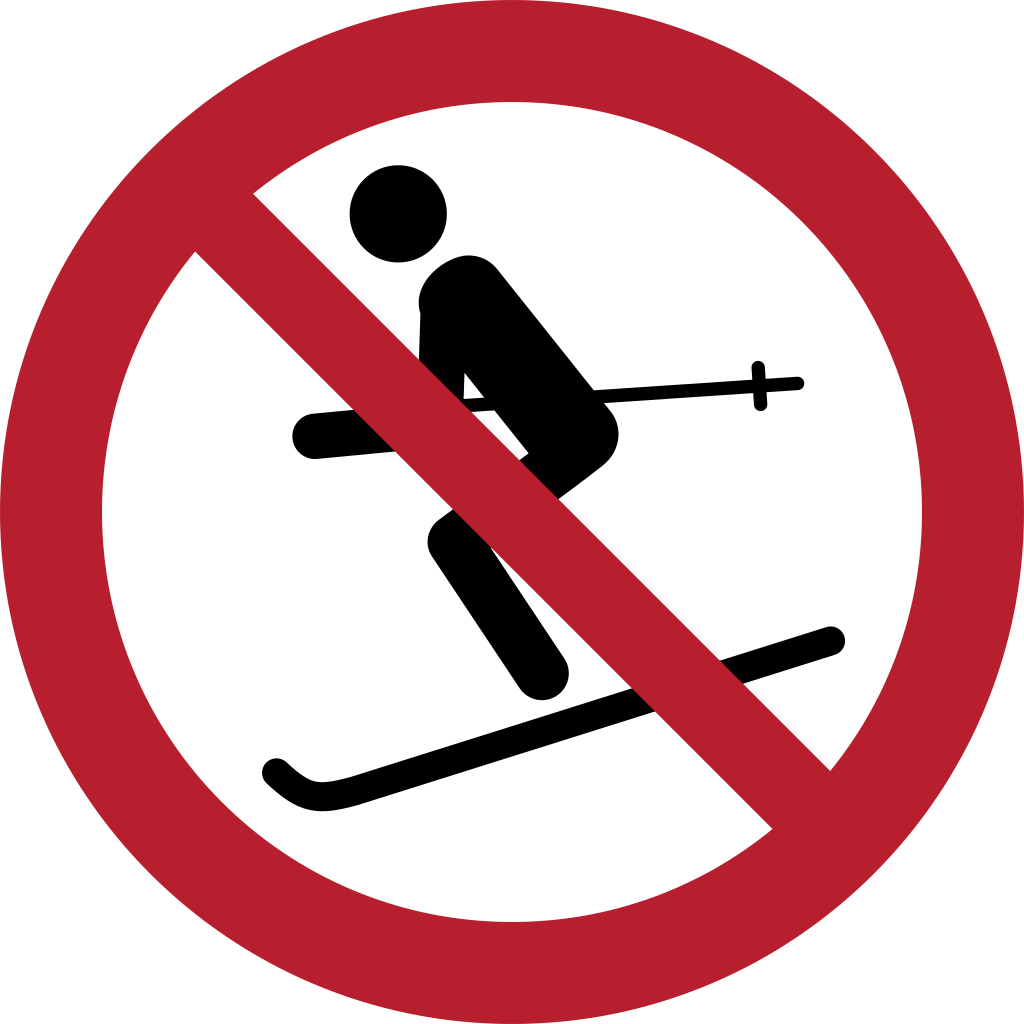
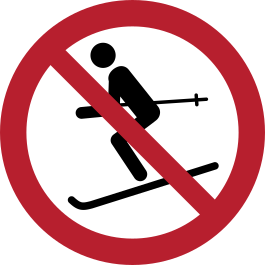
Skiing is prohibited.
Understanding this sign
Red circular signs with a diagonal bar identify an action that must not be taken in the marked area.
Check what object or action the symbol prohibits. A prohibition sign does not identify all the hazards in an area.
What ISO 7010 P076 Prohibits
P076 bans skiing wherever it is displayed. The ISO 7010 register lists the referent as No skiing and the function as prohibiting skiing; the pictogram is a descending skier crossed out by the red band and diagonal bar that ISO 3864-1 defines for all prohibition signs. It reads instantly across languages, which is the point — ski areas serve international guests, and a closure that only works in the local language fails exactly when it matters.
The sign carries no reason on its face, and that is deliberate. The prohibition may be permanent (a zone never open to skiers) or operational (terrain closed today), and the authority behind it may be a resort, a municipality, a landowner, or a park administration. What the viewer needs to know is binary: past this sign, skiing is not permitted.
Typical Situations Behind the Sign
The highest-stakes use is avalanche closure: patrols shut slopes when the hazard rating rises or before control work, and skiing past that closure endangers the skier, the rescuers who must respond, and anyone below the release zone. Other operational closures cover slopes being groomed — winch-cat cables under tension across a piste are a lethal, nearly invisible hazard at night — plus snowmaking work, race training areas, and terrain with insufficient cover.
Permanent postings are just as common: pedestrian and sledding zones where mixed traffic causes collisions, cross-country trails not built for downhill speeds, ecological protection areas and wildlife refuges, and property boundaries where a landowner or park authority excludes ski traffic entirely. Municipalities also use the pictogram on urban slopes, embankments, and dams that attract skiers after snowfall.
Closure Signs, Ropes, and Enforcement
A prohibition pictogram alone rarely closes terrain convincingly. Resorts combine P076 with physical barriers — ropes, fencing, bamboo crosses at the entry — and often with text stating the reason and duration, because skiers comply better with a closure they understand. The distinction between a marked temporary closure and a permanent prohibition should be visible on the ground: temporary closures come down when the hazard clears, while permanent signs stay posted year-round.
Ducking a closure has real consequences. Under the FIS Rules for Conduct, every skier must obey markings and signals, and resorts revoke passes for violations; in several alpine jurisdictions, triggering an avalanche in closed terrain can bring criminal liability and rescue-cost recovery. The sign converts a safety judgment made by patrol into an enforceable boundary.
Choosing Between P076 and Neighboring Signs
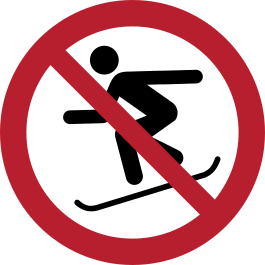
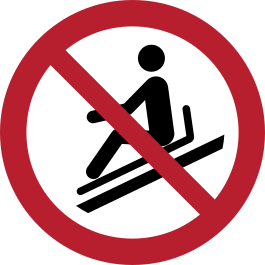
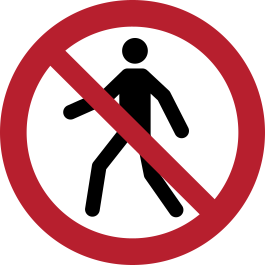
P076 targets skiers specifically. Where the intent is to exclude all sliding sports from an area, it is posted together with P077 (no snowboarding) and P078 (no tobogganing or sledding); posting only the skier pictogram invites the argument that boards and sleds are fine. Where the area is closed to all entry — an avalanche control zone during blasting, for instance — a no-thoroughfare message such as P004 or a full closure barrier communicates more than a sport-specific ban.
The reverse case matters too: some terrain excludes skiers but welcomes other users, such as dedicated sled runs, snowshoe routes, or nordic trails. There, P076 does precise work that a general keep-out sign cannot, telling skiers to stay off while leaving the intended users free to pass.
Where you will see P076
Ski patrols attach it to the ropes, fencing, and bamboo crosses closing avalanche terrain and slopes being groomed, where winch-cat cables under tension are a nearly invisible night hazard. Permanent postings cover dedicated sled runs, cross-country trails, ecological protection areas, and urban embankments and dams, often together with P077 and P078 so boards and sleds are excluded too.
Common questions about P076
What does a no skiing sign with a red circle mean?
That is prohibition sign P076 from ISO 7010: skiing is not permitted beyond that point. The sign itself does not say why — the reason may be avalanche closure, grooming or snowmaking work, a zone reserved for sledding or pedestrians, wildlife protection, or a property boundary — but the instruction is unconditional until the sign or closure is removed.
Is it illegal to ski past a closed sign?
It depends on the jurisdiction, but it is never consequence-free. The FIS Rules for Conduct oblige skiers to respect signs and markings, resorts revoke lift passes for ducking closures, and in some alpine countries entering closed avalanche terrain can lead to fines, liability for rescue costs, or criminal charges if others are endangered. Check the local rules, and treat patrol closures as binding.
Does the P076 sign also ban snowboarding and sledding?
Not by itself. P076 depicts and prohibits skiing; ISO 7010 provides separate signs for snowboarding (P077) and tobogganing or sledding (P078). Areas closed to all sliding traffic normally display the relevant signs together or use a general closure with barriers instead.
Why are slopes closed for grooming at night?
Grooming machines on steep terrain work with winch cables anchored uphill and stretched under high tension across the slope. The cable is almost invisible in the dark, can span an entire piste, and can shift suddenly — a skier riding a closed run at night can hit it at speed. Closures during grooming and snowmaking protect skiers from hazards they cannot see or anticipate.
Reference details
| Symbol code | P076 |
|---|---|
| Sign family | ISO Prohibition Signs |
| Standard reference | ISO 7010:2019 / ISO 3864-1 ISO Online Browsing Platform: P076 |
| Screen color reference | #FF0000. Screen colors are not a production color specification. |
| Download formats | SVG reference artwork; a 1024 × 1024 pixel PNG conversion on a white canvas. |
| Record date | · How to interpret our dates |
| Page updated |
Choosing a physical sign size
Download dimensions are not installation dimensions. Select sign size, material, placement, and lighting using the applicable standard and the actual viewing conditions. Chemical label sizing follows its own rules. Read the artwork and sizing guide.
Sources and artwork credits
- Artwork source
- Wikimedia Commons file page
- Creator credited by source
- Clemenspool
- License
- CC0
- Source metadata checked
SVG files are local reference copies. PNG files are raster conversions. Check the linked file history and license terms before reuse; a source-metadata check is not certification of the artwork or a workplace installation.
Report a correction to this reference