Do not stare at light source
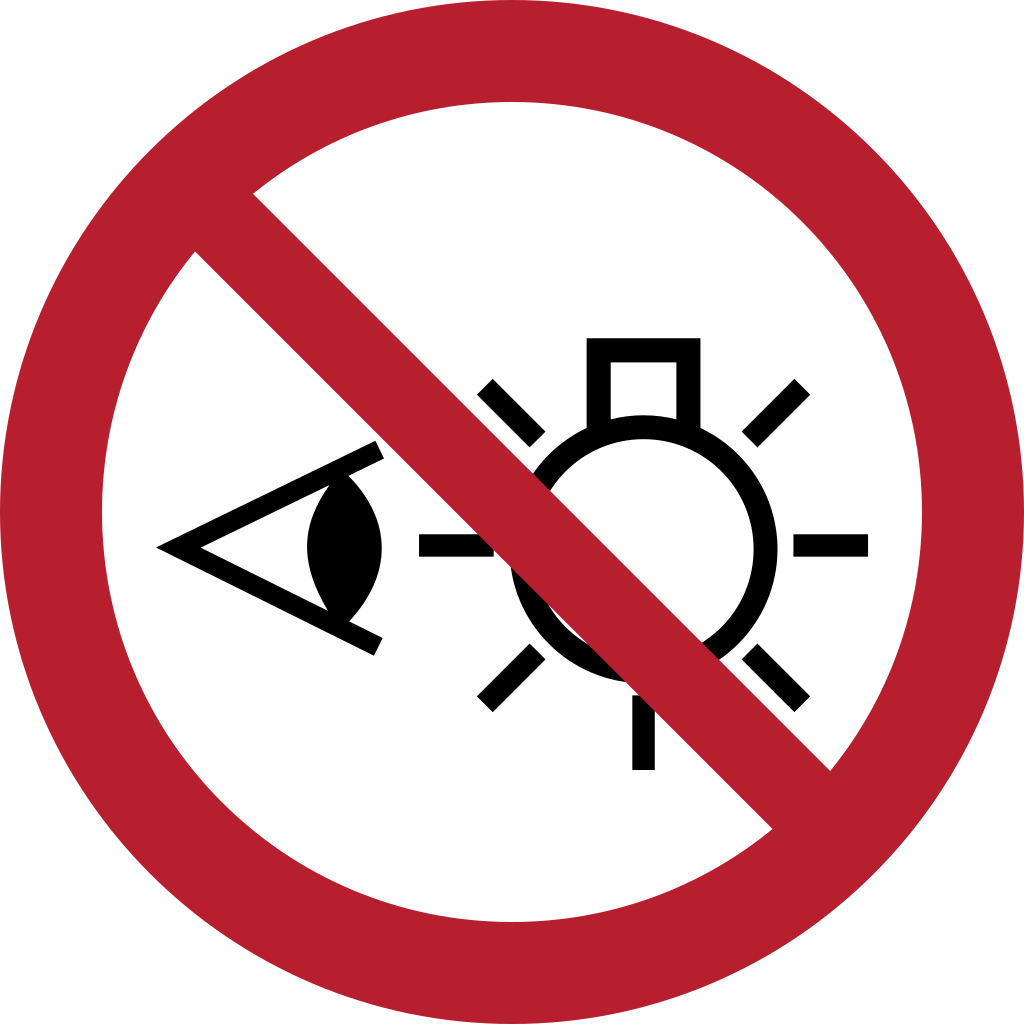
Staring at the light source is prohibited.
Understanding this sign
Red circular signs with a diagonal bar identify an action that must not be taken in the marked area.
Check what object or action the symbol prohibits. A prohibition sign does not identify all the hazards in an area.
Bright Enough to Harm, Not a Laser
ISO 7010 P075 prohibits staring at the marked light source. Its territory is intense broadband and LED light rather than lasers: high-output LED floodlights and luminaires, projectors, stage and studio lighting, UV curing and disinfection lamps, machine-vision illuminators, and inspection lights. These sources cannot cut or burn like a laser beam, but a sustained, deliberate gaze into them can still injure the retina or, with strong UV output, the cornea and skin around the eyes.
The dominant concern for visible high-intensity sources is the blue light photochemical hazard — photoretinitis, damage to the retina from cumulative exposure to short-wavelength visible light. The natural aversion response, blinking and looking away, limits accidental glances to a fraction of a second; P075 targets the exposure that response cannot prevent, which is choosing to look — during installation, aiming, cleaning, or troubleshooting, when the temptation to inspect a running source directly is strongest.
The Photobiological Safety Framework Behind the Label
Lamps and lamp systems are assessed under IEC 62471, which classifies products into risk groups from RG0 (exempt) to RG3 based on how quickly emission limits can be exceeded. For moderate-risk products the assessment's practical output is a labeling and instruction obligation whose canonical wording is close to the P075 message: do not stare at the operating lamp, it may be harmful to the eyes. The ISO 7010 pictogram lets manufacturers express that instruction without language.
Consequently P075 is mostly encountered as a product marking — on the luminaire housing near the aperture, in datasheets and installation manuals — and secondarily as a facility sign where fixed installations such as UV curing tunnels, disinfection units, or high-bay inspection lighting create a viewing hazard at working positions. Machine builders integrating strong illuminators fold the same pictogram into their ISO 12100-based information for use.
P075, W027, and Laser Signage
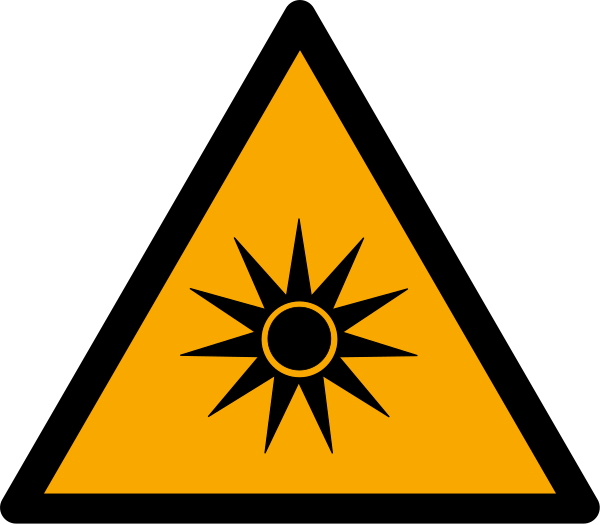
ISO 7010 approaches optical radiation from two sides. W027, the yellow triangle for optical radiation, warns that hazardous UV, visible, or infrared emission exists in an area — it describes the hazard. P075 prescribes behavior: whatever else you do here, do not fix your gaze on the source. Installations such as UV curing stations commonly display both, often alongside mandatory signs for eye protection where filtered goggles are required.
Lasers live under a separate regime. Laser products are classified per IEC 60825-1 and carry their own class-specific labels and warning text, and laser controlled areas use laser-specific signage rather than P075. Using P075 on a laser aperture would understate the hazard: laser damage can occur faster than any decision to stare, which is precisely why the two systems are kept apart.
Where you will see P075
It is mostly encountered as a product marking on luminaire housings near the aperture and in datasheets and installation manuals, following IEC 62471 risk-group labeling for high-output LED floodlights, projectors, stage and studio lighting, and machine-vision illuminators. Facilities post it where fixed installations such as UV curing tunnels, disinfection units, or high-bay inspection lighting create a viewing hazard at working positions, often alongside the W027 optical radiation triangle and eye-protection mandates.
Common questions about P075
What kind of lights need a do-not-stare warning label?
High-intensity non-laser sources: powerful LED floodlights and luminaires, projectors, stage lighting, UV curing and germicidal lamps, and machine-vision or inspection illuminators. Under IEC 62471 photobiological assessment, products in the moderate risk groups must inform users not to stare at the operating lamp, and ISO 7010 P075 is the pictogram form of that instruction.
Can an LED light actually damage your eyes?
A brief accidental glance at most products is handled by your natural aversion response. The risk comes from intentionally staring at high-output sources, where cumulative blue-light exposure can cause photochemical injury to the retina (photoretinitis), and strong UV emitters can additionally harm the cornea and surrounding skin. P075 exists for exactly that deliberate-gaze scenario.
What is the difference between P075 and the W027 optical radiation sign?
W027 is a warning: it tells you hazardous optical radiation (UV, visible, or infrared) is present in the area. P075 is a prohibition: it forbids the specific act of staring at the source. Facilities with UV curing or intense lighting often post both, plus a mandatory eye-protection sign where filtered goggles are required.
Should laser equipment carry the P075 sign?
No. Lasers are classified and labeled under their own standard, IEC 60825-1, with class-specific warnings, and laser controlled areas use laser-specific signage. P075 covers broadband and LED sources where the harm mechanism is staring; laser injury can happen faster than any gaze decision, so substituting P075 would understate the hazard.
Reference details
| Symbol code | P075 |
|---|---|
| Sign family | ISO Prohibition Signs |
| Standard reference | ISO 7010:2019 / ISO 3864-1 ISO Online Browsing Platform: P075 |
| Screen color reference | #FF0000. Screen colors are not a production color specification. |
| Download formats | SVG reference artwork; a 1024 × 1024 pixel PNG conversion on a white canvas. |
| Record date | · How to interpret our dates |
| Page updated |
Choosing a physical sign size
Download dimensions are not installation dimensions. Select sign size, material, placement, and lighting using the applicable standard and the actual viewing conditions. Chemical label sizing follows its own rules. Read the artwork and sizing guide.
Sources and artwork credits
- Artwork source
- Wikimedia Commons file page
- Creator credited by source
- Clemenspool
- License
- CC0
- Source metadata checked
SVG files are local reference copies. PNG files are raster conversions. Check the linked file history and license terms before reuse; a source-metadata check is not certification of the artwork or a workplace installation.
Report a correction to this reference