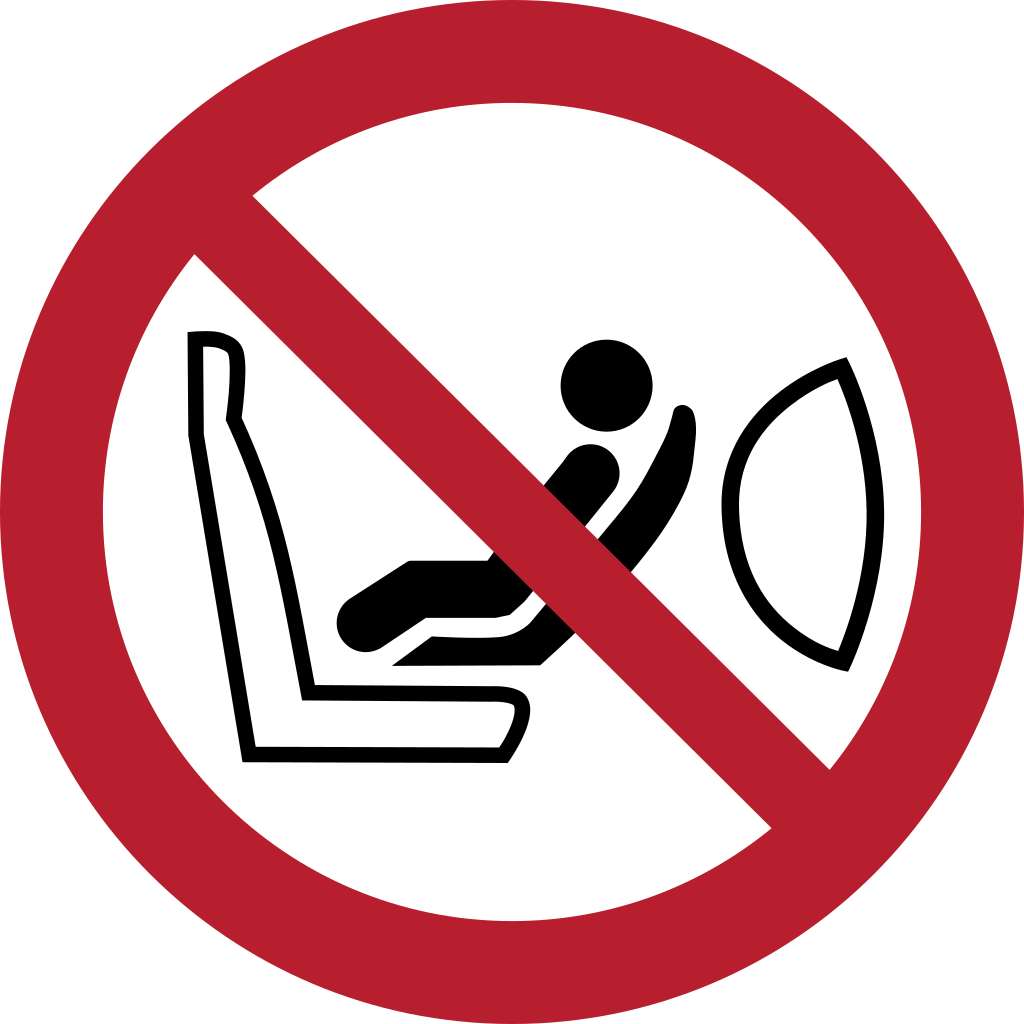
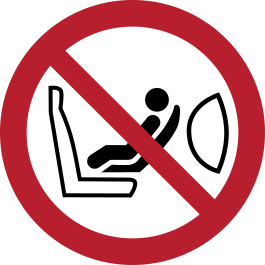
Child seat installation prohibited
Installing a child seat at the marked position is prohibited.
Understanding this sign
Red circular signs with a diagonal bar identify an action that must not be taken in the marked area.
Check what object or action the symbol prohibits. A prohibition sign does not identify all the hazards in an area.
What ISO 7010 P074 Prohibits
P074 forbids installing a rear-facing child restraint on a vehicle seat protected by an active frontal airbag — in practice, the front passenger seat of most cars. The ISO register wording is precise about this combination: it is not a general ban on child seats, nor on the front seat, but on the specific pairing of a rearward-facing restraint with a live airbag in front of it.
This is one of the few ISO 7010 prohibitions that lives inside consumer products rather than on facility walls. Drivers meet it as a label on the sun visor, the dashboard end-cap, or the side of the passenger seat, and again in the owner's manual and on the child restraint itself, where manufacturers repeat the warning in symbol form so it survives language barriers and resale.
Why the Combination Is Lethal
A rear-facing infant carrier positions the child's head close to the dashboard, directly in the deployment path of the frontal airbag. Airbags inflate explosively within milliseconds to catch an adult torso; that same inflation strikes the shell of a rearward-facing seat at close range, driving it violently backward. Infants died this way in real crashes during the 1990s as airbags became standard, which is what drove the labeling requirements.
The danger is specific to geometry, not to airbags in general. A forward-facing child in the rear seat is nowhere near the frontal airbag; a rear-facing carrier in the back row is likewise safe from it. The prohibition exists because the front passenger position is the one place where a rear-facing shell and a deploying bag occupy the same space.
The Regulatory Label Behind the Symbol
Vehicle regulations on both sides of the Atlantic require a permanent airbag warning against rear-facing child restraints on airbag-equipped passenger seats: US federal motor vehicle safety standards mandate visor labeling, and UN vehicle regulations applied across Europe and much of the world require an equivalent warning label, for which the ISO-style pictogram is the recognized form. Child restraint standards additionally require the warning on the seat product itself.
The P074 entry in ISO 7010 standardizes the graphic so that carmakers, restraint manufacturers, taxi and rental fleets, and childcare transport operators all draw the same symbol. Fleets are a notable secondary user: rental desks and taxis carrying child seats post it to brief customers who install the seat themselves in an unfamiliar vehicle, where they cannot assume the airbag arrangement matches their own car.
What Drivers Should Actually Do
The default answer is the rear seat: rear-facing restraints belong in the back, which is the safest position for children regardless of airbags. If a vehicle genuinely forces front-seat installation — a two-seater, or a van cab — the frontal passenger airbag must first be deactivated using the manufacturer's key switch or dealer procedure, and the seat moved as far rearward as it goes. With the airbag off, the prohibition no longer applies, because it is conditional on the airbag being active.
Reactivating the airbag when the child seat comes out is the half of the rule people forget, since a deactivated bag then fails to protect the next adult passenger. Vehicles signal status with an indicator lamp near the switch or in the cluster; fleets and families sharing a car should build the check into every seat change rather than trusting memory, treating airbag state like a handover item alongside fuel and keys.
Where you will see P074
Carmakers fix it to sun visors, dashboard end-caps, and passenger seat sides to satisfy US visor-labeling rules and UN vehicle regulations, and child restraint manufacturers repeat the warning on the seat product itself. Rental desks, taxis, and childcare transport fleets post it to brief customers who install a seat themselves in an unfamiliar vehicle.
Common questions about P074
Can I put a rear-facing car seat in the front if I switch the airbag off?
Yes, where the vehicle provides an approved deactivation method — a key-operated switch or a dealer-performed disablement — and the manual permits it. The P074 prohibition is conditional on the frontal airbag being active. Even so, the rear seat remains the recommended location, and you must switch the airbag back on before an adult uses that seat again.
Why is a rear-facing child seat dangerous with a passenger airbag?
Because the carrier places the infant's head inches from the airbag module, and a frontal airbag inflates with enough speed and force to stop an adult in a crash. Deploying into the back of the carrier at near-zero distance, it slams the shell rearward with the child inside — a mechanism that caused infant fatalities before visor warnings and deactivation switches became universal.
Is the airbag warning label legally required in cars?
Yes. US motor vehicle safety standards require a warning label about rear-facing child restraints on the sun visor of airbag-equipped vehicles, and UN regulations adopted across Europe and many other markets require an equivalent permanent warning, commonly rendered with the ISO pictogram. Child seat approval standards also require the warning on rear-facing restraints themselves.
Does the P074 prohibition apply to side airbags or forward-facing seats?
No. The prohibition concerns the frontal passenger airbag and rearward-facing restraints only. Forward-facing child seats are not covered by the symbol, though manufacturers still advise rear-seat installation and maximum distance from any airbag. Side and curtain airbags follow the vehicle handbook's guidance, which normally does not prohibit child seats at those positions.
Reference details
| Symbol code | P074 |
|---|---|
| Sign family | ISO Prohibition Signs |
| Standard reference | ISO 7010:2019 / ISO 3864-1 ISO Online Browsing Platform: P074 |
| Screen color reference | #FF0000. Screen colors are not a production color specification. |
| Download formats | SVG reference artwork; a 1024 × 1024 pixel PNG conversion on a white canvas. |
| Record date | · How to interpret our dates |
| Page updated |
Choosing a physical sign size
Download dimensions are not installation dimensions. Select sign size, material, placement, and lighting using the applicable standard and the actual viewing conditions. Chemical label sizing follows its own rules. Read the artwork and sizing guide.
Sources and artwork credits
- Artwork source
- Wikimedia Commons file page
- Creator credited by source
- Clemenspool
- License
- CC0
- Source metadata checked
SVG files are local reference copies. PNG files are raster conversions. Check the linked file history and license terms before reuse; a source-metadata check is not certification of the artwork or a workplace installation.
Report a correction to this reference