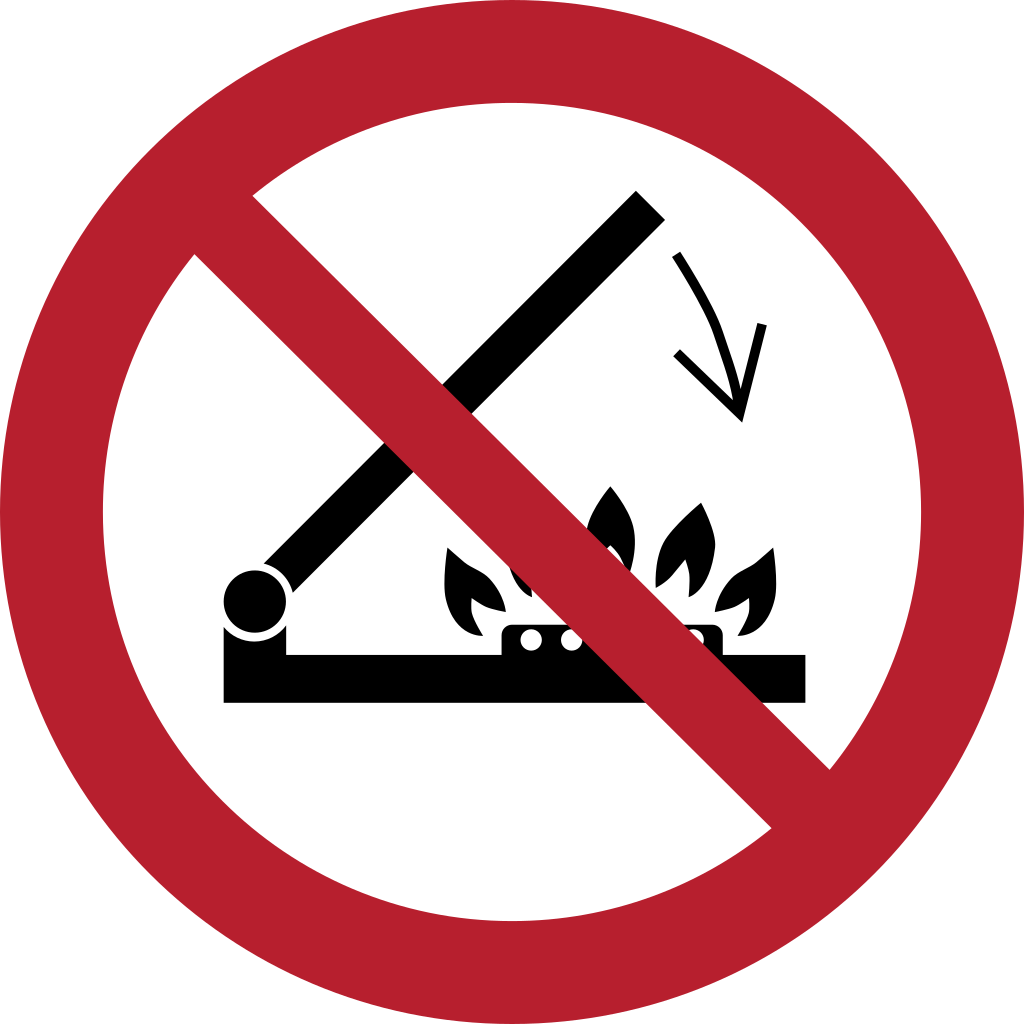
Do not shut lid when burners are operating
Closing the lid while the burners are operating is prohibited.
Understanding this sign
Red circular signs with a diagonal bar identify an action that must not be taken in the marked area.
Check what object or action the symbol prohibits. A prohibition sign does not identify all the hazards in an area.
One Appliance, One Very Specific Rule
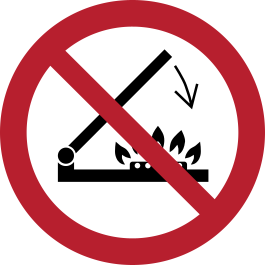
ISO 7010 P073 is among the narrowest prohibitions in the catalogue: do not close the lid while at least one burner is alight. It exists for gas-fired appliances built with a hinged cover over the burners — outdoor cooking appliances, gas hobs with glass lids, camping stoves with fold-down covers, and similar equipment — where the lid is meant to protect the appliance when it is off, not to enclose a live flame. The pictogram shows a lid closing over a flame, barred by the red prohibition ring.
This is a product-safety label first and a facility sign almost never. Manufacturers apply it near the hinge or on the lid itself and repeat the instruction in the user manual, because the hazard arises in the user's hands, at home or at a campsite, far from any workplace signage scheme. Its addition to the ISO 7010 catalogue reflects how far the standard now reaches beyond factory walls into consumer appliance labeling.
What Goes Wrong Under a Closed Lid
Two failure chains motivate the sign. The first is gas accumulation: a closing lid can disturb or starve the flame until it goes out while gas continues to flow. Unburned gas then pools in the covered space, and reopening the lid near the still-hot appliance — or attempting reignition — can flash the accumulated mixture in the user's face. The same chain is why gas barbecue instructions insist on lighting with the lid open.
The second is heat damage. Lids on appliances that carry P073 are not designed as combustion chambers: trapped burner heat can warp metal covers, shatter the tempered-glass lids fitted to many gas hobs, damage seals and controls underneath, and overheat the gas components themselves. On glass-lidded hobs the standing instruction is the same rule in reverse order — extinguish the burners and let them cool before the lid comes down.
Scope: Not Every Barbecue Lid
P073 does not declare closed-lid cooking universally forbidden. Many gas barbecues are engineered precisely for roasting with the hood down, with ventilation and materials rated for it, and their manuals say so. The prohibition belongs to appliances whose cover is a dust-and-weather lid rather than a cooking hood, and the deciding authority is always the manufacturer's instructions for the specific model.
Where the sign or its pictogram appears — on the appliance, in the manual, on rental or campsite equipment — treat it as a design statement: this cover and a burning flame must never coexist. Related signage covers the neighboring risks: P003 (no open flame) governs where the appliance may be lit at all, and hot-surface warnings address the lid and body after use.
Where you will see P073
Appliance makers apply it near the hinge or on the lid of gas hobs with glass covers, outdoor cooking appliances, and camping stoves with fold-down lids, repeating the instruction in the user manual. It is primarily a product-safety label rather than a facility sign, also seen on rental and campsite equipment, and it does not apply to barbecues whose hoods are engineered for closed-lid roasting.
Common questions about P073
Why can't you close the lid while a gas burner is still on?
Because the closing lid can snuff the flame while gas keeps flowing, letting unburned gas pool under the cover and flash when the lid is reopened or the burner is relit. Trapped heat can also warp the lid, shatter glass covers on hobs, and damage seals and gas components not designed to be enclosed with a live flame.
Does the P073 sign mean I can never cook with the barbecue hood closed?
No. Many gas barbecues are specifically designed for closed-hood roasting and their manuals permit it. P073 applies to appliances whose lid is a protective cover rather than a cooking hood — glass-lidded hobs, camping stoves, and grills the manufacturer says must run open. The instructions for your specific model are decisive.
Where is the do-not-shut-lid pictogram usually found?
On the appliance itself — near the lid hinge, on the lid, or beside the burner controls — and in the safety section of the user manual. It is essentially a product label for gas cooking equipment rather than a workplace wall sign, since the risk occurs wherever the appliance is used.
What should I do if the flame goes out under a partly closed lid?
Turn the gas off, open the lid fully, and let the appliance ventilate for several minutes before any attempt to relight, following the waiting time in the manufacturer's instructions. Relighting immediately over accumulated gas is the flash scenario the P073 prohibition exists to prevent.
Reference details
| Symbol code | P073 |
|---|---|
| Sign family | ISO Prohibition Signs |
| Standard reference | ISO 7010:2019 / ISO 3864-1 ISO Online Browsing Platform: P073 |
| Screen color reference | #FF0000. Screen colors are not a production color specification. |
| Download formats | SVG reference artwork; a 1024 × 1024 pixel PNG conversion on a white canvas. |
| Record date | · How to interpret our dates |
| Page updated |
Choosing a physical sign size
Download dimensions are not installation dimensions. Select sign size, material, placement, and lighting using the applicable standard and the actual viewing conditions. Chemical label sizing follows its own rules. Read the artwork and sizing guide.
Sources and artwork credits
- Artwork source
- Wikimedia Commons file page
- Creator credited by source
- Clemenspool
- License
- CC0
- Source metadata checked
SVG files are local reference copies. PNG files are raster conversions. Check the linked file history and license terms before reuse; a source-metadata check is not certification of the artwork or a workplace installation.
Report a correction to this reference