No jumping down
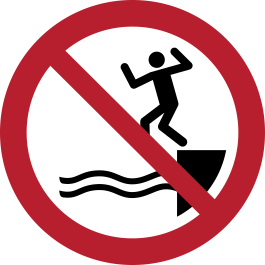
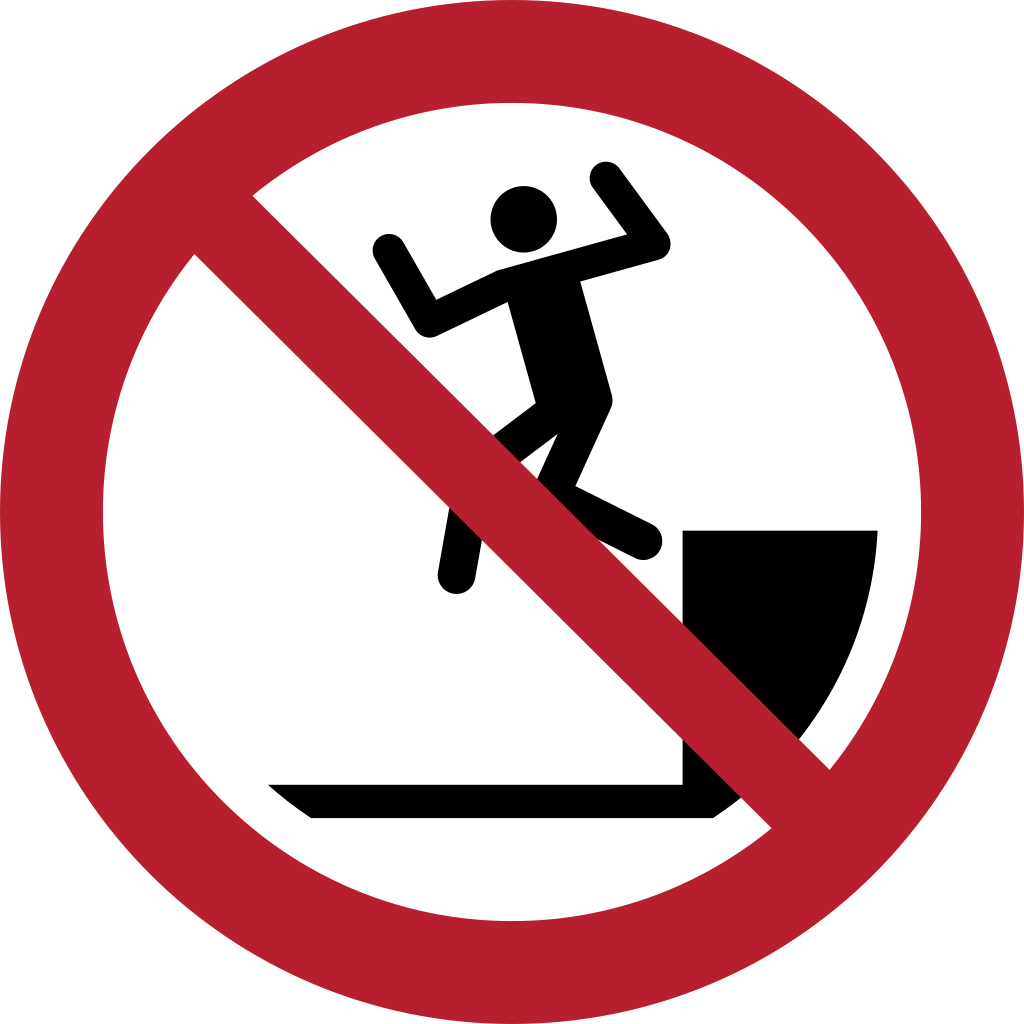
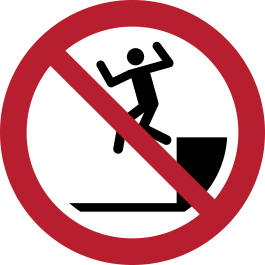
Jumping down from the marked location is prohibited.
Understanding this sign
Red circular signs with a diagonal bar identify an action that must not be taken in the marked area.
Check what object or action the symbol prohibits. A prohibition sign does not identify all the hazards in an area.
A Prohibition Aimed at Shortcuts, Not Falls
P072 prohibits jumping down from the edge, platform, or vehicle where it is posted. The pictogram — a figure leaping from a ledge, canceled in red — targets a deliberate act rather than an accident, which separates it from the W008 drop warning. Among the more recent entries in the ISO 7010 register, it answers a behavior every dock supervisor recognizes: the stairs are twenty meters away and the ground is only a meter down.
The injury pattern is why the shortcut is banned. Jumping even modest heights onto concrete drives impact through ankles, knees, hips, and spine, and repeated over a working life it produces the sprains, fractures, and joint damage that fill musculoskeletal injury statistics. Loads carried during the jump, uneven landing surfaces, and traffic below turn a bad habit into broken bones.
Docks, Platforms, and Vehicle Beds
Loading docks are the archetype. A typical dock face stands around 1.2 meters above the yard — low enough to tempt, high enough to injure — and the landing zone is active truck apron. P072 on the dock edge steers workers to stairs or dock steps and keeps them out of reversing-vehicle paths. The same logic covers mezzanine edges, raised work platforms, staging, and the beds and trailers of trucks, where safe dismounting means facing the vehicle and keeping three points of contact.
Rail environments give the sign its highest-consequence use. Passengers and staff jumping from platform ends or edges onto the track — to retrieve a dropped phone, or to cross rather than use the bridge — face oncoming trains and, on many networks, electrified rails. Operators post P072 at platform ramps and ends alongside barriers and warning signage, making the descent itself the forbidden act regardless of intent to climb back.
Design the Alternative, Then Post the Sign
A jump ban only works when the compliant route is tolerable. If the nearest dock stair sits at the far end of a long face, workers will price in the walk and jump anyway, so effective sites space stairs and ladders along raised edges, keep them unobstructed, and put P072 exactly where the jumping happens — the spots polished smooth at the platform lip usually mark them. Edge-of-surface mounting, visible to someone standing above and looking down, beats wall placement here.
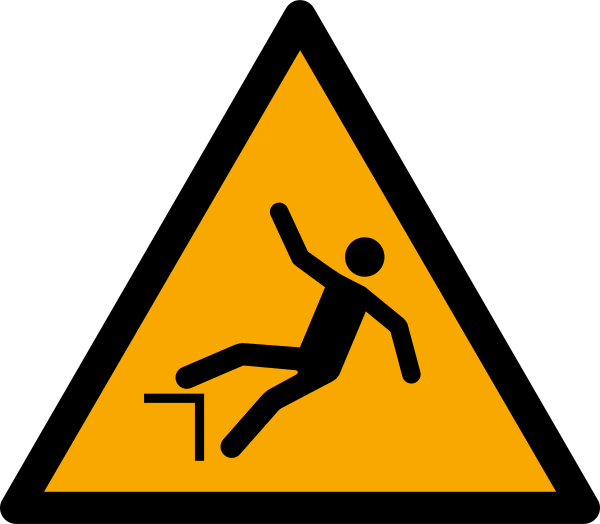
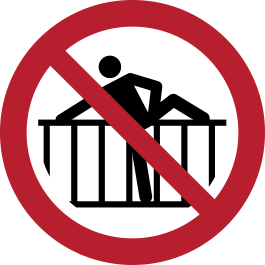
Complementary signage completes the picture. W008 warns everyone near the drop; P071 stops people crossing the guardrail that protects it; P072 addresses the person who has decided to go down the fast way. Vehicle operations add the three-points-of-contact rule to driver training, since cab and trailer dismounts injure drivers at rates signage alone never fixes.
Where you will see P072
Loading docks are the archetype — a 1.2-meter face over an active truck apron — with the sign at the dock edge directing workers to stairs and away from reversing vehicles, and the same logic covers mezzanine edges, raised work platforms, and truck beds and trailers. Rail operators give it the highest-consequence use, posting it at platform ends and ramps where jumping to the track means oncoming trains and, on many networks, electrified rails.
Common questions about P072
Why is jumping off a loading dock such a big deal if it is only a meter high?
Because the numbers accumulate against you. A one-meter jump onto concrete delivers an impact that ankles and knees tolerate until, one day, they do not — and dock jumps often happen with a load in hand, onto surfaces scattered with debris, into the path of reversing trailers. Docks generate a steady stream of fractures and sprains from exactly this act, which is why it gets a dedicated prohibition.
What is the difference between P072 and the W008 fall warning sign?
W008 is a yellow warning triangle alerting people that a drop exists so they do not fall accidentally. P072 is a red prohibition banning the intentional act of jumping down. A mezzanine edge might carry both: the warning for anyone approaching unaware, the prohibition for the worker who knows the edge perfectly well and plans to hop off it.
Where should no jumping down signs be placed?
At the edge itself, oriented so a person standing at the top reading the drop sees the sign in the same glance — dock lips, platform ends, mezzanine edges, and the sides of raised walkways. Concentrate copies where jumping actually occurs, typically the points furthest from stairs, and make sure each signed location has a reasonable compliant route down nearby.
Does P072 apply to getting down from trucks and trailers?
Yes, it is regularly used on vehicle beds, trailer decks, and cab access points, where jumping down is a leading source of driver leg and back injuries. The paired positive rule is to dismount facing the vehicle using the built-in steps and handholds with three points of contact — a slower exit that fleets enforce through training with P072 marking the edge.
Reference details
| Symbol code | P072 |
|---|---|
| Sign family | ISO Prohibition Signs |
| Standard reference | ISO 7010:2019 / ISO 3864-1 ISO Online Browsing Platform: P072 |
| Screen color reference | #FF0000. Screen colors are not a production color specification. |
| Download formats | SVG reference artwork; a 1024 × 1024 pixel PNG conversion on a white canvas. |
| Record date | · How to interpret our dates |
| Page updated |
Choosing a physical sign size
Download dimensions are not installation dimensions. Select sign size, material, placement, and lighting using the applicable standard and the actual viewing conditions. Chemical label sizing follows its own rules. Read the artwork and sizing guide.
Sources and artwork credits
- Artwork source
- Wikimedia Commons file page
- Creator credited by source
- ISO
- License
- Public domain
- Source metadata checked
SVG files are local reference copies. PNG files are raster conversions. Check the linked file history and license terms before reuse; a source-metadata check is not certification of the artwork or a workplace installation.
Report a correction to this reference