Do not cross barrier
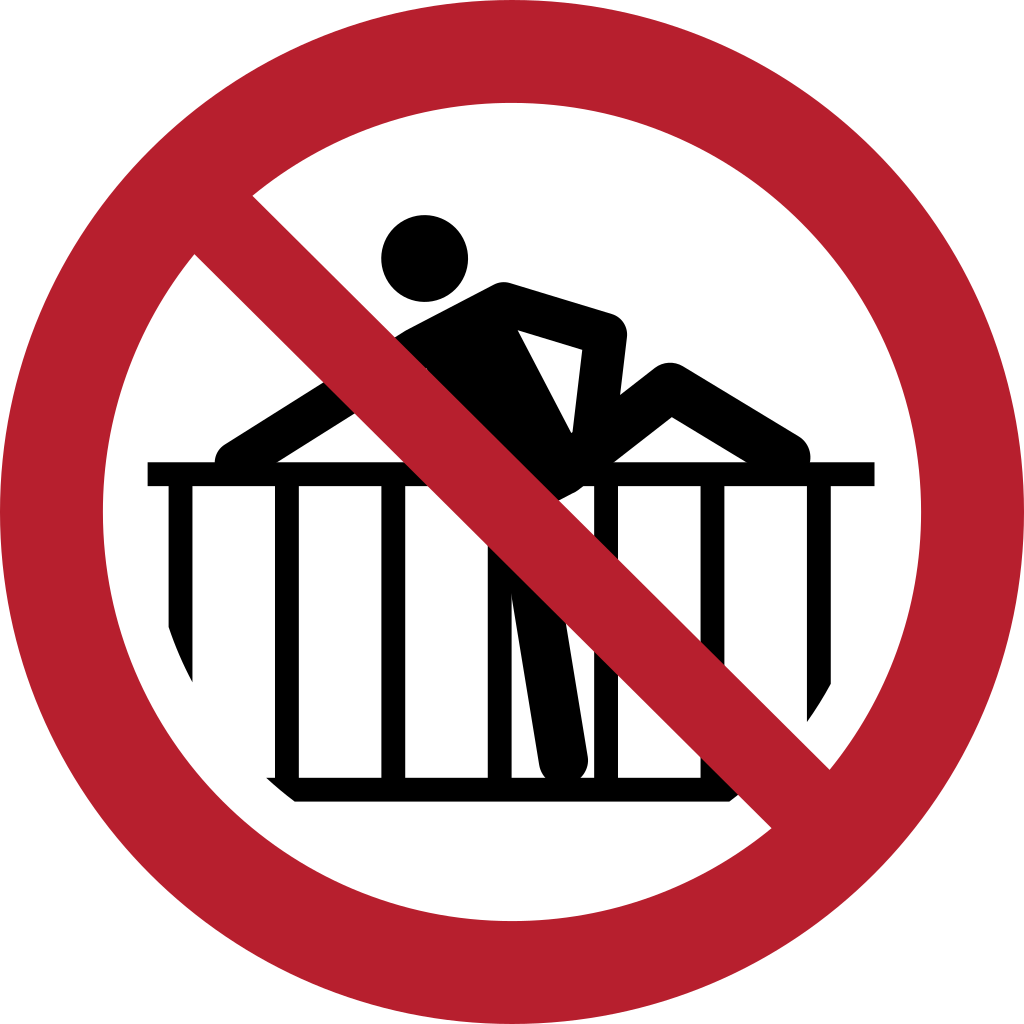
Crossing the barrier is prohibited.
Understanding this sign
Red circular signs with a diagonal bar identify an action that must not be taken in the marked area.
Check what object or action the symbol prohibits. A prohibition sign does not identify all the hazards in an area.
The Barrier Is the Boundary
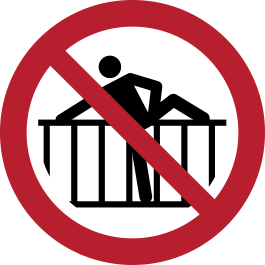
P071 prohibits crossing the barrier on which, or immediately beside which, it appears. The pictogram depicts a person stepping over a rail, struck through in red. It is one of the newer additions to the ISO 7010 catalogue, created because facilities were improvising: a fence with a generic no-entry disc tells people not to pass a point, but not that climbing over, ducking under, or squeezing through the physical barrier itself is the forbidden act, wherever along its length the attempt is made.
That distinction matters wherever a barrier is easy to defeat. Chain lines, retractable belt posts, pedestrian guardrails, and half-height gates stop no one physically; they work by declaring a boundary. P071 attaches the force of a formal prohibition to that declaration, closing the gap a determined shortcut-taker exploits when a barrier is merely symbolic. It also hands stewards and security staff a specific, citable rule instead of an argument about intent.
Where It Earns Its Keep
Event and crowd management is the headline use: stage-front rails, queue systems, cordons around incident scenes, and segregation lines at stadiums and stations, where one person vaulting a rail can trigger surges or push others into the hazard beyond. Transit operators apply it to platform-end gates and to fencing between platforms and running lines, where crossing means entering the path of trains and, on electrified routes, live rails.
Industry deploys P071 on perimeter fencing around robot cells and automated storage systems, on guardrails separating walkways from vehicle routes, on temporary fencing at excavations and roadworks, and on handrails enclosing tank tops or pits. In each case the machinery safety logic is identical: interlocks, safe distances, and traffic plans are all calculated on the assumption that people stay on their side of the steel.
Getting the Sign Right
Mount P071 on the barrier itself, facing approaching pedestrians, and repeat it along any run longer than a few meters — people cross where they stand, not where the sign is. At the points a barrier can legitimately be passed, such as interlocked gates or supervised openings, signage should switch message rather than fall silent: authorized-access wording at the gate keeps the blanket prohibition credible everywhere else.
Select alternatives when the situation differs. P004 no thoroughfare closes a route without reference to a physical barrier; P024 keeps people off an area of ground; site-specific access signs govern who may enter rather than whether the barrier may be breached. And where crossing would be immediately lethal — live conductors, train movements, machine envelopes — pair P071 with the relevant yellow warning triangle so the barrier communicates consequence as well as rule.
Where you will see P071
Event and crowd managers fix it to stage-front rails, queue systems, cordons around incident scenes, and segregation lines at stadiums and stations, while transit operators apply it to platform-end gates and fencing between platforms and running lines. Industrial uses include perimeter fencing around robot cells and automated storage systems, guardrails separating walkways from vehicle routes, temporary fencing at excavations, and handrails enclosing tank tops and pits, repeated along any run longer than a few meters.
Common questions about P071
What does the P071 sign prohibit exactly?
Defeating the barrier by any means — climbing over, crawling under, or passing through it. It is aimed at barriers that are physically easy to cross: queue rails, chain and belt lines, pedestrian guardrails, temporary fencing, and half-height gates. The sign makes explicit that the barrier marks a mandatory boundary, not an obstacle you may negotiate if you are agile enough.
How is do not cross barrier different from a no entry sign?
P004 and other no-entry signs close a route or doorway; P071 governs the physical barrier itself and applies along its whole length. A corridor gate blocking all passage suits P004. A hundred meters of rail between a walkway and a forklift lane, or a crowd rail at a concert, suits P071 repeated along the run, because the prohibited act is stepping over at any point.
Where should P071 signs be positioned on a long barrier?
On the barrier at regular intervals, facing pedestrian approach, sized for the distance at which people walk alongside it. A common failure is one sign at each end of a long fence line: anyone mid-run sees bare rail and infers the rule does not apply there. Add copies at corners, near seating or waiting areas, and anywhere the far side looks like a shortcut.
Do crowd-control barriers at events need this signage?
Increasingly, yes. Event safety planning treats barrier lines as engineered crowd-management elements, and P071 gives stewards an unambiguous, language-independent rule to point to when challenging climbers. It is typically combined with briefed stewarding at pinch points, since at high crowd densities a sign alone will not restrain a surge — the signage supports enforcement rather than replacing it.
Reference details
| Symbol code | P071 |
|---|---|
| Sign family | ISO Prohibition Signs |
| Standard reference | ISO 7010:2019 / ISO 3864-1 ISO Online Browsing Platform: P071 |
| Screen color reference | #FF0000. Screen colors are not a production color specification. |
| Download formats | SVG reference artwork; a 1024 × 1024 pixel PNG conversion on a white canvas. |
| Record date | · How to interpret our dates |
| Page updated |
Choosing a physical sign size
Download dimensions are not installation dimensions. Select sign size, material, placement, and lighting using the applicable standard and the actual viewing conditions. Chemical label sizing follows its own rules. Read the artwork and sizing guide.
Sources and artwork credits
- Artwork source
- Wikimedia Commons file page
- Creator credited by source
- ISO
- License
- Public domain
- Source metadata checked
SVG files are local reference copies. PNG files are raster conversions. Check the linked file history and license terms before reuse; a source-metadata check is not certification of the artwork or a workplace installation.
Report a correction to this reference