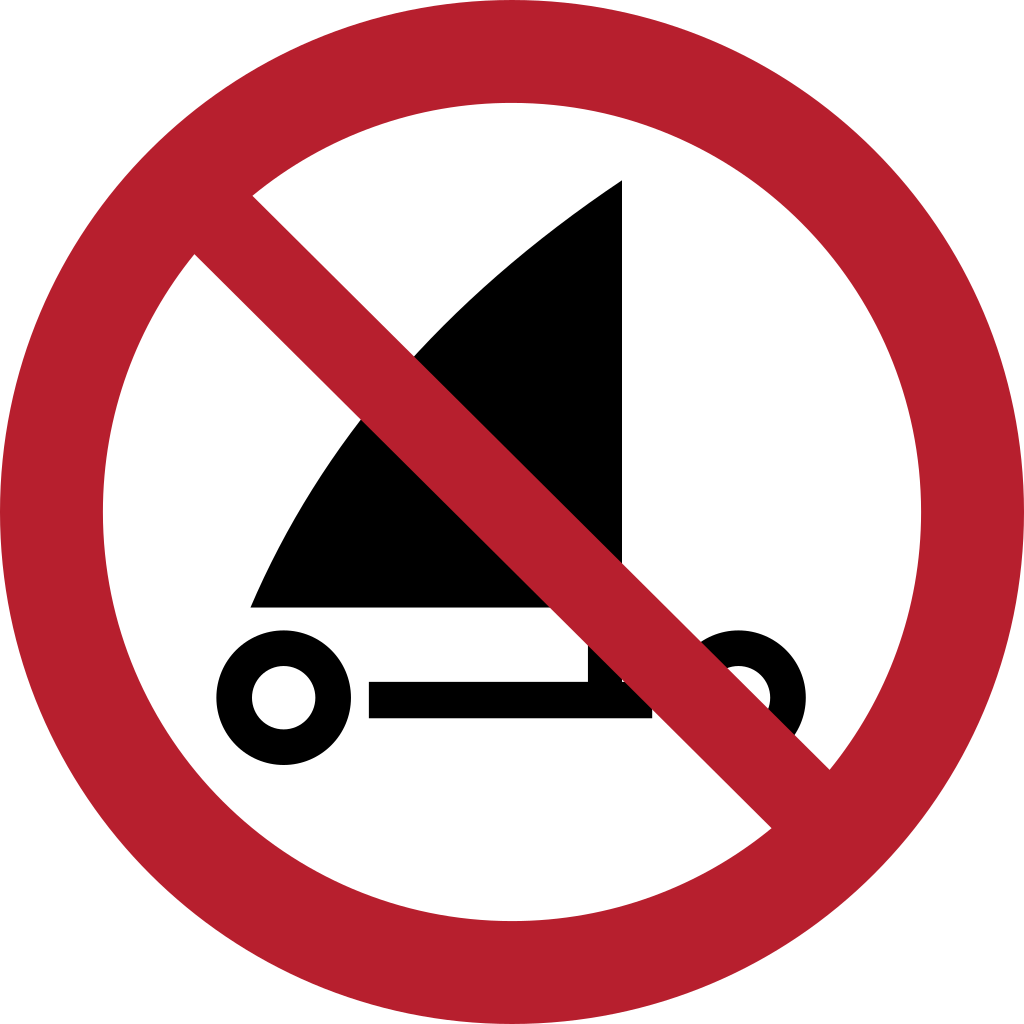
No sand yachting
Sand yachting is prohibited.

Understanding this sign
Red circular signs with a diagonal bar identify an action that must not be taken in the marked area.
Check what object or action the symbol prohibits. A prohibition sign does not identify all the hazards in an area.
What ISO 7010 P067 Means
P067 prohibits sand yachting, also called land sailing or land yachting: piloting a wheeled, wind-driven craft along the beach. A sand yacht is a lightweight three-wheeled chassis carrying a rig, steered from a reclined seat, and on firm sand a good breeze pushes it to speeds well beyond anything else sharing the foreshore. Uniquely among the water safety prohibitions in this part of the ISO 7010 catalogue, the activity it bans takes place on land — the beach itself is the venue.
The pictogram shows the wheeled yacht under sail, crossed by the red prohibition ring and bar. Related derivatives such as kite buggies are mechanically similar — wheeled beach craft under wind power — though pedantically distinct because a buggy is pulled by a flown kite; sites troubled by both usually say so in supplementary text rather than relying on the sand-yacht image alone.
Pedestrians, Tides, and Why Beaches Ban It
The core conflict is speed differential on shared ground. Walkers, dogs, children, and horse riders use the same firm sand strip that sand yachts need, and a pilot seated at ankle height has restricted sightlines while carrying too much pace to stop short. A collision at sand-yacht speeds is a serious vehicle strike, not a bump, so authorities exclude the craft from busy resort frontages outright and confine it to wide, quieter beaches — often only outside the summer season or before the crowds arrive.
Tides shape the sport in a way few other beach activities share. Sand yachting needs the broad, hard-packed flats exposed at low water, so sessions run in tide windows and ranges with big tidal flats attract the sport. Those same flats can carry additional restrictions — nature conservation on wader feeding grounds, vehicle bans, military ranges — and P067 is the instrument that closes specific frontages while clubs operate on agreed sections elsewhere.
Where the Sign Is Used and What It Does Not Cover
P067 appears on beach access boards at resort towns adjoining known land-sailing coasts, at slipway and foreshore vehicle entrances where yachts are wheeled down, and at the boundaries of zoned beaches where a club circuit exists further along. Coastal regions of northern France, Belgium, and parts of Britain and Ireland, where the sport has an organized presence on wide tidal beaches, are typical settings; elsewhere the sign is rare because the activity is.
Because a sand yacht never enters the water, the marine craft prohibitions say nothing about it — P053 covers sailing boats afloat, and no combination of the water-based signs excludes a wheeled craft from the sand. That gap is precisely why P067 was registered. Conversely, P067 does not restrict any activity on the water, so a beach can prohibit land sailing while its offshore zone remains open to dinghies and boards.
Where you will see P067
Resort towns on known land-sailing coasts add it to beach access boards, to slipway and foreshore vehicle entrances where yachts are wheeled down, and to the boundaries of zoned beaches with a club circuit further along. Wide tidal beaches in northern France, Belgium, and parts of Britain and Ireland are the typical settings, where authorities close busy frontages while clubs operate on agreed sections elsewhere.
Common questions about P067
What is the no sand yachting sign prohibiting?
The use of sand yachts, also known as land yachts or land-sailing craft — wheeled vehicles driven along the beach by a sail. The ban covers the beach frontage the signage marks. It is ISO 7010 reference P067, part of the standard's water and beach safety group.
Why would a beach ban sand yachting?
Mainly pedestrian safety. Sand yachts reach high speeds on firm sand, the pilot sits low with limited visibility, and stopping distances are long, so mixing them with walkers, children, and horse riders on a busy foreshore risks serious collisions. Conservation of feeding and nesting grounds on tidal flats is another common reason.
Does the no sand yachting sign also cover kite buggies?
Not explicitly — the pictogram depicts a sailed yacht, while a kite buggy is towed by a flown kite. Many beach authorities treat the two alike because the ground hazard is the same, but a site that intends to ban buggies and kite landboards as well should state that in supplementary text or local byelaws.
Can I sand yacht at low tide if the sign is posted?
No. The prohibition applies whenever you are on the signed frontage, regardless of tide. Tide state matters to where the sport is practical, not to whether the ban applies — although some beaches restrict land sailing only seasonally or on certain sections, in which case the supplementary panel should define those limits.
Reference details
| Symbol code | P067 |
|---|---|
| Sign family | ISO Prohibition Signs |
| Standard reference | ISO 7010:2019 / ISO 3864-1 ISO Online Browsing Platform: P067 |
| Screen color reference | #FF0000. Screen colors are not a production color specification. |
| Download formats | SVG reference artwork; a 1024 × 1024 pixel PNG conversion on a white canvas. |
| Record date | · How to interpret our dates |
| Page updated |
Choosing a physical sign size
Download dimensions are not installation dimensions. Select sign size, material, placement, and lighting using the applicable standard and the actual viewing conditions. Chemical label sizing follows its own rules. Read the artwork and sizing guide.
Sources and artwork credits
- Artwork source
- Wikimedia Commons file page
- Creator credited by source
- ISO
- License
- Public domain
- Source metadata checked
SVG files are local reference copies. PNG files are raster conversions. Check the linked file history and license terms before reuse; a source-metadata check is not certification of the artwork or a workplace installation.
Report a correction to this reference