No parasailing
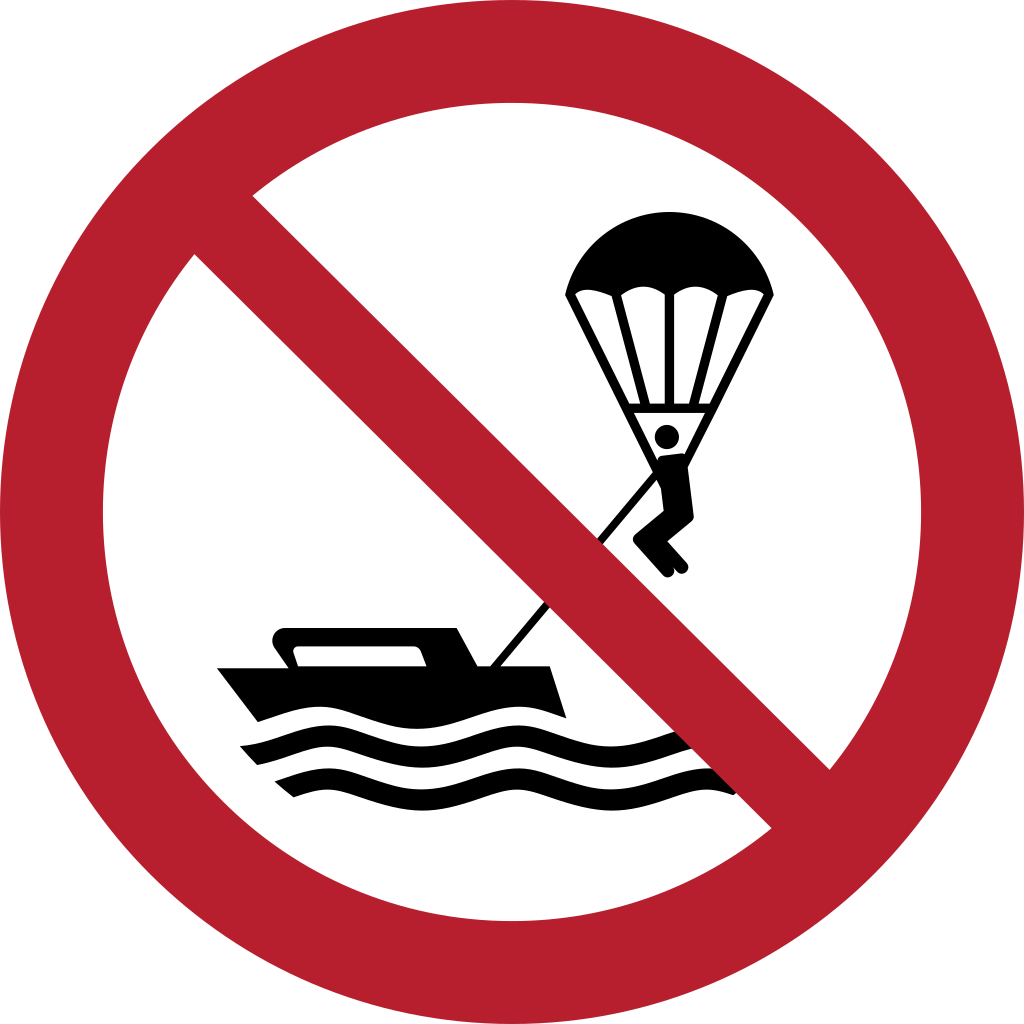
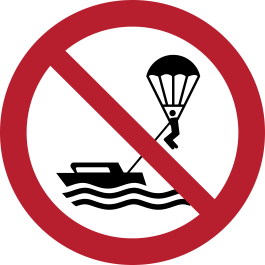
Parasailing is prohibited.
Understanding this sign
Red circular signs with a diagonal bar identify an action that must not be taken in the marked area.
Check what object or action the symbol prohibits. A prohibition sign does not identify all the hazards in an area.
What ISO 7010 P066 Means
P066 prohibits parasailing, the activity in which a person is lifted under a parachute-style canopy towed on a line behind a powered boat. The pictogram shows the canopy and suspended rider under the red prohibition ring. Registered within the water safety signs of ISO 7010, it addresses an activity that is almost always run commercially — resort operators selling rides — rather than something individuals do with their own equipment.
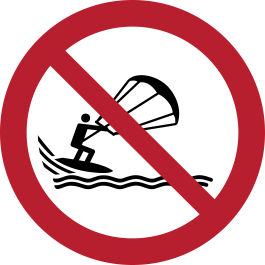
The sign is distinct from the other airborne-sport references. Kitesurfing under P065 involves a self-piloted rider driving a board with a traction kite; a parasail passenger controls nothing and hangs high above the water at the end of a long towline while the boat's crew manages the flight. That passenger-aloft, boat-controlled arrangement is what P066 targets.
Why Parasailing Is Restricted
Height is the defining hazard. A parasail canopy can carry its passenger far above the water, which brings aviation-style conflicts onto a beach: proximity to airfields and low-flying aircraft routes, power lines and cable spans, piers, cranes, and cliff faces all become strike risks that no purely surface activity faces. Authorities accordingly ban the activity near such obstacles, and near airport approach paths, where the canopy would intrude into used airspace.
On the surface, the operation needs a long clear run. The towline stretches well behind the boat, and launch and recovery — winching the passenger off and back onto a platform or beach — demand space and calm conditions. Where an area is congested with swimmers, moorings, or other traffic, or where an engine failure would drift a descending canopy onto rocks or a busy beach, P066 closes the area to the activity. Many jurisdictions also regulate parasailing operators through licensing, and the sign marks water excluded from any licensed operating area.
Typical Locations and Related Signs
P066 is most often seen at resort coastlines that host commercial watersports: on beach entry boards covering the supervised bathing frontage, near marinas and harbor entrances where a towline would obstruct traffic, and along shorelines beneath cables, bridges, or flight paths. Because rides are sold from kiosks, posting at the concession and boat-boarding points reaches the operator and the customer at the decision moment, which shore-wide signage alone does not.
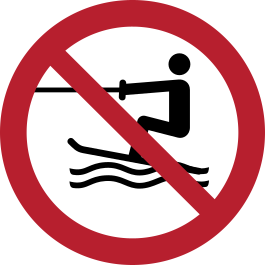
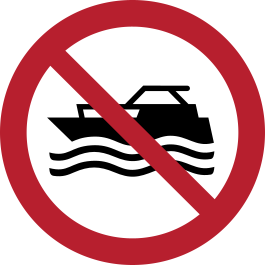
The activity is a towed one, so on water marked with P058 (no towed water activity) parasailing is already excluded along with skiing and inflatable rides; P066 exists for places that need to name it specifically, often because commercial operators work the same beach. Sites banning powered craft entirely with P056 make both signs unnecessary, since without a tow boat there is no parasail.
Where you will see P066
Resort coastlines hosting commercial watersports display it on beach entry boards along supervised bathing frontage, near marinas and harbor entrances where a long towline would obstruct traffic, and along shorelines beneath cables, bridges, or airport flight paths where an airborne passenger faces strike risks. Because rides are sold from kiosks, posting at the concession and boat-boarding points reaches operator and customer at the moment of decision.
Common questions about P066
What does the no parasailing sign prohibit exactly?
It prohibits parasailing in the marked area — being towed aloft under a canopy behind a boat, including the launch, flight, and recovery phases. It applies equally to commercial ride operators and private equipment, though in practice nearly all parasailing is a paid, operator-run activity.
Why is parasailing banned near airports and power lines?
Because the passenger flies high above the surface at the end of a towline, parasailing can conflict with low-altitude airspace and strike fixed obstacles such as cable spans, piers, and cliffs. Areas near airfield approaches and overhead lines are therefore among the most common places to find the P066 prohibition.
Is parasailing already covered by the no towed water activity sign?
Largely, yes — parasailing is a towed activity, so a P058 zone excludes it along with waterskiing and inflatable rides. P066 is the more precise reference and is used where authorities want the ban on parasailing to be explicit and unmistakable, typically at resorts where commercial parasail operations exist.
Who enforces a no parasailing zone?
Usually the authority managing the water — a harbormaster, coastal municipality, or maritime administration — under local byelaws or navigation rules. Where parasailing operators are licensed, enforcement also works through the licence: operating inside a prohibited area can cost the operator their permit, which is often a stronger deterrent than action against individual customers.
Reference details
| Symbol code | P066 |
|---|---|
| Sign family | ISO Prohibition Signs |
| Standard reference | ISO 7010:2019 / ISO 3864-1 ISO Online Browsing Platform: P066 |
| Screen color reference | #FF0000. Screen colors are not a production color specification. |
| Download formats | SVG reference artwork; a 1024 × 1024 pixel PNG conversion on a white canvas. |
| Record date | · How to interpret our dates |
| Page updated |
Choosing a physical sign size
Download dimensions are not installation dimensions. Select sign size, material, placement, and lighting using the applicable standard and the actual viewing conditions. Chemical label sizing follows its own rules. Read the artwork and sizing guide.
Sources and artwork credits
- Artwork source
- Wikimedia Commons file page
- Creator credited by source
- ISO
- License
- Public domain
- Source metadata checked
SVG files are local reference copies. PNG files are raster conversions. Check the linked file history and license terms before reuse; a source-metadata check is not certification of the artwork or a workplace installation.
Report a correction to this reference