No kite surfing
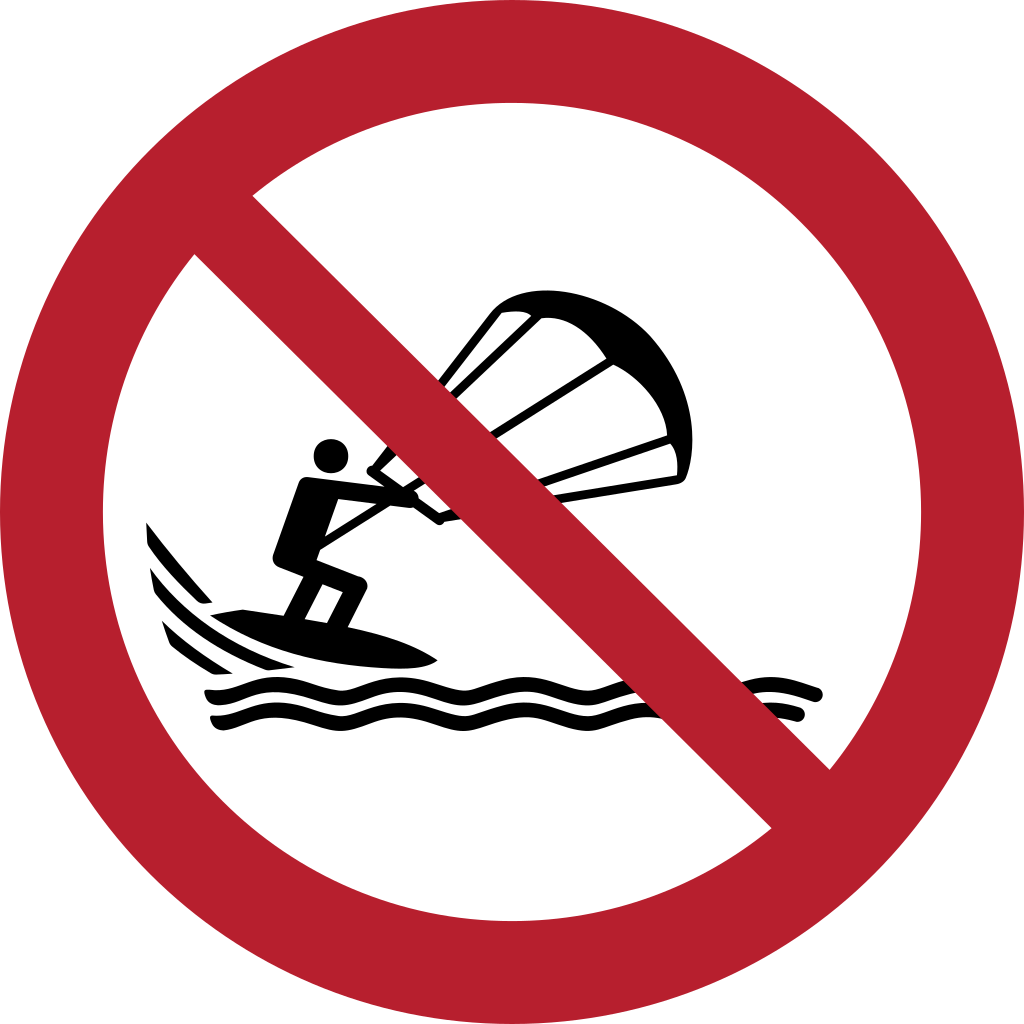
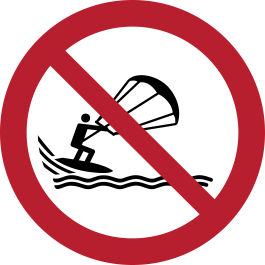
Kite surfing is prohibited.
Understanding this sign
Red circular signs with a diagonal bar identify an action that must not be taken in the marked area.
Check what object or action the symbol prohibits. A prohibition sign does not identify all the hazards in an area.
What ISO 7010 P065 Prohibits
P065 forbids kitesurfing — riding a board while harnessed to a traction kite flown on lines. The prohibition reaches the whole operation, including launching, landing, and relaunching the kite, because those phases happen on or over the beach rather than out on the water. The pictogram shows a kiteboarder with the kite overhead, struck through in the red ISO prohibition style, and belongs among the water safety references of ISO 7010:2019.
Among the wind-sport prohibitions, P065 is the one whose hazard extends into the air. A sailboard's rig stays within arm's reach of its rider, which is P054's territory; a kite flies tens of meters away on tensioned lines and can drag its pilot across sand, shallows, or obstacles when mishandled. That difference in footprint is why kitesurfing gets its own reference and its own, often stricter, zoning.
The Downwind Hazard Footprint
A kite in trouble does not fall where its rider stands — it powers up and travels downwind, taking the rider with it and sweeping its lines through everything in between. Thin lines under load can cut, and a lofted or dragged rider becomes a projectile through sunbathers, promenades, parked cars, or overhead wires. Safe practice therefore demands a clear downwind buffer at launch and landing, and beaches that cannot provide one respond by prohibiting the sport across the crowded frontage.
This is why P065 zones are frequently defined by the beach, not the water. A municipality may permit riding offshore while banning kite launch and landing along the promenade, funneling riders to a designated corridor with space and helpers. Where the sign stands alone with no alternative zone indicated, the prohibition is usually total for that frontage, typically during the bathing season when the sand is at its most crowded.
Where the Sign Appears
Expect P065 on entry boards at lifeguarded resort beaches, near beachfront cafés and sun-lounger concessions that occupy the downwind run, close to piers, groynes, and overhead cables that foul kite lines, and around harbor approaches where a kited rider would cross traffic unable to stop. Some nature reserves also post it because a large moving kite disturbs roosting and nesting birds in ways a sail does not.
At venues that zone rather than ban, the P065 board normally carries a map: riding area, launch corridor, seasonal dates, and sometimes wind-direction caveats, since an onshore gale turns even a generous corridor into a hazard. Kitesurfing associations often negotiate these schemes with councils, so the sign frequently marks the boundary of an agreed arrangement rather than hostility to the sport.
Distinguishing P065 from P054 and P066
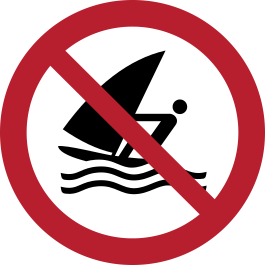
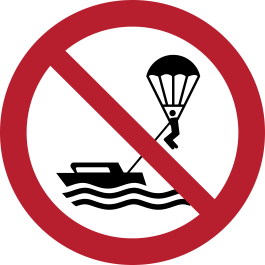
Confusion between the airborne water sports is common. P065 concerns a rider on a board pulling power from a free-flying kite; P054 covers sailboards, where the rig is fixed to the board; P066 covers parasailing, where a parachute canopy is towed aloft behind a boat. Each has a different failure mode — line sweep, hull strike, and cable or altitude hazards respectively — so authorities post whichever matches the local problem.
Wing foiling, where the rider holds an inflatable handheld wing, is newer than these registrations and is not squarely any of them. Sites that need to regulate wings currently rely on supplementary text or local rules rather than stretching P065, whose pictogram plainly depicts a line-flown kite.
Where you will see P065
Expect it on entry boards at lifeguarded resort beaches, near beachfront cafés and sun-lounger concessions occupying the downwind run, close to piers, groynes, and overhead cables that foul kite lines, and around harbor approaches where a kited rider would cross traffic unable to stop. Some nature reserves post it because a large moving kite disturbs roosting and nesting birds, and venues that zone rather than ban add a map of the riding area and launch corridor.
Common questions about P065
Why is kitesurfing banned on some beaches when windsurfing is allowed?
The kite is the difference. It flies far from the rider on tensioned lines, and a gust or mistake sends kite and rider downwind through whatever occupies the beach — swimmers, sunbathers, street furniture. A windsurf rig stays attached to the board. Beaches without a safe downwind buffer for launching and landing often prohibit kites while tolerating sailboards.
Does the no kitesurfing sign apply to launching a kite on the beach?
Yes, in practice. Launching and landing are the highest-risk phases of the sport and take place on the sand, so a P065 prohibition on a beach frontage covers flying the kite there, not just riding on the water. Where a council permits offshore riding, it will normally designate a specific launch corridor and show it on the sign.
How is the no kitesurfing sign different from the no parasailing sign?
P065 (kitesurfing) addresses a board rider powered by a traction kite they control themselves. P066 (parasailing) addresses passengers lifted under a canopy towed behind a boat. The sports look superficially similar from shore but have different operators, hazards, and regulations, so ISO 7010 registers them separately.
Is kitesurfing prohibited everywhere the sign is posted, all year?
Not necessarily. Many P065 installations are seasonal or zonal — banning the crowded bathing frontage in summer while a mapped launch corridor or offshore area stays open. Read the supplementary panel for dates and boundaries, and check whether a local kitesurfing association has an access agreement for that beach.
Reference details
| Symbol code | P065 |
|---|---|
| Sign family | ISO Prohibition Signs |
| Standard reference | ISO 7010:2019 / ISO 3864-1 ISO Online Browsing Platform: P065 |
| Screen color reference | #FF0000. Screen colors are not a production color specification. |
| Download formats | SVG reference artwork; a 1024 × 1024 pixel PNG conversion on a white canvas. |
| Record date | · How to interpret our dates |
| Page updated |
Choosing a physical sign size
Download dimensions are not installation dimensions. Select sign size, material, placement, and lighting using the applicable standard and the actual viewing conditions. Chemical label sizing follows its own rules. Read the artwork and sizing guide.
Sources and artwork credits
- Artwork source
- Wikimedia Commons file page
- Creator credited by source
- ISO
- License
- Public domain
- Source metadata checked
SVG files are local reference copies. PNG files are raster conversions. Check the linked file history and license terms before reuse; a source-metadata check is not certification of the artwork or a workplace installation.
Report a correction to this reference