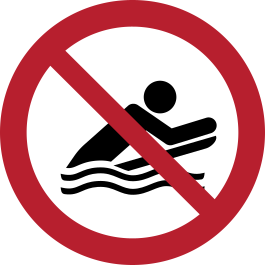
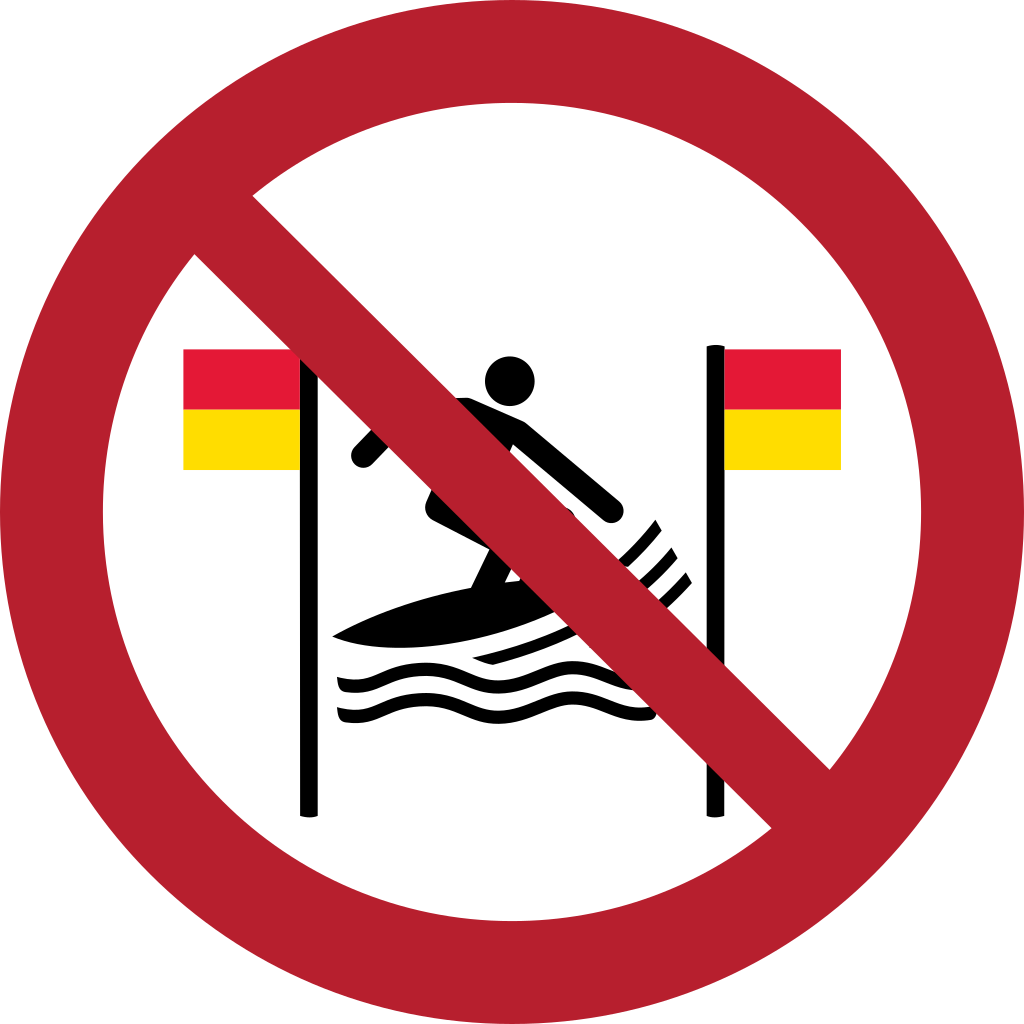
No surfing between the red-and-yellow flags
Surfing between the red-and-yellow flags is prohibited.
Understanding this sign
Red circular signs with a diagonal bar identify an action that must not be taken in the marked area.
Check what object or action the symbol prohibits. A prohibition sign does not identify all the hazards in an area.
What ISO 7010 P064 Prohibits
P064 keeps surf craft out of the flagged bathing zone. Its registered function is to prohibit people using surf craft in designated swimming areas — the stretch of water between the paired red-and-yellow flags that lifeguards set out to mark the patrolled bathing zone. The pictogram shows a surfer on a wave between two flags, cancelled by the red prohibition bar.
"Surf craft" is read broadly in lifeguard practice: surfboards above all, but the exclusion of ridden craft from the bathing zone typically extends to paddleboards, kayaks, surf skis, and similar hard equipment under local beach rules. The sign is unusual in the ISO catalogue because its scope is defined not by where the sign stands but by where the flags stand on any given day.
Understanding the Red-and-Yellow Flags
Red-and-yellow flags are the international lifeguard convention, standardized for beaches in ISO 20712-2, for the supervised bathing area: swim between the flags and you are inside the zone the lifeguards are actively watching, positioned over the safest water they have assessed that day. The flags move with tides, sandbanks, and rip locations, so the protected zone is dynamic.
That is exactly why boards must stay out of it. The flagged area concentrates the beach's swimmers — including children and weak swimmers who chose it for safety — into a compact box. P064 preserves that box as board-free water, with surfing pushed to the areas outside the flags, on many beaches marked separately for craft (in several countries with black-and-white quartered flags).
Why Surf Craft and Bathers Don't Mix
A surfboard on a wave is a fast, heavy object with a rider who has limited steering and a hard nose and fins leading the way. Among bathers it causes lacerations, concussions, and worse; even a loose board on its leash whips through the water with force. Lifeguards, meanwhile, must distinguish a swimmer in difficulty from splashing riders — mixing craft into the swim zone degrades the surveillance the flags exist to provide.
The separation serves surfers too. A board-riding zone free of swimmers means riders are not forced into constant evasive bailing, and a collision on a crowded inside section is the classic way a surfer loses their board into a crowd. Well-zoned beaches with visible P064 signage tend to see better voluntary compliance from both communities than beaches relying on lifeguard whistles alone.
Deploying P064 on a Patrolled Beach
Because the flagged zone moves, P064 lives at fixed decision points rather than at the zone boundary itself: beach entrances, board-hire kiosks, slipways, lifeguard stations, and promenade ramps where surfers commit to a route down the beach. The sign teaches the rule; the flags then define where it applies each day, and lifeguards enforce the boundary in real time.
P064 pairs naturally with a flag-explanation board — many beach visitors do not know what red-and-yellow flags mean — and with P063 where bodyboarding has its own fixed restrictions. On beaches with a designated craft area, signage should point surfers toward it: prohibitions that come with a sanctioned alternative are followed far more consistently.
Where you will see P064
Because the flagged zone moves with tides and rips, the sign lives at fixed decision points: beach entrances, board-hire kiosks, slipways, lifeguard stations, and promenade ramps where surfers commit to a route down the beach. It pairs with flag-explanation boards for visitors and with signage pointing riders toward the designated craft area, since prohibitions with a sanctioned alternative are followed more consistently.
Common questions about P064
What do red and yellow flags on a beach mean?
Paired red-and-yellow flags mark the lifeguard-patrolled bathing zone: the water between them has been assessed as the safest place to swim that day and is under active surveillance. The convention is standardized in ISO 20712-2 and used by lifeguard services worldwide. Swimmers should stay between the flags; surf craft must stay out of that zone, which is the rule ISO 7010 P064 communicates.
Can I surf outside the red and yellow flags?
Generally yes — the P064 prohibition applies to the flagged bathing zone, not the whole beach. Many patrolled beaches designate a separate craft area for boards, in some countries marked with black-and-white quartered flags, and local bylaws may add their own restrictions. Check the beach's zoning signage and ask the lifeguards; the flagged swim zone also moves during the day as conditions change.
Does P064 apply to paddleboards and kayaks or just surfboards?
The ISO function speaks of surf craft, and lifeguard services normally apply the bathing-zone exclusion to all ridden craft — surfboards, SUPs, kayaks, surf skis, and similar hard equipment — because the collision hazard to swimmers is the same. Soft bodyboards are sometimes tolerated between the flags at the lifeguards' discretion and are separately covered by P063 where they are banned; local beach rules are the final word.
Where should a no surfing between the flags sign be posted?
At fixed points where water users make their route decision: beach access ramps, car-park paths, surf-hire and surf-school locations, and lifeguard towers. Because the flags reposition with tide and conditions, the sign cannot mark the boundary itself; it states the standing rule, and the day's flags show where that rule currently applies.
Reference details
| Symbol code | P064 |
|---|---|
| Sign family | ISO Prohibition Signs |
| Standard reference | ISO 7010:2019 / ISO 3864-1 ISO Online Browsing Platform: P064 |
| Screen color reference | #FF0000. Screen colors are not a production color specification. |
| Download formats | SVG reference artwork; a 1024 × 1024 pixel PNG conversion on a white canvas. |
| Record date | · How to interpret our dates |
| Page updated |
Choosing a physical sign size
Download dimensions are not installation dimensions. Select sign size, material, placement, and lighting using the applicable standard and the actual viewing conditions. Chemical label sizing follows its own rules. Read the artwork and sizing guide.
Sources and artwork credits
- Artwork source
- Wikimedia Commons file page
- Creator credited by source
- ISO
- License
- Public domain
- Source metadata checked
SVG files are local reference copies. PNG files are raster conversions. Check the linked file history and license terms before reuse; a source-metadata check is not certification of the artwork or a workplace installation.
Report a correction to this reference