No body boarding
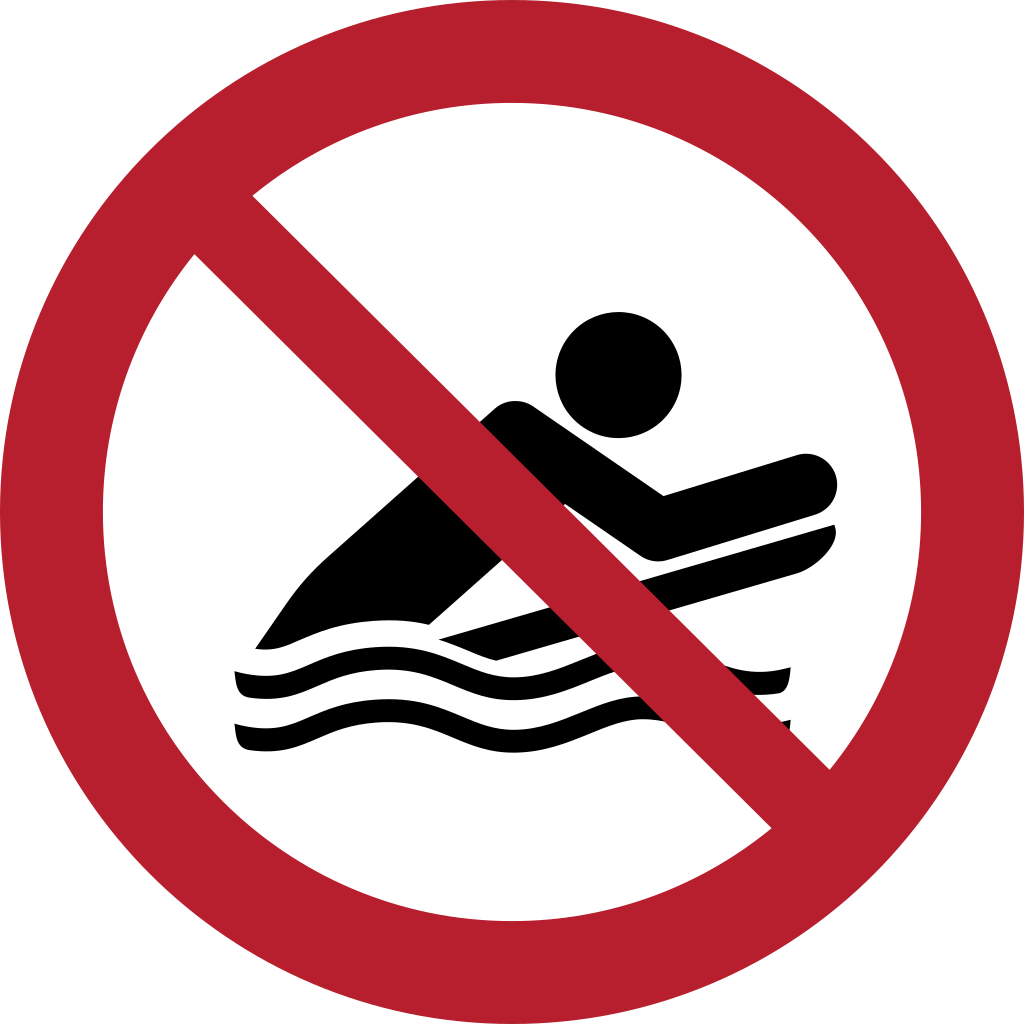
Body boarding is prohibited.
Understanding this sign
Red circular signs with a diagonal bar identify an action that must not be taken in the marked area.
Check what object or action the symbol prohibits. A prohibition sign does not identify all the hazards in an area.
What ISO 7010 P063 Prohibits
P063 bans body boarding — riding waves prone on a short foam board, also called boogie boarding. The pictogram shows a prone rider on a bodyboard beneath the crossed red circle, with the ISO register naming the function as prohibiting body boarding (or boogie boarding). It is a beach zoning sign: where it stands, the water is closed to bodyboards specifically, not necessarily to swimmers or to other activities.
The sign comes from the ISO 20712-1 water safety set developed for beach and coastal authorities, and it is nearly always deployed as one element of a zoning scheme rather than a blanket ban — telling bodyboarders which stretch of beach is theirs by marking where it is not, while flags and further signs allocate the remaining water between swimmers and other craft.
Why Beaches Restrict Bodyboarding
The main driver is separating riders from bathers. A bodyboarder catches a wave and travels fast, prone and low, straight toward shore through the zone where swimmers stand and children play; collisions injure both parties, and a crowded bathing area gives the rider nowhere to steer. Lifeguard services therefore assign wave-riding craft their own zones and exclude them from designated bathing water, with P063 marking the excluded stretch.
Conditions justify local bans too. Some beaches prohibit bodyboarding at heavy shore-break spots, where waves dump directly onto the sand and drive prone riders headfirst into the bottom — a recognized cause of serious neck and spinal injuries — or where rips run strongest. Because bodyboards attract inexperienced users on cheap foam boards, these condition-based restrictions protect precisely the people least able to judge the surf.
P063 in the Beach Zoning System
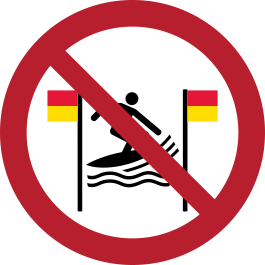
P063 works alongside P064, which keeps surf craft out of the red-and-yellow flagged bathing zone. The difference is scope and trigger: P064 is tied to the lifeguard flag system and covers surf craft in the flagged area, while P063 targets bodyboarding wherever the sign is posted, flags or not. A beach might ban bodyboards year-round off a rocky corner with P063, and exclude all boards from the flagged zone with P064 only during patrol hours.
For beach operators the practical companion measures matter as much as the sign: publish the zoning map at access points, move signage when the flagged zones move with the tide and sandbanks, and make sure the permitted bodyboarding area is actually signposted too — a prohibition with no visible alternative mostly gets ignored.
Where you will see P063
Lifeguard services deploy it to separate fast-moving prone riders from designated bathing areas where swimmers stand and children play, marking the excluded stretch while flags allocate the remaining water. Beaches also post it at heavy shore-break spots that drive riders headfirst into the sand and where rips run strongest, and operators pair it with zoning maps at access points, relocating signage as flagged zones move with tide and sandbanks and signposting the permitted bodyboarding area too.
Common questions about P063
What does a no bodyboarding sign mean at the beach?
It is ISO 7010 P063, which prohibits body boarding (boogie boarding) in the waters it marks. It usually reflects beach zoning — bodyboards are excluded from bathing areas and directed to a designated craft zone elsewhere on the beach — or a local hazard such as heavy shore break or strong rips. Swimming may still be permitted where P063 stands; check the flags and other posted signs.
Why would bodyboarding be banned but swimming allowed?
Because the risk being managed is the board and its speed, not presence in the water. A rider planing shoreward on a wave moves much faster than a swimmer and travels through the shallows where bathers stand, so lifeguards separate the two activities into different zones. On such beaches P063 protects the bathing area; bodyboarders use the section reserved for wave-riding craft.
What is the difference between P063 and P064?
P063 prohibits bodyboarding wherever the sign is posted, independent of any flag system. P064 prohibits surf craft between the red-and-yellow flags — the lifeguard-patrolled bathing zone — and so applies to a moving, flag-defined area during patrols. Beaches often need both: P064 for the patrolled swim zone and P063 for fixed locations where bodyboards are never appropriate.
Reference details
| Symbol code | P063 |
|---|---|
| Sign family | ISO Prohibition Signs |
| Standard reference | ISO 7010:2019 / ISO 3864-1 ISO Online Browsing Platform: P063 |
| Screen color reference | #FF0000. Screen colors are not a production color specification. |
| Download formats | SVG reference artwork; a 1024 × 1024 pixel PNG conversion on a white canvas. |
| Record date | · How to interpret our dates |
| Page updated |
Choosing a physical sign size
Download dimensions are not installation dimensions. Select sign size, material, placement, and lighting using the applicable standard and the actual viewing conditions. Chemical label sizing follows its own rules. Read the artwork and sizing guide.
Sources and artwork credits
- Artwork source
- Wikimedia Commons file page
- Creator credited by source
- ISO
- License
- Public domain
- Source metadata checked
SVG files are local reference copies. PNG files are raster conversions. Check the linked file history and license terms before reuse; a source-metadata check is not certification of the artwork or a workplace installation.
Report a correction to this reference