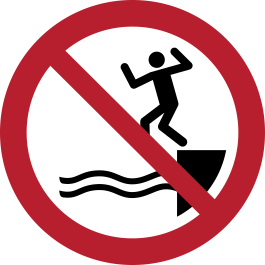
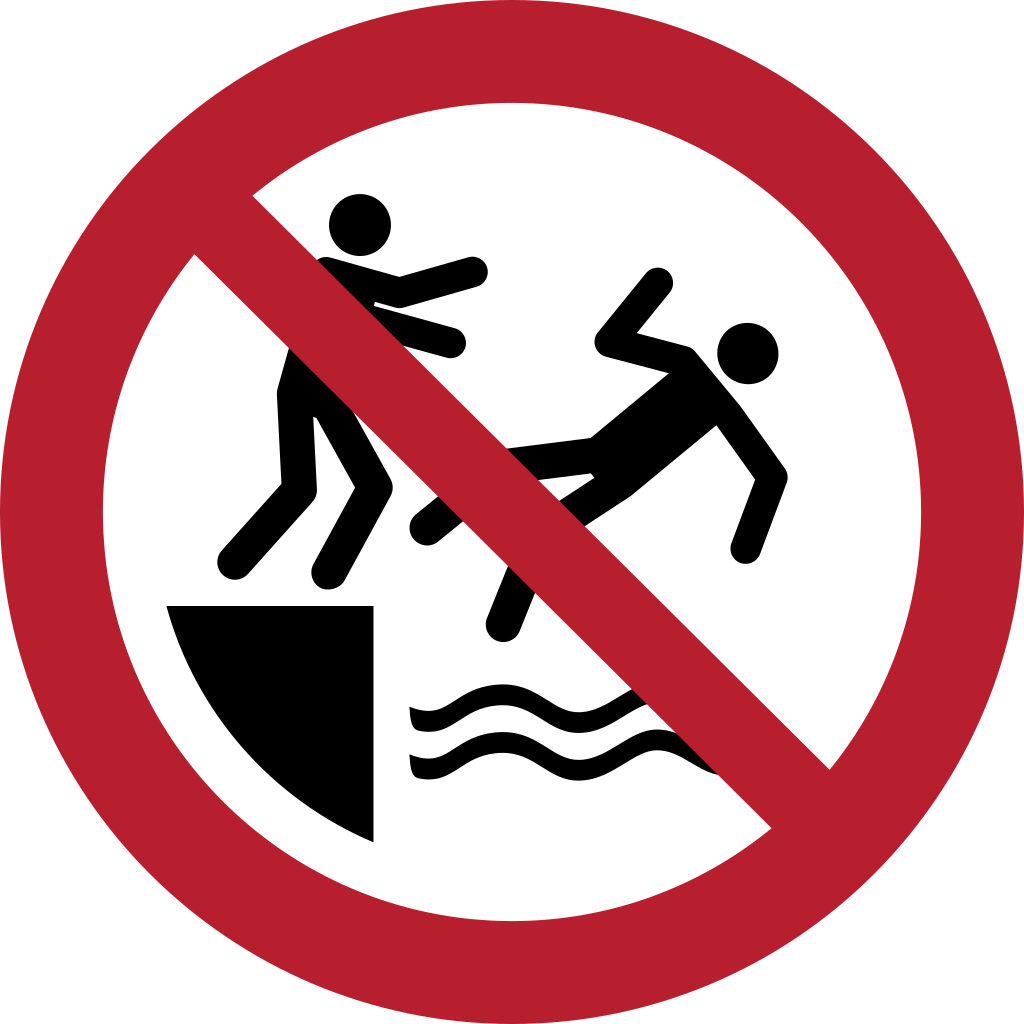
No pushing into water
Pushing people into the water is prohibited.
Understanding this sign
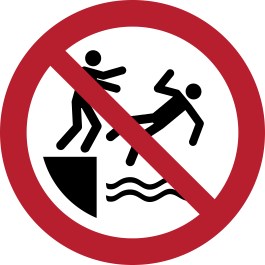
Red circular signs with a diagonal bar identify an action that must not be taken in the marked area.
Check what object or action the symbol prohibits. A prohibition sign does not identify all the hazards in an area.
What ISO 7010 P062 Means
P062 prohibits pushing people into the water. The pictogram shows one figure shoving another off an edge toward the waterline inside the red circle-and-bar, and the register describes its function as prohibiting pushing people into the water. It is the anti-horseplay sign of the aquatic series: where P052 and P061 govern how you may enter the water yourself, P062 forbids putting someone else in without their consent.
That distinction is the whole point. A person who jumps has at least chosen the moment, checked the landing, and taken a breath. A person who is pushed has done none of those things, which converts a prank at the pool edge into a genuinely dangerous event — and one the surrounding bathers and supervising staff had no chance to see coming either.
Why a Push Is Worse Than a Jump
The pushed person enters the water unprepared: mid-breath, possibly mid-sentence, facing the wrong way, sometimes fully clothed, and with no chance to protect their head. They may be a non-swimmer — the pusher rarely checks — and they cannot control their trajectory, so they strike the pool edge, ladder rails, shallow bottom, or other bathers on the way in. Inhaling water on an involuntary gasp is common, and in cold open water that gasp alone can start a drowning.
Lifeguards also lose their margin. Surveillance systems assume people enter the water at predictable points in predictable ways; a body arriving suddenly among bathers, possibly stunned or panicking, is exactly the incident that turns a routine session into a rescue. Prohibiting the push protects the victim, the surrounding swimmers, and the supervision model at once.
Where P062 Is Used
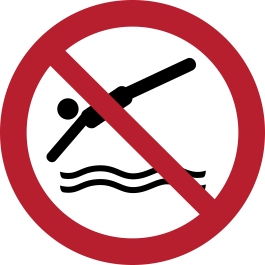
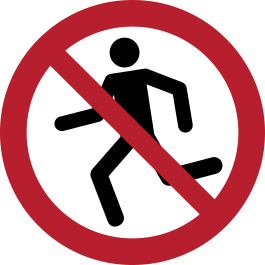
The sign belongs wherever crowds, edges, and water meet: municipal and hotel pool surrounds, jetties and pontoons at lakes and swim parks, harbour steps, school swimming facilities, and holiday resorts. It is usually mounted as part of a poolside rules cluster together with P048, P052, and P061 — the no-running, no-diving, and no-jumping pictograms — covering the standard set of behaviors lifeguards enforce.
For operators, P062 does quiet legal work as well as preventive work. Horseplay incidents often end in liability disputes, and a clearly posted, language-independent pictogram establishes that the behavior was expressly forbidden. Its ISO 20712-1 heritage means the same symbol reads identically to international guests who share no common language with the staff.
Where you will see P062
Municipal and hotel pool surrounds, jetties and pontoons at lakes and swim parks, harbour steps, school swimming facilities, and holiday resorts mount it wherever crowds, edges, and water meet. It typically joins a poolside rules cluster with P048, P052, and P061, and its language-independent pictogram also documents that the behavior was expressly forbidden if a horseplay incident ends in a liability dispute.
Common questions about P062
Is there really an official sign for not pushing people into the pool?
Yes. ISO 7010 registers P062, "no pushing into water", with the function of prohibiting pushing people into the water. It exists because push-in incidents are a recurring cause of poolside injuries and near-drownings, and facilities needed a standardized, wordless way to state the rule to visitors of any language.
Why is pushing someone into water dangerous if they can swim?
Because the danger is in the entry, not the swim. A pushed person cannot time their breath, protect their head, or choose where they land, so they risk striking the edge, the bottom, or other bathers, and inhaling water on the involuntary gasp of sudden immersion. In cold open water that gasp reflex can incapacitate even competent swimmers within seconds of going under.
What is the difference between the P061 and P062 signs?
P061 prohibits jumping into the water yourself; P062 prohibits pushing another person in. They address different actors — the willing jumper versus the prankster — and pools with an active horseplay problem typically display both, often alongside P048 (no running) and P052 (no diving) in a single rules panel.
Reference details
| Symbol code | P062 |
|---|---|
| Sign family | ISO Prohibition Signs |
| Standard reference | ISO 7010:2019 / ISO 3864-1 ISO Online Browsing Platform: P062 |
| Screen color reference | #FF0000. Screen colors are not a production color specification. |
| Download formats | SVG reference artwork; a 1024 × 1024 pixel PNG conversion on a white canvas. |
| Record date | · How to interpret our dates |
| Page updated |
Choosing a physical sign size
Download dimensions are not installation dimensions. Select sign size, material, placement, and lighting using the applicable standard and the actual viewing conditions. Chemical label sizing follows its own rules. Read the artwork and sizing guide.
Sources and artwork credits
- Artwork source
- Wikimedia Commons file page
- Creator credited by source
- ISO
- License
- Public domain
- Source metadata checked
SVG files are local reference copies. PNG files are raster conversions. Check the linked file history and license terms before reuse; a source-metadata check is not certification of the artwork or a workplace installation.
Report a correction to this reference