No outdoor footwear
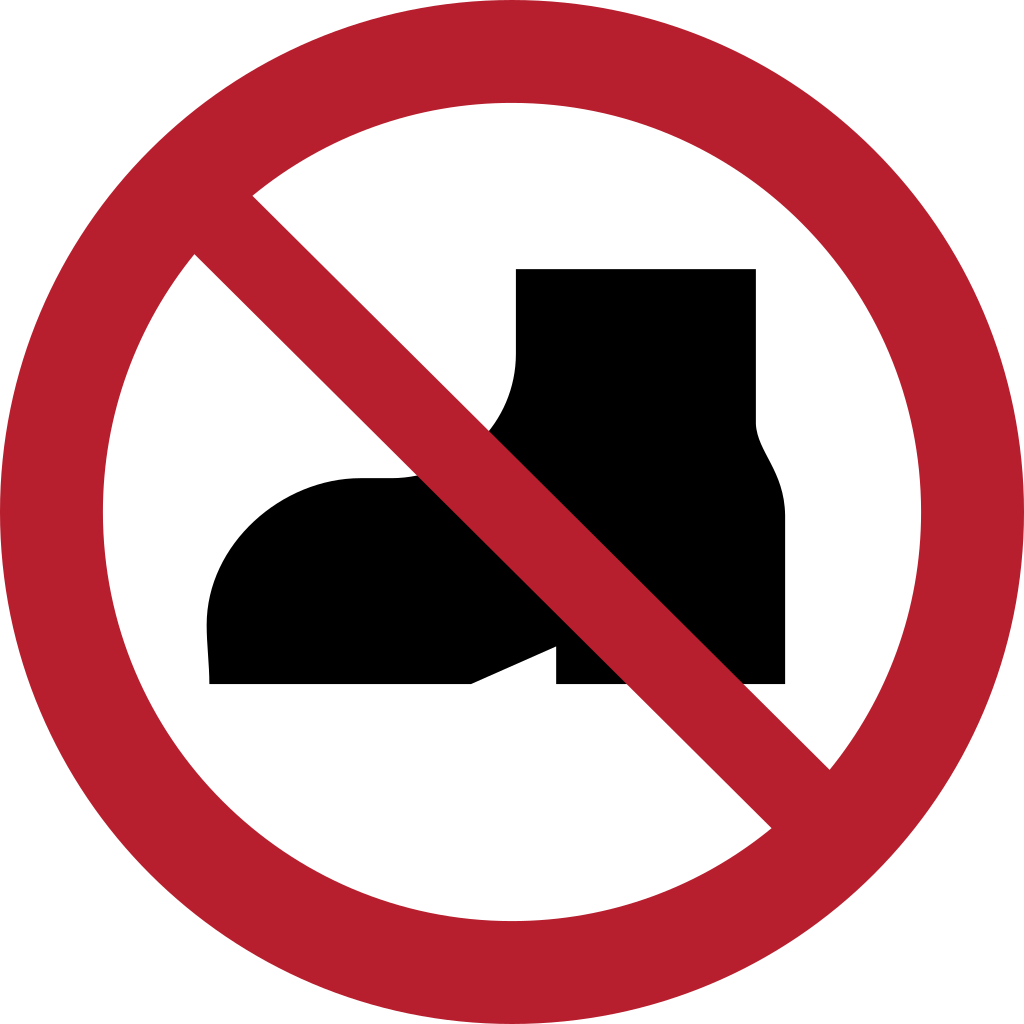
Outdoor footwear is prohibited beyond the marked point.
Understanding this sign
Red circular signs with a diagonal bar identify an action that must not be taken in the marked area.
Check what object or action the symbol prohibits. A prohibition sign does not identify all the hazards in an area.
What ISO 7010 P060 Means
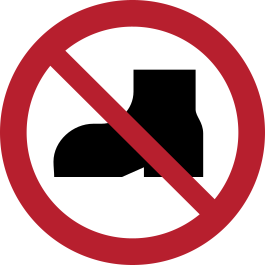
P060 prohibits wearing outdoor footwear beyond the point where it is displayed. The pictogram — a laced street shoe under the red prohibition circle and bar — marks a hygiene or cleanliness boundary: everything past the sign is a controlled floor zone that street soles would contaminate. The ISO register states the function plainly as prohibiting the wearing of outdoor footwear.
Unlike most prohibition signs, P060 is about what shoes carry rather than what people do. Outdoor soles transport grit, road grime, microorganisms, allergens, and chemical residues, and the sign designates the threshold where those contaminants must stop — whether the answer is bare feet, indoor shoes, overshoes, or dedicated cleanroom footwear depends on the facility.
Pools, Spas, and Changing Villages
Aquatic facilities are the sign's most visible home, which is why it sits within ISO 7010's water safety cluster. Pool surrounds operate as barefoot zones: street shoes track in dirt and pathogens that end up in the pool water and load the filtration and disinfection systems, and grit underfoot damages both tiles and bathers' bare feet. P060 at the changing-village exit defines where the barefoot zone begins.
Spas, saunas, and hydrotherapy suites apply the same boundary even more strictly because warm, humid floors favor microbial growth and users often have broken skin or reduced immunity. Facilities commonly reinforce the sign with a physical cue — a bench, a floor color change, or a shoe rack — since a threshold people must step over is obeyed far more reliably than a sign alone.
Cleanrooms, Food Plants, and Other Controlled Floors
Industry uses P060 wherever floor-borne contamination threatens the product or the environment. Electronics and pharmaceutical cleanrooms exclude street shoes at the gowning room; food production areas require captive footwear or overboots under hygiene management systems; hospitals apply it at operating suites and some intensive care or isolation areas. In each case the sign marks the start of the controlled zone where dedicated footwear becomes mandatory.
There are cultural and comfort-driven uses too: martial arts dojos and tatami-floored rooms, gyms with sprung or matted floors, and some laboratories and animal facilities that need bidirectional control — keeping outside contamination out and internal material in. Where the concern runs both ways, the sign usually appears on both faces of the boundary.
Making the Footwear Boundary Work
A P060 sign succeeds only when the transition is practical. Provide somewhere to sit, storage for the excluded shoes, and the replacement — overshoe dispensers, captive clogs, or a clean-side rack — immediately at the sign. Facilities that force people to carry street shoes through the clean zone to store them defeat their own control, so the storage must sit on the dirty side of the line.
Note that P060 is the opposite of a PPE instruction. M008, the mandatory safe-footwear sign, tells people to put protective shoes on; P060 tells them to take outdoor shoes off. Some environments need both messages at the same door — a food plant may ban street shoes and require hygienic safety boots — and posting the pair together makes the two-step rule explicit.
Where you will see P060
Aquatic facilities post it at the changing-village exit where the barefoot pool surround begins, and saunas, spas, and hydrotherapy suites apply the boundary even more strictly. Industry uses it at cleanroom gowning rooms in electronics and pharmaceutical plants, food production areas requiring captive footwear, and hospital operating suites, while dojos and matted gyms add cultural and floor-protection uses — always with seating, shoe storage, and the replacement footwear right at the line.
Common questions about P060
What does the crossed-out shoe safety sign mean?
It is ISO 7010 P060, which prohibits wearing outdoor footwear past that point. The area beyond it is a controlled floor zone — a pool barefoot area, a cleanroom, a food production hall, a mat-floored room — where street shoes would introduce dirt, microorganisms, or grit. What replaces them (bare feet, indoor shoes, or overshoes) is set by the facility, usually stated on supplementary text nearby.
Why are outdoor shoes banned around swimming pools?
Street soles carry soil, road contaminants, and fecal and fungal organisms picked up outdoors. On a pool surround these wash into the water, increasing the disinfection burden, and the grit abrades tiles and cuts bare feet. Defining a barefoot zone with P060 at the changing-room boundary keeps that contamination out of the pool hall at the source, which is cheaper and more effective than treating it in the water.
Is P060 the same as a sign requiring safety shoes?
No — it is closer to the reverse. P060 is a prohibition that removes outdoor footwear; M008 is a mandatory sign requiring protective footwear to be worn. They answer different questions and can validly appear side by side, for example at a food factory entrance where street shoes are forbidden and captive hygienic safety boots are compulsory.
Where exactly should a no outdoor footwear sign be mounted?
Precisely at the boundary where the rule takes effect, ideally combined with a physical transition: a bench, a step-over barrier, a floor color change, and shoe storage on the outdoor side with replacement footwear on the clean side. Signs posted deep inside the controlled zone, after people have already walked in, document the rule without enforcing it.
Reference details
| Symbol code | P060 |
|---|---|
| Sign family | ISO Prohibition Signs |
| Standard reference | ISO 7010:2019 / ISO 3864-1 ISO Online Browsing Platform: P060 |
| Screen color reference | #FF0000. Screen colors are not a production color specification. |
| Download formats | SVG reference artwork; a 1024 × 1024 pixel PNG conversion on a white canvas. |
| Record date | · How to interpret our dates |
| Page updated |
Choosing a physical sign size
Download dimensions are not installation dimensions. Select sign size, material, placement, and lighting using the applicable standard and the actual viewing conditions. Chemical label sizing follows its own rules. Read the artwork and sizing guide.
Sources and artwork credits
- Artwork source
- Wikimedia Commons file page
- Creator credited by source
- ISO
- License
- Public domain
- Source metadata checked
SVG files are local reference copies. PNG files are raster conversions. Check the linked file history and license terms before reuse; a source-metadata check is not certification of the artwork or a workplace installation.
Report a correction to this reference