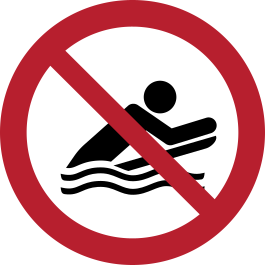
No surf craft
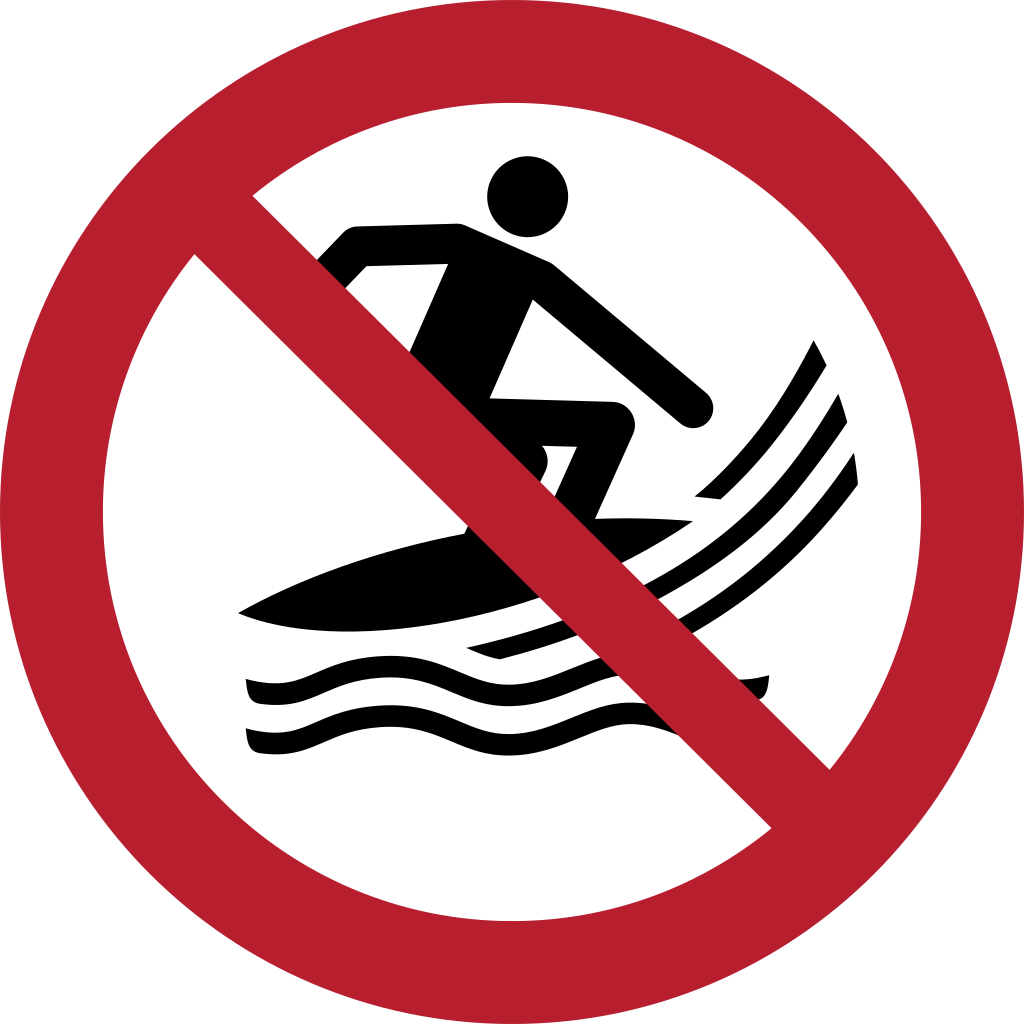
Surf craft are prohibited.
Understanding this sign
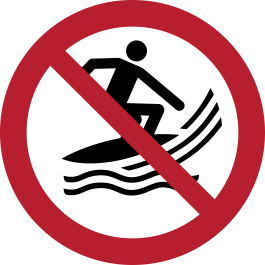
Red circular signs with a diagonal bar identify an action that must not be taken in the marked area.
Check what object or action the symbol prohibits. A prohibition sign does not identify all the hazards in an area.
Meaning and Scope of ISO 7010 P059
P059 prohibits the use of surf craft — the ISO register cites surfboards, surf skis, and surf kayaks as examples. The common thread is a rigid ridden craft used in breaking waves: hard boards with fins, paddled skis, and wave-riding kayaks all qualify. Displayed in the standard red prohibition format, the sign tells beach users that this stretch of surf is closed to board and paddle wave craft.
Soft bodyboards are deliberately outside this reference. ISO 7010 registers a separate sign, P063, for bodyboarding, reflecting lifeguard practice of treating soft foam boards ridden prone as compatible with bathing areas where hard-finned surfboards are not. A beach intending to exclude both must therefore post both symbols; P059 on its own leaves bodyboarding formally permitted.
Why Surf Zones Are Closed to Boards
The dominant hazard is impact. A surfboard is a heavy, pointed object with sharp fins, moving at wave speed, and a lost board travels the length of its leash — or the full width of the surf zone if the leash snaps — through water where bathers stand chest-deep and cannot dodge. Head lacerations and fin cuts from runaway boards are a staple of lifeguard incident logs, which is why supervised bathing water is routinely closed to surf craft while remaining open to swimmers.
Flag-based beach management formalizes this separation in much of the world: one flag combination marks water for swimmers, another marks the surf craft area, and P059 signage fixes the rule at access points when flags are down or misread. Some sites also invoke the sign for non-safety reasons, such as protecting a crowded shorebreak on small summer days or closing a hazardous reef break to visiting surfers.
P059 Among the Board and Paddle Signs
The neighboring references carve up the board sports precisely. Bodyboards belong to P063; paddled flat-water craft, including SUPs used off the waves, belong to P055 as manually powered craft; sailboards and kiteboards answer to P054 and P065 because wind, not waves, drives them. A surf ski or surf kayak sits under P059 when used in the break, illustrating that the activity and environment, not just the hull, determine the correct sign.
For beach operators the practical rule is to map each activity actually occurring on the beach to its registered symbol and post the set together on the entry board. Surfers who see their specific craft depicted comply far better than when asked to infer a ban from a generic no-boating sign that plainly depicts something else.
Placement on a Working Beach
Post P059 at every path onto the sand, at surf-school assembly points, and beside the flagpoles that mark the bathing area, since the boundary between swim and surf zones is where conflicts happen. Where the restriction is seasonal or applies only between certain flags, the supplementary panel should say so plainly; an apparently absolute sign that locals visibly ignore in winter teaches visitors to ignore it in summer too.
On beaches with shifting sandbanks the zoning moves with the banks, so authorities often keep P059 boards mobile, repositioning them alongside the day's flags. Fixing the symbols to a permanent promenade sign while the actual zones migrate hundreds of meters along the beach is a common and avoidable failure.
Where you will see P059
Lifeguarded beaches post it at every path onto the sand, at surf-school assembly points, and beside the flagpoles that separate swim and surf zones, since a runaway board with sharp fins travels through water where bathers stand chest-deep. Where sandbanks shift the zoning, authorities keep the boards mobile and reposition them with the day's flags, and seasonal or flag-conditional restrictions carry supplementary panels saying so plainly.
Common questions about P059
Does a no surf craft sign include bodyboards?
No. ISO 7010 assigns bodyboarding its own prohibition sign, P063. P059 covers hard surf craft — surfboards, surf skis, and surf kayaks. Beaches that want to exclude soft bodyboards as well as boards must display both references, and many bathing beaches deliberately allow bodyboarding where surfboards are banned.
Can I use a stand-up paddleboard where P059 is posted?
In breaking waves, no — a SUP surfed in the break is being used as a surf craft. On flat water a paddled SUP is classed as a manually powered craft under P055 instead, so whether it is allowed depends on which signs the site displays and how local byelaws define the zones.
Why are surfboards banned in swimming areas?
A hard board with fins traveling at wave speed can cause serious injury to a swimmer, and a board lost in a wipeout sweeps the radius of its leash through crowded shallows. Separating board riders from bathers, by flags and by P059 signage, is standard lifeguard practice at supervised beaches.
Is the no surf craft sign permanent or seasonal?
It depends on the beach. Some prohibitions apply year-round, for example over hazardous reefs, but many operate only during the lifeguarded season or within the flagged bathing area of the day. Check the supplementary text panel and the current flag arrangement — the sign's scope should be defined there.
Reference details
| Symbol code | P059 |
|---|---|
| Sign family | ISO Prohibition Signs |
| Standard reference | ISO 7010:2019 / ISO 3864-1 ISO Online Browsing Platform: P059 |
| Screen color reference | #FF0000. Screen colors are not a production color specification. |
| Download formats | SVG reference artwork; a 1024 × 1024 pixel PNG conversion on a white canvas. |
| Record date | · How to interpret our dates |
| Page updated |
Choosing a physical sign size
Download dimensions are not installation dimensions. Select sign size, material, placement, and lighting using the applicable standard and the actual viewing conditions. Chemical label sizing follows its own rules. Read the artwork and sizing guide.
Sources and artwork credits
- Artwork source
- Wikimedia Commons file page
- Creator credited by source
- ISO
- License
- Public domain
- Source metadata checked
SVG files are local reference copies. PNG files are raster conversions. Check the linked file history and license terms before reuse; a source-metadata check is not certification of the artwork or a workplace installation.
Report a correction to this reference