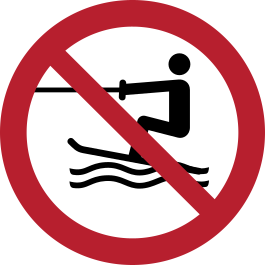
No personal water craft
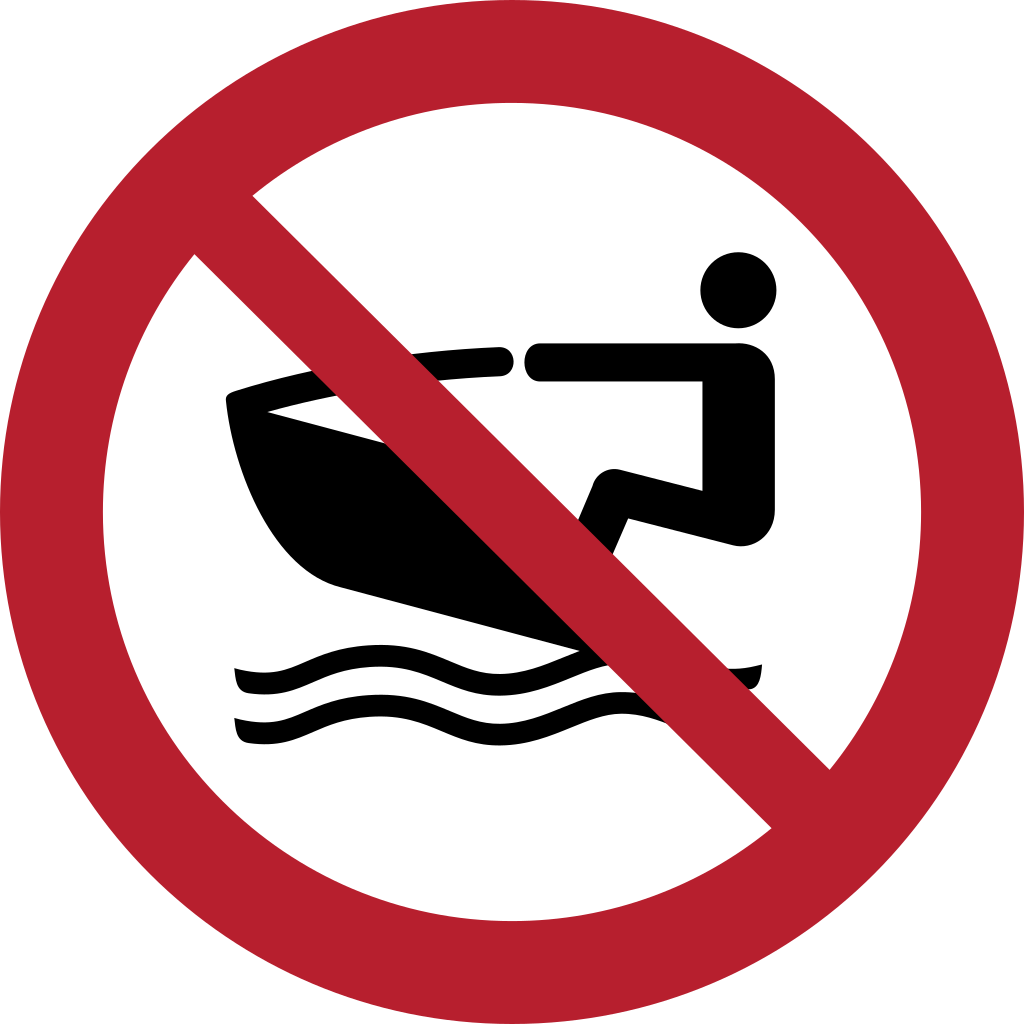
Personal watercraft are prohibited.
Understanding this sign
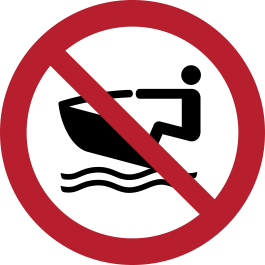
Red circular signs with a diagonal bar identify an action that must not be taken in the marked area.
Check what object or action the symbol prohibits. A prohibition sign does not identify all the hazards in an area.
What ISO 7010 P057 Covers
P057 prohibits personal water craft — the ride-on, jet-propelled machines commonly called jet skis, including sit-down runabouts and stand-up models. The ISO register gives jet-ski use as the example activity. A PWC is defined by how it is ridden as much as how it is powered: the operator sits, stands, or kneels on the hull rather than inside it, and thrust comes from a water jet instead of an exposed propeller.
The reference exists separately from P056 because PWC are treated as a distinct class almost everywhere they operate. Many jurisdictions impose PWC-specific rules — minimum operator ages, licensing, kill-cord requirements, dedicated launch sites — so a symbol that names the craft type directly is more enforceable than expecting riders to read themselves into a general motorboat ban.
Why PWC Attract Targeted Restrictions
The conflict profile of a jet ski differs from that of an ordinary motorboat. PWC accelerate violently, turn inside their own length, and are frequently ridden for the maneuvering itself — wave jumping, tight circles, sprints along the shore — which keeps them close to beaches where swimmers concentrate. Their high-pitched engine note carries across water and generates more complaints per craft than most other vessels, pushing councils toward exclusion zones even where cruising motorboats remain welcome.
There is also a control subtlety: most PWC lose steering when the rider releases the throttle, because the jet provides both thrust and directional authority. An inexperienced rider who backs off to avoid a swimmer may keep traveling straight at them. That characteristic, combined with rental operations putting first-time riders on powerful machines, explains why bathing beaches and crowded anchorages so often carry P057 in addition to, or instead of, broader craft prohibitions.
Where the Sign Is Posted
P057 appears at flagged swimming beaches, harbor and marina entrances, mooring fields, nature reserves sensitive to noise and wash, and inland lakes whose byelaws exclude PWC entirely. Resort coastlines often zone rather than ban: riding is confined to an offshore area reached through a marked access lane, and P057 defines the inshore strip where machines must not operate or must only transit at dead-slow speed as local rules dictate.
Slipway and launch-ramp signage matters more for this craft class than most, since PWC arrive by trailer and enter the water at a handful of predictable points. Posting P057 with a zone map at the ramp reaches riders before they are afloat, when a shoreline sign would be unreadable from a machine moving at speed.
P057 Versus Other Craft Prohibitions
If a site's problem is powered vessels generally, P056 is the broader tool; P057 exists for the many locations where jet skis are singled out while other boats are tolerated. The two are complementary, and beach authorities that intend to exclude both frequently display them side by side to preempt the argument that a PWC is not a boat.
Note that a PWC towing an inflatable ring or a wakeboarder additionally engages P058, the towed water activity prohibition. A rider inside a P058 zone may be permitted to ride but not to tow — a distinction that catches out rental operators, and one reason composite signboards spelling out each rule outperform single symbols on busy waterfronts.
Where you will see P057
Flagged swimming beaches, harbor and marina entrances, mooring fields, nature reserves sensitive to noise and wash, and inland lakes with exclusion byelaws are the standard postings. Resort coastlines use it to define the inshore strip where machines must not operate or may only transit dead-slow to an offshore riding zone, and slipway signage matters most of all, since PWC arrive by trailer and a zone map at the launch ramp reaches riders before they are afloat.
Common questions about P057
Is a no personal water craft sign the same as a no jet ski sign?
Effectively yes. Personal water craft is the formal term for jet skis and similar ride-on, jet-propelled machines, and jet-ski use is the example given in the ISO register for P057. The sign covers sit-down and stand-up models alike, regardless of brand.
Why do beaches ban jet skis but allow motorboats?
Jet skis are typically ridden close to shore for maneuvering and jumping, accelerate and turn far more aggressively than displacement boats, lose steering when the throttle is released, and produce a noise signature that generates complaints. Many jurisdictions also have PWC-specific age, licence, or zoning rules, so authorities restrict them separately from general boat traffic.
Does P057 stop a jet ski from towing an inflatable?
P057 stops the jet ski from operating in the zone at all, which necessarily prevents towing there. On water where PWC are allowed but towing is not, the applicable sign is P058, the towed water activity prohibition — so check which of the two symbols is actually posted.
Where should a no PWC sign be placed?
At launch ramps and slipways where riders put machines in the water, at beach access points along the restricted frontage, and on buoys or boards marking the zone boundary offshore. Because a rider at speed cannot read shore signage, ramp-side maps showing the exclusion area are the most effective single placement.
Reference details
| Symbol code | P057 |
|---|---|
| Sign family | ISO Prohibition Signs |
| Standard reference | ISO 7010:2019 / ISO 3864-1 ISO Online Browsing Platform: P057 |
| Screen color reference | #FF0000. Screen colors are not a production color specification. |
| Download formats | SVG reference artwork; a 1024 × 1024 pixel PNG conversion on a white canvas. |
| Record date | · How to interpret our dates |
| Page updated |
Choosing a physical sign size
Download dimensions are not installation dimensions. Select sign size, material, placement, and lighting using the applicable standard and the actual viewing conditions. Chemical label sizing follows its own rules. Read the artwork and sizing guide.
Sources and artwork credits
- Artwork source
- Wikimedia Commons file page
- Creator credited by source
- ISO
- License
- Public domain
- Source metadata checked
SVG files are local reference copies. PNG files are raster conversions. Check the linked file history and license terms before reuse; a source-metadata check is not certification of the artwork or a workplace installation.
Report a correction to this reference