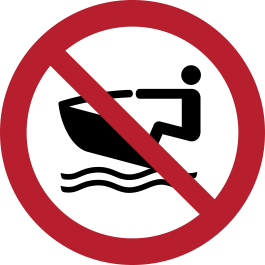
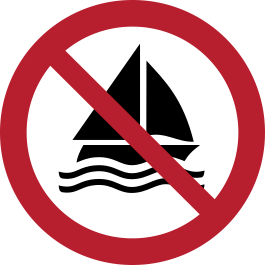
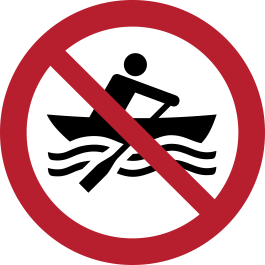
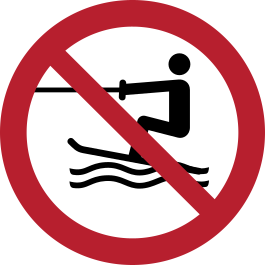
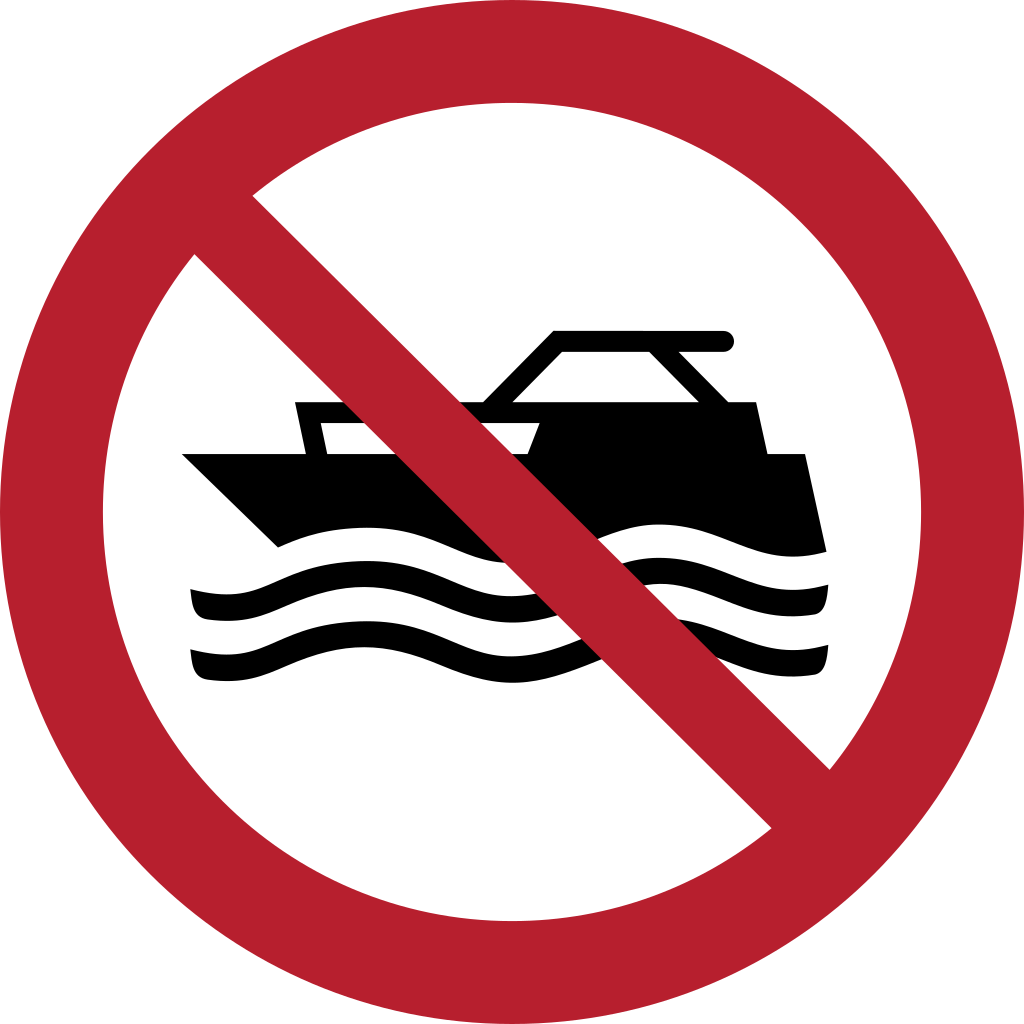
No mechanically powered craft
Mechanically powered craft are prohibited.
Understanding this sign
Red circular signs with a diagonal bar identify an action that must not be taken in the marked area.
Check what object or action the symbol prohibits. A prohibition sign does not identify all the hazards in an area.
Scope of ISO 7010 P056
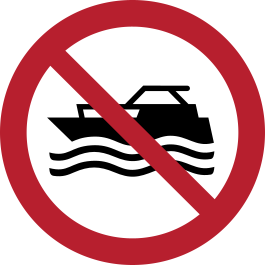
P056 prohibits mechanically powered craft — vessels driven by an engine or motor of any kind. Petrol outboards, inboard diesels, electric drives, and jet propulsion all qualify; the fuel and drive type are irrelevant, since the test is that machinery rather than wind or muscle moves the boat. The pictogram shows a motorboat under the red prohibition ring, and the reference sits in the water safety group of ISO 7010:2019 alongside its ISO 20712-1 origins.
P056 is the broadest of the craft prohibitions and overlaps deliberately with P057. A jet ski is mechanically powered, so P056 alone technically excludes it, but because personal water craft raise distinct enforcement issues many authorities post P057 as well to remove any argument. Sailing boats and rowed or paddled craft are outside P056 entirely and answer to P053 and P055.
The Hazards Behind the Ban
Propeller strike is the injury that drives most motor-craft exclusions near swimmers. A person in the water is nearly invisible from the helm of a planing boat, and the closing speeds involved leave neither party time to react. Engine noise also masks shouted warnings, and a swimmer cannot hear direction well underwater, so separation by zoning — motor traffic outside the buoy line, bathers inside — is the standard control at supervised beaches and lake swim areas.
Away from bathers, wake and wash justify the sign. Moored fleets, floating docks, canal banks, and nesting or spawning habitat all suffer from repeated boat wake, and anglers and paddlers get swamped by it. Reservoirs and small lakes add a third rationale: fuel and oil residues from combustion engines are unwelcome in drinking-water storage, which is why some sites ban petrol engines while tolerating electric ones under a locally worded variant of the rule.
Typical Locations and Local Rules
You will meet P056 at buoyed bathing zones, marina fairways reserved for berth-holders, environmentally protected backwaters, rowing and canoe race courses during events, and reservoirs closed to powered navigation. Inland waterway authorities also use it at weir streams and flood channels where an engine failure would carry the vessel into a hydraulic hazard.
The prohibition frequently coexists with speed and wake regimes rather than replacing them: a lake may allow motor craft in a central zone under a speed limit while posting P056 across swimming bays and shallows. Because such schemes are creatures of local byelaw, the ISO symbol is usually accompanied by text panels giving the zone boundaries, permitted hours, or exemptions for rescue and patrol vessels.
Choosing Between P056 and Its Neighbors
Use P056 when engine-driven vessels as a class are the problem. If the issue is specifically jet skis and similar ride-on craft, P057 targets them precisely; if it is boats towing skiers or inflatables, P058 addresses the towing activity without banning powered navigation as such. These finer-grained signs let a site prohibit the troublesome behavior while keeping the water open to ordinary motor cruising.
Rescue boats, harbor patrol, and maintenance workboats normally operate inside P056 zones under an explicit exemption in the byelaw or site rules — the sign governs the public, not the authority that posted it. Facilities should state such exemptions on the supplementary panel so that visitors seeing a lifeguard launch inside the zone do not conclude the sign is unenforced.
Where you will see P056
Buoyed bathing zones, marina fairways reserved for berth-holders, environmentally protected backwaters, rowing and canoe race courses during events, and reservoirs closed to powered navigation all display it. Inland waterway authorities also post it at weir streams and flood channels where an engine failure would carry a vessel into a hydraulic hazard, typically with text panels stating zone boundaries and rescue-craft exemptions.
Common questions about P056
Does the no mechanically powered craft sign include electric boats?
Yes. Any craft propelled by a motor is mechanically powered, whether the engine burns petrol or diesel or runs on batteries. Some sites choose to permit electric propulsion for environmental reasons, but that is a local exception that must be stated in text — the P056 symbol itself covers all engine types.
Are jet skis covered by P056 or do they need a separate sign?
A jet ski is a mechanically powered craft, so P056 does cover it. However, ISO 7010 also registers P057 specifically for personal water craft, and many authorities post both because PWC riders and PWC-specific regulations are common enough to warrant an unambiguous, dedicated symbol.
Why are motorboats banned near swimming areas?
Mainly propeller and hull strike risk — swimmers are extremely hard to see from a moving boat — plus engine noise masking warnings and wake creating difficulty for weak swimmers. Zoning that keeps powered craft outside a buoyed bathing area is the standard control at beaches and inland swim sites.
Can a lake ban motor craft but still allow sailing and kayaking?
Yes, and this is common. P056 restricts only engine-driven vessels. Sailing craft would need P053 and human-powered craft P055 to be excluded, so a water body posting P056 alone remains open to those activities unless other signs or byelaws say otherwise.
Reference details
| Symbol code | P056 |
|---|---|
| Sign family | ISO Prohibition Signs |
| Standard reference | ISO 7010:2019 / ISO 3864-1 ISO Online Browsing Platform: P056 |
| Screen color reference | #FF0000. Screen colors are not a production color specification. |
| Download formats | SVG reference artwork; a 1024 × 1024 pixel PNG conversion on a white canvas. |
| Record date | · How to interpret our dates |
| Page updated |
Choosing a physical sign size
Download dimensions are not installation dimensions. Select sign size, material, placement, and lighting using the applicable standard and the actual viewing conditions. Chemical label sizing follows its own rules. Read the artwork and sizing guide.
Sources and artwork credits
- Artwork source
- Wikimedia Commons file page
- Creator credited by source
- ISO
- License
- Public domain
- Source metadata checked
SVG files are local reference copies. PNG files are raster conversions. Check the linked file history and license terms before reuse; a source-metadata check is not certification of the artwork or a workplace installation.
Report a correction to this reference