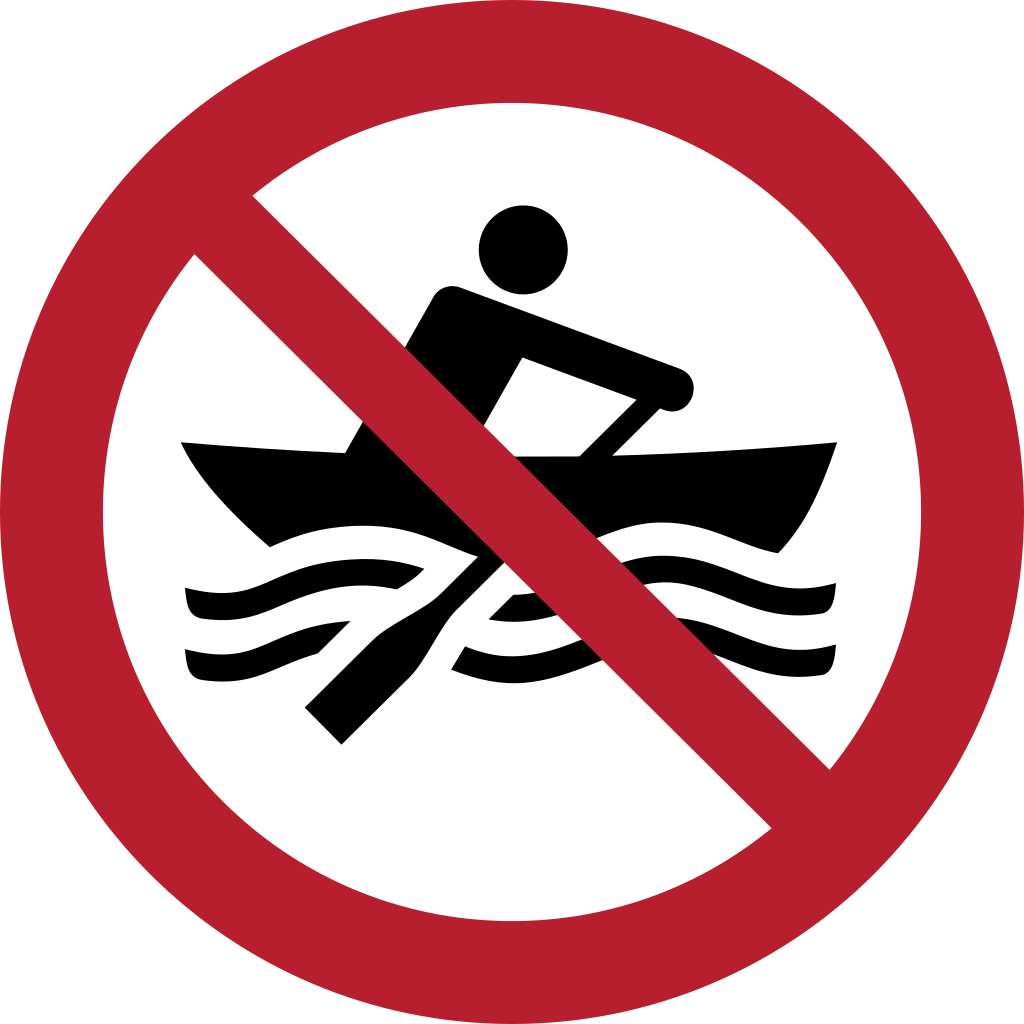
No manually powered craft
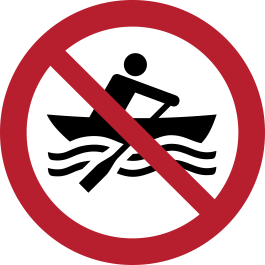
Manually powered craft are prohibited.
Understanding this sign
Red circular signs with a diagonal bar identify an action that must not be taken in the marked area.
Check what object or action the symbol prohibits. A prohibition sign does not identify all the hazards in an area.
What Counts as a Manually Powered Craft
ISO 7010 P055 prohibits craft moved by human effort: rowing boats, sculls, kayaks, canoes, punts, pedalos, and by extension stand-up paddleboards. The ISO register describes its function as prohibiting rowing, sculling, paddling, punting, and pedalo use. The defining test is the power source — muscle, applied through oars, paddles, poles, or pedals — regardless of whether the vessel is a racing shell or an inflatable dinghy with a set of oars.
This makes P055 the human-power counterpart to P056, which addresses engine-driven vessels. The two often appear together where a water body is closed to all boating, but each also stands alone: a quiet fishing lake may exclude paddlers while permitting the warden's outboard, and conversely a canoe trail can run through water closed to motor traffic.
Where and Why Paddled Craft Are Excluded
Drinking-water reservoirs are a classic P055 location: operators restrict small craft to protect water quality and because steep banks, cold water, and draw-off currents make capsizes unusually dangerous. Weir pools, dam faces, lock approaches, and spillway channels are also routinely closed to paddlers, since a kayak caught in a towback or drawn toward an intake has little chance of powering clear.
In busy navigations the concern reverses — the paddler becomes the hazard exposure. Canoes and rowing boats sit low, show up poorly on radar, and cross channels slowly, so port and canal authorities exclude them from ferry lanes, ship turning areas, and tunnel or lock cuts. At bathing beaches the sign keeps hard-hulled craft, and their bow speed, out of the water where swimmers cannot easily be seen from deck level.
Reading P055 Alongside Its Siblings
Boundary cases cause most of the confusion around this sign. A paddled SUP is manually powered; the same board ridden on a wave becomes surf craft territory under P059. A kayak with a clip-on electric trolling motor stops being manually powered and falls under P056. Pedal-drive fishing kayaks remain within P055 because the pedals transmit human effort, exactly like a pedalo.
Swimmers are outside the scope entirely — prohibiting boats says nothing about bathing, which has its own reference in the water safety series. Site managers who intend to close water to every activity should not stretch P055 to imply that; the honest approach is to post each applicable prohibition, or a general access restriction, so that visitors and enforcement officers read the signs the same way.
Practical Posting Guidance
Position P055 where paddlers can act on it: at slipways, portage points, canoe launch steps, and the upstream and downstream approaches to the closed reach. River users travel through a site rather than arriving at a gate, so a restriction on a weir pool needs signage visible from the water in both directions, at a distance that leaves room to egress before the hazard.
Because inflatable kayaks and paddleboards arrive in car boots rather than on trailers, car-park and beach-access signage catches users that slipway signs miss. Pairing the pictogram with a short text panel naming the covered craft — rowing boats, canoes, kayaks, paddleboards, pedalos — removes the ambiguity that a silhouette of a single rower leaves open.
Where you will see P055
Drinking-water reservoirs restrict paddled craft to protect quality and because cold water and draw-off currents make capsizes unusually dangerous, while weir pools, dam faces, and lock approaches are closed because a kayak caught in a towback cannot power clear. Port and canal authorities also exclude low-sitting paddlers from ferry lanes and ship turning areas, posting the sign at slipways, portage points, and both approaches to the closed reach.
Common questions about P055
Does the no manually powered craft sign cover paddleboards and kayaks?
Yes. P055 covers any craft driven by human power, which includes kayaks, canoes, rowing boats, punts, pedalos, and stand-up paddleboards used with a paddle. The ISO register's examples are rowing, sculling, paddling, punting, and pedalo use.
What about a kayak fitted with an electric motor?
Once a motor provides the propulsion, the craft is mechanically powered and falls under P056 rather than P055. Pedal-drive kayaks, by contrast, stay within P055 because the pedals are still transmitting human effort. On water where both signs are posted the distinction makes no practical difference.
Why do reservoirs ban canoes and rowing boats?
Two main reasons: protecting drinking-water quality, and the danger profile of the water itself — cold deep water, steep engineered banks with few egress points, and currents near draw-off towers and spillways that can trap a small craft. Some reservoirs license paddling through a club or permit scheme while posting P055 across the rest of the shoreline.
Does P055 mean swimming is banned too?
No. P055 addresses craft only. Swimming is a separate activity with its own prohibition reference in the ISO water safety signs, so a site that wants to exclude both must display both symbols. Never assume one prohibition implies another.
Reference details
| Symbol code | P055 |
|---|---|
| Sign family | ISO Prohibition Signs |
| Standard reference | ISO 7010:2019 / ISO 3864-1 ISO Online Browsing Platform: P055 |
| Screen color reference | #FF0000. Screen colors are not a production color specification. |
| Download formats | SVG reference artwork; a 1024 × 1024 pixel PNG conversion on a white canvas. |
| Record date | · How to interpret our dates |
| Page updated |
Choosing a physical sign size
Download dimensions are not installation dimensions. Select sign size, material, placement, and lighting using the applicable standard and the actual viewing conditions. Chemical label sizing follows its own rules. Read the artwork and sizing guide.
Sources and artwork credits
- Artwork source
- Wikimedia Commons file page
- Creator credited by source
- ISO
- License
- Public domain
- Source metadata checked
SVG files are local reference copies. PNG files are raster conversions. Check the linked file history and license terms before reuse; a source-metadata check is not certification of the artwork or a workplace installation.
Report a correction to this reference