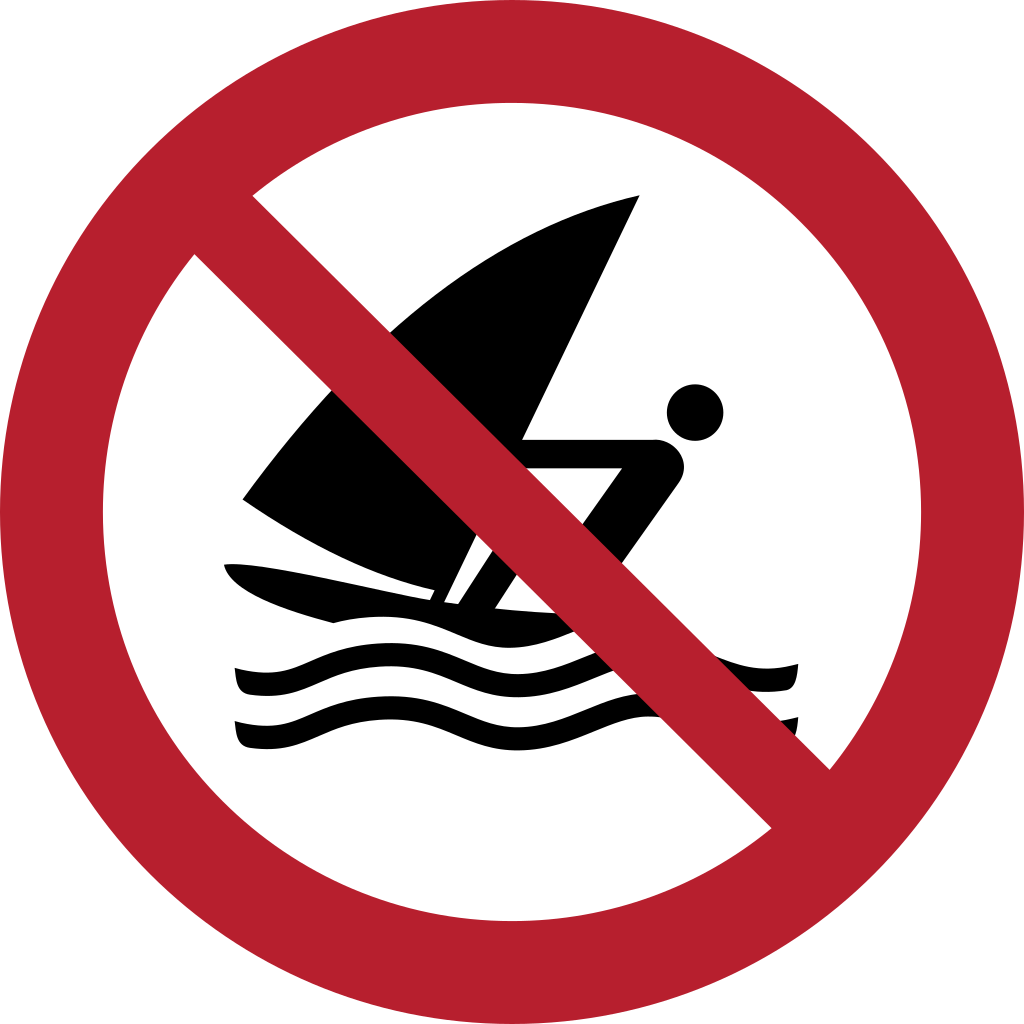
No windsurfing
Windsurfing is prohibited.
Understanding this sign
Red circular signs with a diagonal bar identify an action that must not be taken in the marked area.
Check what object or action the symbol prohibits. A prohibition sign does not identify all the hazards in an area.
Meaning of ISO 7010 P054
P054 forbids windsurfing — riding a board propelled by a sail rig that the rider holds and pivots on a universal joint. The pictogram shows a sailboard and rider crossed out in the familiar red ring-and-slash format. The reference belongs to the water safety group that ISO 7010:2019 absorbed from ISO 20712-1, so it is drawn to be understood by international beach visitors without any accompanying text.
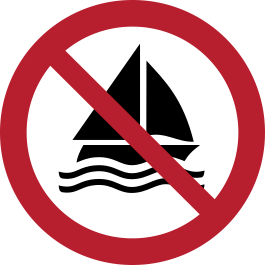
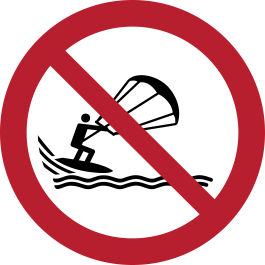
The scope is the sailboard itself, not wind sports generally. A hulled dinghy is a sailing craft under P053, and a rider pulled by a traction kite on flying lines is covered by P065. This precision exists because the three activities behave differently on the water: a windsurfer occupies a compact footprint and moves fast in gusts, whereas a kite sweeps a large arc of airspace and a dinghy is slower but far heavier.
Why Sailboards Get Their Own Ban
Windsurfers accelerate sharply, plane at speeds that leave little reaction time, and fall frequently while learning — a combination that mixes badly with swimmers. Unlike a boat, a sailboard cannot hold station: when the rider drops the rig the board drifts, and an uphauling beginner can be blown sideways through a bathing zone. Lifeguard services therefore commonly exclude sailboards from flagged swim areas even where other craft operate nearby under different rules.
Shore conflict is the second driver. Rigging up takes beach space, and launching through a shore break means carrying a board and sail through the exact strip of water where children play. Many coastal authorities respond with corridor zoning: windsurfing is banned along the supervised frontage but allowed through a marked launch lane, with P054 defining where the prohibition applies rather than banning the sport outright.
Where You Will See This Sign
Look for P054 on beach entry boards at supervised bathing beaches, on lakeshores near swim platforms and rental jetties, at reservoir sites where board sports are unlicensed, and around harbor mouths where a fast sailboard would cross commercial traffic. Seasonal resorts often apply the restriction only during the lifeguarded summer months and note the dates on a supplementary panel beneath the symbol.
On large windsurfing venues the sign frequently works in the opposite direction to what visitors expect: it protects the sport by concentrating it. Marking the swim zone and mooring field as off-limits with P054 lets the rest of the water stay open, which is easier to enforce than trying to fence sailors into a small box.
Related References and Common Confusions
P054 sits between two easily confused neighbors. If the sail is attached to a hull, use P053; if the power comes from a kite flown on lines, use P065. Foiling sailboards remain sailboards for signage purposes because the propulsion method is unchanged, though site rules sometimes address foils separately due to the sharp mast and wing.
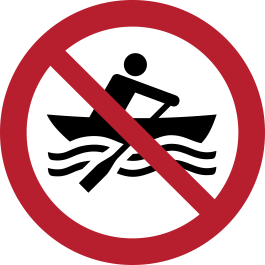
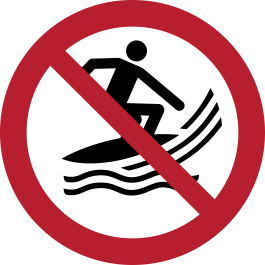
A stand-up paddleboard is not covered here at all — paddled boards count as manually powered craft under P055, and board craft ridden on waves fall under P059. Managers auditing their beach signage should check that each symbol posted matches an activity actually seen on site, since an inaccurate sign is routinely ignored and undermines the ones that matter.
Where you will see P054
Beach entry boards at supervised bathing beaches carry it to keep fast-planing, frequently falling sailboards out of flagged swim zones, and it also appears on lakeshores near swim platforms and rental jetties, at reservoirs where board sports are unlicensed, and around harbor mouths crossing commercial traffic. Coastal authorities often use it for corridor zoning, banning the sport along the lifeguarded frontage while leaving a marked launch lane open, sometimes seasonally.
Common questions about P054
What is the difference between the no windsurfing and no sailing signs?
P054 (no windsurfing) applies to sailboards, where the rider stands on a board holding a pivoting rig. P053 (no sailing) applies to sail-driven boats with a hull and fixed rig, such as dinghies and yachts. A water body can prohibit one and permit the other, so ISO 7010 keeps them as separate references.
Does a no windsurfing sign apply to kitesurfing or paddleboarding?
No. Kitesurfing has its own sign, P065, because kite lines create a different hazard pattern. Paddleboarding is a manually powered activity under P055. If you see only P054 posted, those other activities are not formally prohibited by that sign, although local byelaws may still restrict them.
Why do beaches ban windsurfing near swimming areas?
Sailboards travel quickly, are hard to stop or hold stationary, and drift when the rider falls or uphauls, so they pose a collision risk to swimmers who get little warning. Beaches usually confine the ban to the supervised bathing frontage and provide a separate launch corridor rather than excluding windsurfing from the whole coastline.
Is P054 an official international standard sign?
Yes. P054 is registered in ISO 7010, the international standard for safety signs, within the water safety group aligned with ISO 20712-1. Using the registered pictogram rather than a locally drawn graphic means the message stays recognizable to visitors regardless of language.
Reference details
| Symbol code | P054 |
|---|---|
| Sign family | ISO Prohibition Signs |
| Standard reference | ISO 7010:2019 / ISO 3864-1 ISO Online Browsing Platform: P054 |
| Screen color reference | #FF0000. Screen colors are not a production color specification. |
| Download formats | SVG reference artwork; a 1024 × 1024 pixel PNG conversion on a white canvas. |
| Record date | · How to interpret our dates |
| Page updated |
Choosing a physical sign size
Download dimensions are not installation dimensions. Select sign size, material, placement, and lighting using the applicable standard and the actual viewing conditions. Chemical label sizing follows its own rules. Read the artwork and sizing guide.
Sources and artwork credits
- Artwork source
- Wikimedia Commons file page
- Creator credited by source
- ISO
- License
- Public domain
- Source metadata checked
SVG files are local reference copies. PNG files are raster conversions. Check the linked file history and license terms before reuse; a source-metadata check is not certification of the artwork or a workplace installation.
Report a correction to this reference