No sailing
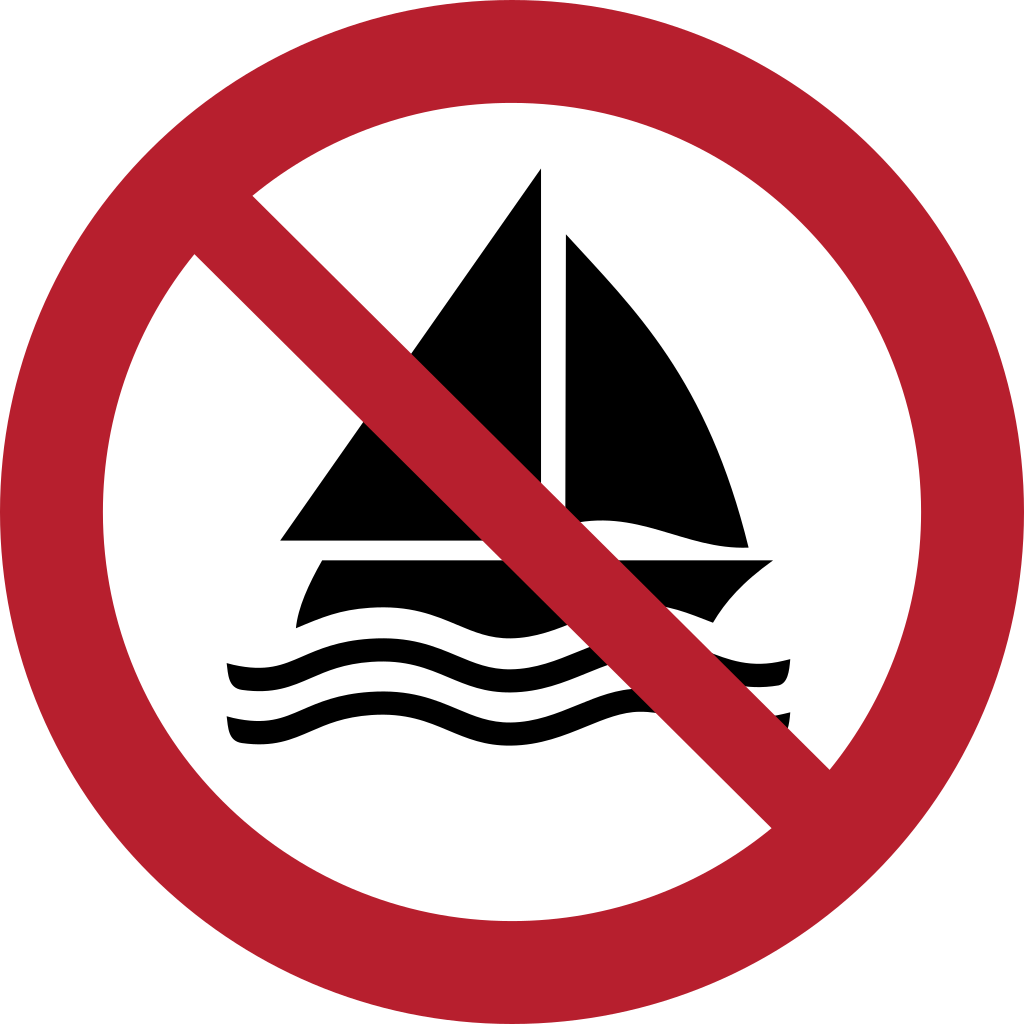
Sailing is prohibited.
Understanding this sign
Red circular signs with a diagonal bar identify an action that must not be taken in the marked area.
Check what object or action the symbol prohibits. A prohibition sign does not identify all the hazards in an area.
What ISO 7010 P053 Prohibits
P053 bans sailing in the stretch of water it marks. The pictogram — a sailing dinghy struck through by the standard red prohibition ring and bar — covers craft driven by sail on a mast, from small dinghies and catamarans up to keelboats and sailing yachts. It is one of the water safety prohibition signs incorporated into ISO 7010:2019 from the ISO 20712-1 water safety series, which is why it appears far more often on beaches, lakes, and waterways than in industrial settings.
The sign is aimed at the craft category, not the crew. It says nothing about swimming, paddling, or motorized boating in the same area; those activities carry their own reference numbers. A bathing lagoon might post P053 alongside P056 and P057 while leaving kayaks free to pass, so operators of a mixed-use water body typically display it as part of a signboard listing several activity rules together.
Why Authorities Exclude Sailing Craft
Sailing craft present a distinctive control problem for water managers: their course depends on the wind. A dinghy beating upwind must tack repeatedly across a channel, and in light or shifting air it may be unable to hold clear of a swim line or a moored fleet at all. Stopping quickly is equally hard, since a sailboat has no brakes and limited reverse. Zones where predictable, contained movement matters — designated bathing waters, narrow navigation fairways, dam and weir approaches — are therefore commonly closed to sail.
Collisions between sailboats and swimmers are a real concern because a hull under way is heavy and quiet, giving bathers little audible warning. Harbormasters also use P053 to keep leisure sailors out of commercial traffic lanes and ferry turning basins, where right-of-way rules would otherwise put slow, wind-dependent craft in front of vessels that cannot maneuver around them.
Typical Posting Locations
Expect P053 at the boundaries of buoyed bathing areas, on reservoir shores where recreational sailing is not licensed, at the mouths of harbor entrances and lock cuts, and near hydraulic structures such as spillways. Coastal municipalities frequently post it on beach entry boards during the supervised swimming season, sometimes with supplementary text giving seasonal dates or the limits of the restricted zone.
Because the restriction often applies to a defined patch of water rather than the whole shoreline, effective installations pair the sign with a map panel or with buoys marking where the exclusion starts and ends. A lone pictogram on a promenade railing tells a sailor little about how far offshore the ban extends, so ISO 20712-guided beach signage practice favors composite boards that show the zoning in plan view.
Distinguishing P053 from Neighboring Signs
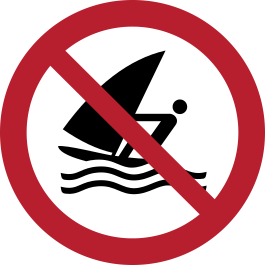
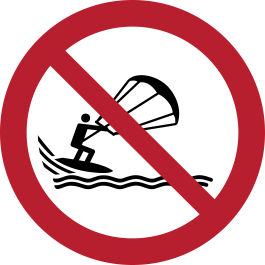
P053 is specific to hulled craft carrying a rig. Windsurfing boards, where the rider holds a pivoting sail, fall under P054, and traction-kite riding is covered by P065. Sites that want a beach free of every wind-driven watercraft need all three symbols, since prohibiting one category does not imply the others.
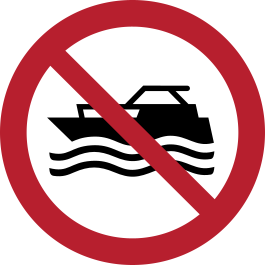
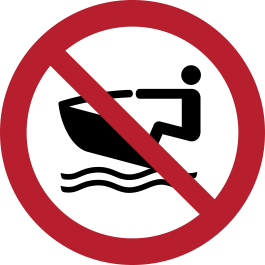
For engine-driven vessels the correct references are P056 (mechanically powered craft) and P057 (personal water craft), while human-propelled boats fall under P055. Choosing the precise sign matters: posting P053 on a lake plagued by speedboat wake bans the wrong user group and leaves the actual problem untouched.
Where you will see P053
It stands at the boundaries of buoyed bathing areas, on reservoir shores where recreational sailing is not licensed, at harbor entrances and lock cuts, and near spillways and other hydraulic structures. Coastal municipalities add it to beach entry boards during the supervised swimming season, and harbormasters use it to keep wind-dependent leisure craft out of commercial traffic lanes and ferry turning basins, ideally paired with a map panel or buoys marking the exclusion limits.
Common questions about P053
What does the no sailing sign with the red circle mean?
It is ISO 7010 reference P053, a prohibition sign meaning sailing is not permitted in the marked area. It applies to sail-driven boats such as dinghies, catamarans, and yachts. It does not by itself ban swimming, paddling, windsurfing, or motorboats — each of those has a separate ISO reference.
Does a no sailing sign also ban windsurfing or kitesurfing?
No. Windsurfing has its own prohibition sign, P054, and kitesurfing has P065. P053 covers boats with a fixed rig on a hull. If a beach authority wants to exclude all wind-powered craft it should display each relevant symbol, usually grouped on one signboard.
Who has the authority to prohibit sailing on a lake or beach?
Typically the body that manages the water: a local council or beach authority for coastal bathing areas, a harbormaster or port authority for harbor waters, a navigation authority for rivers and canals, and the reservoir owner or water company for inland reservoirs. The sign communicates a rule made under that body's byelaws or site regulations, so the enforcement mechanism depends on the jurisdiction.
Where should P053 be positioned to be effective?
At the points where sailors would launch or enter the restricted water — slipways, beach access points, harbor entrances — and ideally alongside a plan showing the extent of the exclusion zone, backed up by marker buoys on the water itself. A sign visible only from land does little for craft already sailing along the coast.
Reference details
| Symbol code | P053 |
|---|---|
| Sign family | ISO Prohibition Signs |
| Standard reference | ISO 7010:2019 / ISO 3864-1 ISO Online Browsing Platform: P053 |
| Screen color reference | #FF0000. Screen colors are not a production color specification. |
| Download formats | SVG reference artwork; a 1024 × 1024 pixel PNG conversion on a white canvas. |
| Record date | · How to interpret our dates |
| Page updated |
Choosing a physical sign size
Download dimensions are not installation dimensions. Select sign size, material, placement, and lighting using the applicable standard and the actual viewing conditions. Chemical label sizing follows its own rules. Read the artwork and sizing guide.
Sources and artwork credits
- Artwork source
- Wikimedia Commons file page
- Creator credited by source
- ISO
- License
- Public domain
- Source metadata checked
SVG files are local reference copies. PNG files are raster conversions. Check the linked file history and license terms before reuse; a source-metadata check is not certification of the artwork or a workplace installation.
Report a correction to this reference