No diving
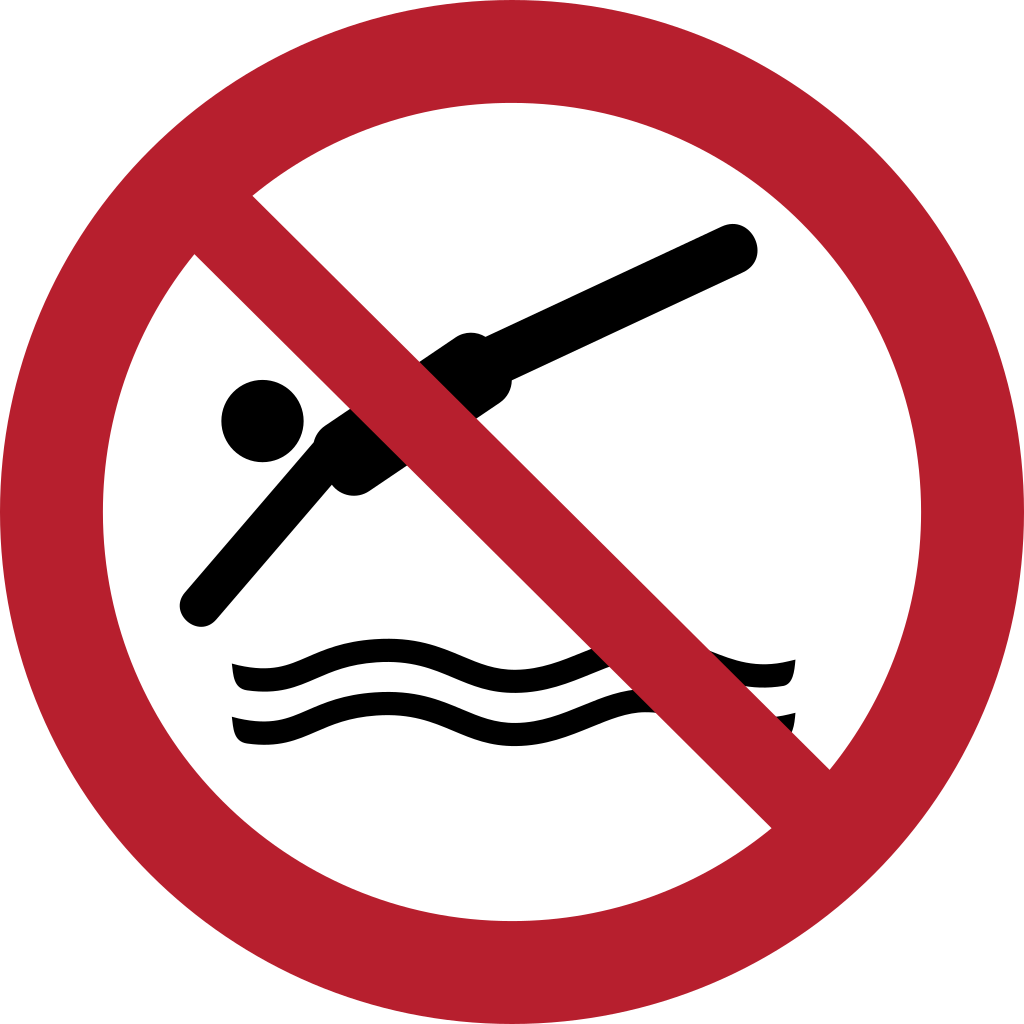
Diving into the water is prohibited.
Understanding this sign
Red circular signs with a diagonal bar identify an action that must not be taken in the marked area.
Check what object or action the symbol prohibits. A prohibition sign does not identify all the hazards in an area.
What ISO 7010 P052 Prohibits
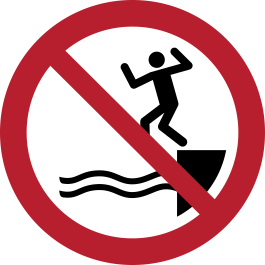
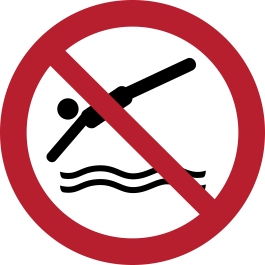
P052 forbids diving — entering the water headfirst. The pictogram shows a human figure plunging head-down toward a waterline, cancelled by the red bar of the ISO 3864-1 prohibition format. Its registered function, to prohibit diving into the water, is deliberately narrow: swimming in the pool or lake may be perfectly acceptable where P052 is posted, but arriving headfirst is not.
This is arguably the highest-stakes sign in the aquatic prohibition family, because the injury it prevents is catastrophic and permanent rather than merely serious. It appears wherever water depth is insufficient for a headfirst entry, and it is one of the water safety signs carried into ISO 7010 from the ISO 20712-1 series.
The Injury Behind the Sign
A headfirst dive into shallow water drives the crown of the skull into the bottom with the full momentum of the falling body, compressing and fracturing the cervical spine. The result is frequently quadriplegia in an otherwise healthy young person; diving into shallow water is one of the leading causes of traumatic spinal cord injury connected with recreation. Victims often misjudged depth by less than the length of their own outstretched arms.
Depth perception is the core problem. Clear water looks deeper than it is, murky water hides the bottom entirely, and natural waterbeds shelve unpredictably. A depth that receives a shallow racing start safely will still break the neck of someone diving steeply, which is why operators post the prohibition rather than relying on bathers to judge each entry.
Where the Sign Is Posted
Swimming pools carry P052 along the shallow end and anywhere the floor slopes upward, typically beside the painted depth markings so the number and the prohibition are read together. Hotel and holiday-park pools — often shallow throughout and used by guests unfamiliar with the layout — commonly post it around the entire perimeter, as do waterparks, splash zones, and hydrotherapy pools.
In open water it guards jetties, pontoons, floating platforms, rocky ledges, and swim-area docks where the bottom is close beneath. Tidal locations deserve particular attention: a platform with generous clearance at high tide can sit over knee-deep water hours later, so P052 there should carry supplementary text about variable depth.
Distinguishing P052 from Nearby Signs
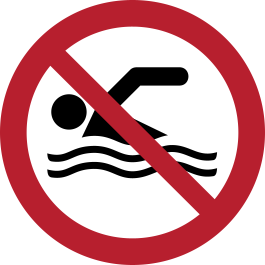
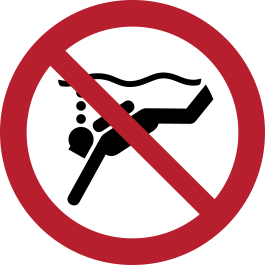
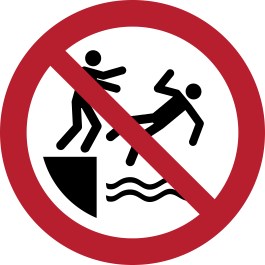
P061 bans jumping — feet-first entry — while P052 bans headfirst entry; a pool edge over moderately shallow water might display only P052, whereas a harbour wall high above cold water of unknown depth usually needs P061 or both. P049 goes further and closes the water to swimmers entirely. And despite the similar English word, P051 concerns scuba equipment, not entry technique.
Facilities sometimes assume a painted "NO DIVING" stencil on the deck is equivalent. Text stencils fade, get resurfaced over, and mean nothing to visitors who do not read the language; the ISO pictogram communicates across languages and, mounted vertically at eye level, remains visible when the deck is crowded with towels and bathers.
Where you will see P052
Pools carry it along the shallow end and wherever the floor slopes upward, ideally beside painted depth markings; hotel and holiday-park pools often ring the whole perimeter with it, as do waterparks and hydrotherapy pools. Open-water placements guard jetties, pontoons, floating platforms, rocky ledges, and swim docks, with tidal locations adding supplementary text about variable depth.
Common questions about P052
What depth of water is safe for diving headfirst?
There is no single safe number, because entry angle, height, and body size all matter, and standards for purpose-built diving facilities set requirements well beyond typical pool depths. The practical guidance is the reverse: never dive into water where you do not know the depth, and never dive where P052 is posted — the operator has already determined the water is too shallow for headfirst entry.
What is the difference between no diving and no jumping signs?
P052 (no diving) bans headfirst entry, protecting the head and neck from striking the bottom in shallow water. P061 (no jumping into water) bans feet-first jumps, which is about impact from height, unknown depth, submerged objects, and cold-water shock. A shallow pool typically needs only P052; a quay or bridge over deep, cold water needs P061; some locations justify both.
Why do hotel pools say no diving everywhere?
Most hotel and resort pools are designed for standing-depth recreation, often shallower than they appear, and their guests have no familiarity with the pool's profile. Because a first-time visitor cannot know where the floor rises, operators prohibit headfirst entry across the whole pool rather than zone it, and post P052 around the full perimeter alongside depth markings.
Does a no diving sign also ban jumping in feet first?
Strictly, no. P052's registered function covers diving — headfirst entry — so feet-first jumping falls under P061 instead. In practice many facilities intend to stop all boisterous entries and should therefore post both signs, or back the signage with written pool rules. Relying on P052 alone to prohibit jumping invites exactly the argument a sign is supposed to prevent.
Reference details
| Symbol code | P052 |
|---|---|
| Sign family | ISO Prohibition Signs |
| Standard reference | ISO 7010:2019 / ISO 3864-1 ISO Online Browsing Platform: P052 |
| Screen color reference | #FF0000. Screen colors are not a production color specification. |
| Download formats | SVG reference artwork; a 1024 × 1024 pixel PNG conversion on a white canvas. |
| Record date | · How to interpret our dates |
| Page updated |
Choosing a physical sign size
Download dimensions are not installation dimensions. Select sign size, material, placement, and lighting using the applicable standard and the actual viewing conditions. Chemical label sizing follows its own rules. Read the artwork and sizing guide.
Sources and artwork credits
- Artwork source
- Wikimedia Commons file page
- Creator credited by source
- ISO
- License
- Public domain
- Source metadata checked
SVG files are local reference copies. PNG files are raster conversions. Check the linked file history and license terms before reuse; a source-metadata check is not certification of the artwork or a workplace installation.
Report a correction to this reference