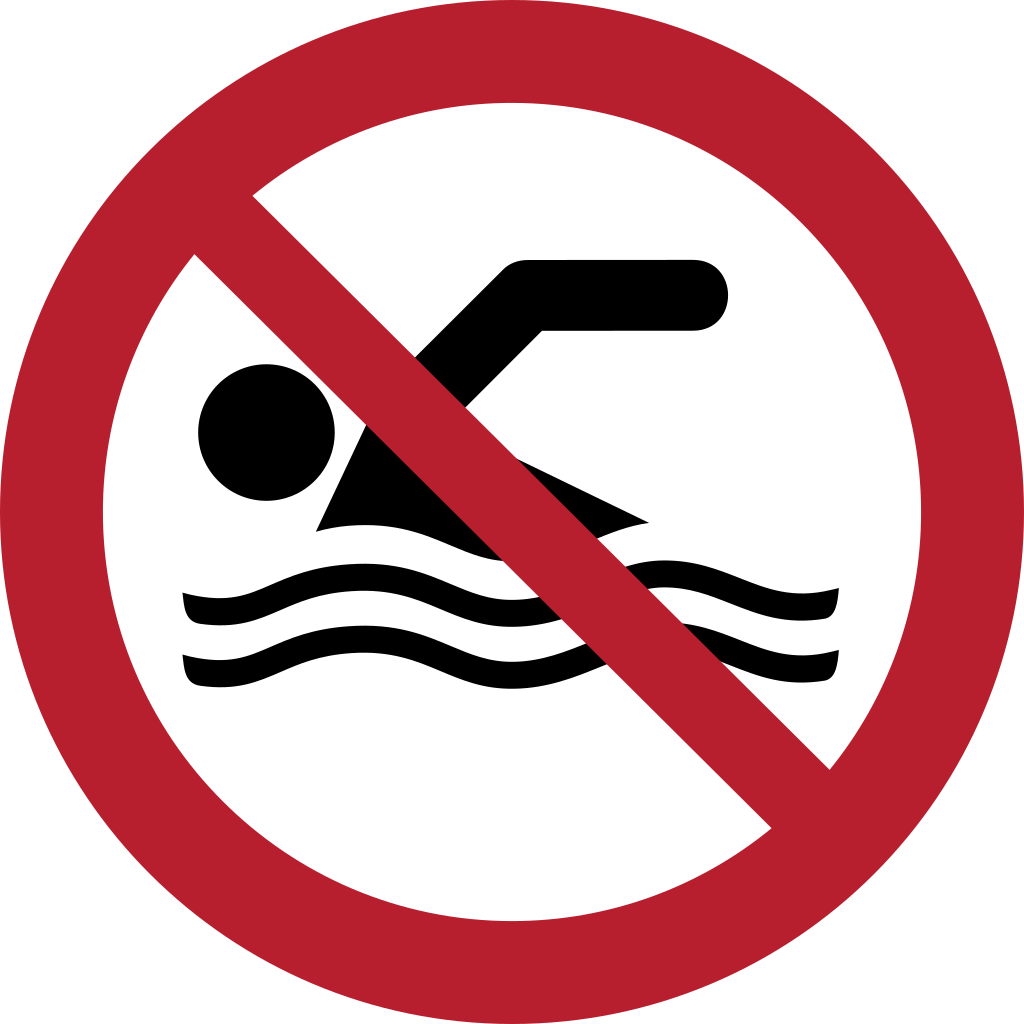
No swimming
Swimming is prohibited.
Understanding this sign
Red circular signs with a diagonal bar identify an action that must not be taken in the marked area.
Check what object or action the symbol prohibits. A prohibition sign does not identify all the hazards in an area.
What ISO 7010 P049 Prohibits
P049 closes a body of water to swimming entirely. The pictogram — a swimmer's head and arm above a waterline, struck through by the red prohibition bar — communicates that people must not be in the water at all, however they might enter it. This makes P049 the broadest of the aquatic prohibition signs: where it is posted, questions about diving technique or jump height are moot because bathing itself is forbidden.
The sign belongs to the water safety family that ISO 7010 absorbed from ISO 20712-1, the standard covering water safety signs and their use at beaches, inland waters, and man-made water features. On lifeguarded beaches, the equivalent real-time message is the red flag, which signals that the water is closed to bathers.
Reasons Water Gets Closed to Swimmers
Open-water bans usually reflect hazards a swimmer cannot judge from shore: rip currents and undertow, cold depths that trigger swim failure, weirs and sluices with recirculating flow, sudden drop-offs, and submerged structures. Vessel traffic is another major driver — harbors, marinas, navigation channels, and lock approaches ban swimming because helm positions offer poor visibility of a head at water level.
Water quality closes swimming areas too. Blue-green algal blooms, sewage outfalls, and agricultural runoff make otherwise calm water unsafe, and P049 is often the sign posted during such advisories. Industrial water bodies — cooling ponds, effluent lagoons, tailings facilities, fire-water reservoirs — carry chemical, thermal, or entrapment hazards and are typically signed permanently.
Typical Locations for the Sign
Expect P049 at reservoirs and their dam faces, canal and river locks, quarry lakes, dock edges, ferry terminals, aqueducts, and water treatment works. Utilities and navigation authorities post it at access points around their assets because these waters combine cold depth, machinery-driven currents, and no safe egress — vertical concrete or sheet-pile walls give a tired swimmer nothing to climb.
Placement should anticipate informal access, not just official entrances. Quarry swimming and reservoir dipping spike during hot weather, so operators sign the shoreline paths, fence gaps, and small beaches where people actually get in, rather than only the gated road entrance nobody walks past. Pairing the prohibition with an explanation board that names the specific danger — cold depth, submerged machinery, intake currents — does more for voluntary compliance than the symbol alone.
How P049 Differs from Its Neighbors
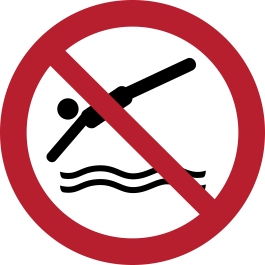
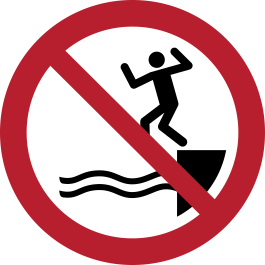
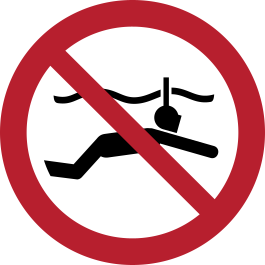
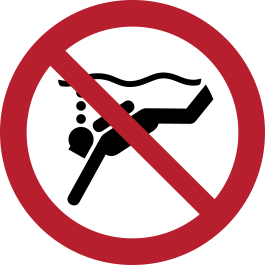
P052 (no diving) and P061 (no jumping into water) regulate how people enter water that may otherwise be open for bathing; P049 removes the option altogether. Similarly, P050 and P051 ban snorkelling and sub-aqua equipment in waters where surface swimming might still be permitted. Choosing the narrowest accurate sign matters: overusing P049 where only headfirst entry is dangerous erodes trust in all the signage on site.
P049 also combines naturally with warning signs that explain the closure — sudden-drop, thin-ice, or strong-current warnings from the ISO water safety set — and with rescue equipment signage. A site that bans swimming should still mark its lifebuoys and throwlines, because prohibition signs do not stop accidental falls into the water.
Where you will see P049
Reservoirs and dam faces, canal and river locks, quarry lakes, dock edges, ferry terminals, and water treatment works are signed permanently by utilities and navigation authorities, whose waters combine cold depth, machinery-driven currents, and vertical walls with no egress. Placement anticipates informal access — shoreline paths, fence gaps, and the small beaches where people actually enter — and pairing the symbol with a board naming the specific danger improves compliance.
Common questions about P049
What does the no swimming symbol officially mean?
ISO 7010 P049 means the water is closed to swimming and bathing of any kind. Its registered function is "to prohibit swimming", so it covers wading in deep enough to swim, bathing, and open-water swimming alike. It does not by itself ban boating, fishing from shore, or other activities that keep people out of the water — sites that need those restrictions post additional signs.
Why do reservoirs and quarries have no swimming signs?
Because their dangers are invisible from the bank. Reservoirs and flooded quarries are extremely cold below the surface even in summer, which causes swim failure within minutes; they contain submerged machinery, ledges, and abandoned equipment; water levels and intakes create currents; and steep or vertical sides leave no easy way out. Drownings at these sites typically involve strong, confident swimmers, which is precisely why blanket prohibition is used.
Is a red flag the same as a no swimming sign?
They deliver the same instruction through different channels. A red beach flag, standardized in ISO 20712-2, is a real-time signal from lifeguards that conditions currently prohibit bathing. P049 is a fixed sign marking a standing prohibition. Beaches often use both: permanent P049 signs at hazardous corners of the beach, and flags that change with daily conditions elsewhere.
Do I use P049 or P052 at a shallow pool?
P052. If people are allowed in the water but must not enter headfirst, the correct sign is P052 (no diving). P049 is only appropriate when swimming itself is forbidden — for example a decorative pond, a plant room tank, or a closed section of open water. Using the total ban where only one entry method is dangerous sends a message the site does not actually enforce.
Reference details
| Symbol code | P049 |
|---|---|
| Sign family | ISO Prohibition Signs |
| Standard reference | ISO 7010:2019 / ISO 3864-1 ISO Online Browsing Platform: P049 |
| Screen color reference | #FF0000. Screen colors are not a production color specification. |
| Download formats | SVG reference artwork; a 1024 × 1024 pixel PNG conversion on a white canvas. |
| Record date | · How to interpret our dates |
| Page updated |
Choosing a physical sign size
Download dimensions are not installation dimensions. Select sign size, material, placement, and lighting using the applicable standard and the actual viewing conditions. Chemical label sizing follows its own rules. Read the artwork and sizing guide.
Sources and artwork credits
- Artwork source
- Wikimedia Commons file page
- Creator credited by source
- ISO
- License
- Public domain
- Source metadata checked
SVG files are local reference copies. PNG files are raster conversions. Check the linked file history and license terms before reuse; a source-metadata check is not certification of the artwork or a workplace installation.
Report a correction to this reference