No running
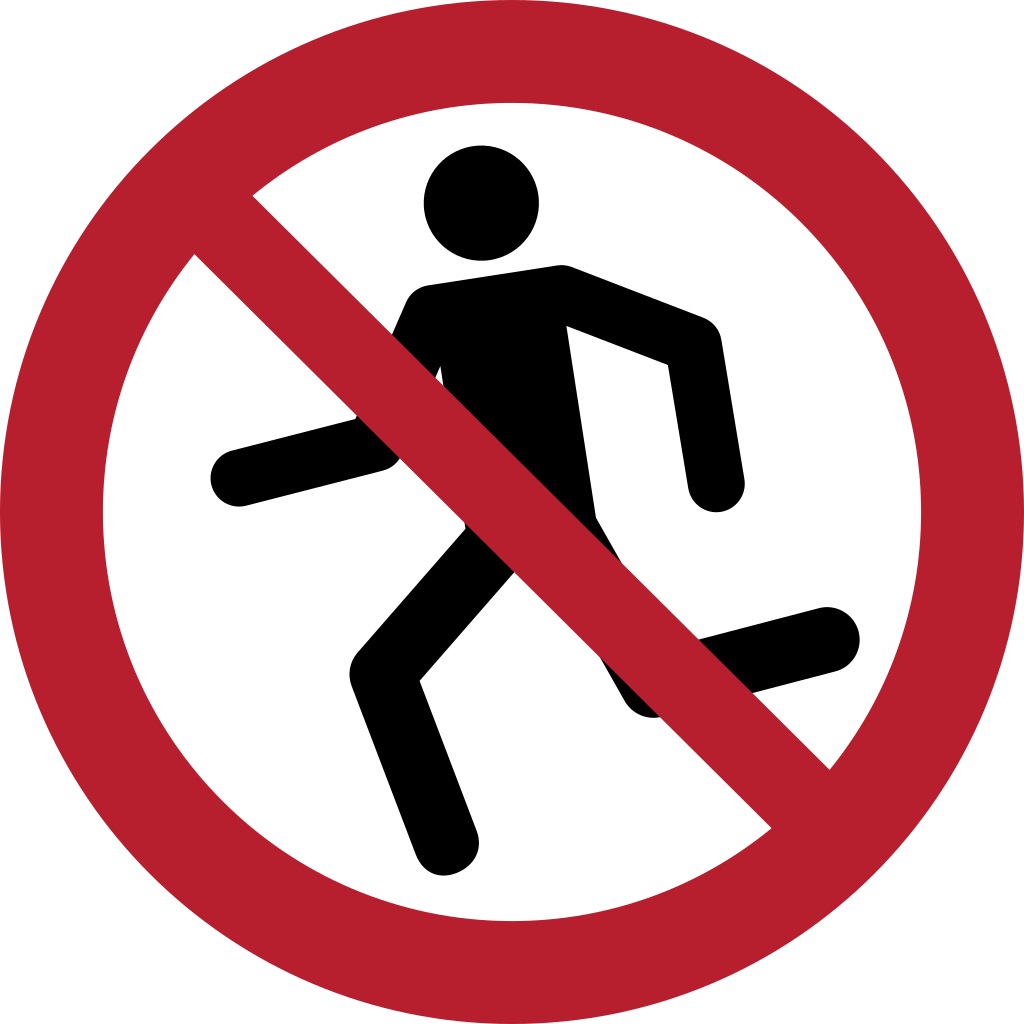
Running is prohibited.
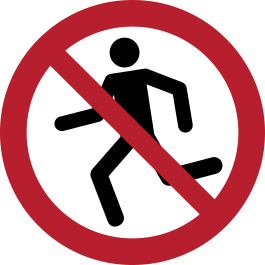
Understanding this sign
Red circular signs with a diagonal bar identify an action that must not be taken in the marked area.
Check what object or action the symbol prohibits. A prohibition sign does not identify all the hazards in an area.
What ISO 7010 P048 Prohibits
P048 bans running in the area where it is posted. The pictogram shows a person in a running stride inside the standard red prohibition roundel, and the ISO register defines its function simply as prohibiting running. Unlike hazard warnings, P048 targets a behavior rather than a condition: it tells people to walk, whatever their reason for hurrying, because the surface or the surroundings make running dangerous.
The sign entered ISO 7010 alongside the water safety signs harmonized from ISO 20712-1, which is why it is most familiar from swimming pools and aquatic facilities. Its use is not limited to leisure settings, though — any environment where a slip, a collision, or an uncontrolled fall is likely can post it.
Why Pool Decks Ban Running
Wet tile, smooth concrete, and bare feet form one of the most reliable slip combinations in any public facility. A runner who loses traction on a pool surround falls onto an unforgiving surface, often striking the pool edge, steps, or another bather on the way down. Head injuries at the poolside and uncontrolled entries into shallow water are exactly the incidents lifeguard operating procedures are written to prevent.
Running also defeats supervision. Lifeguards scan bathers in the water; a child sprinting along the deck moves faster than the scan pattern and can enter the water unnoticed. Posting P048 gives staff a visual rule they can point to when enforcing the walking requirement, which is why it appears in almost every pool's normal operating plan.
Use Outside Aquatic Facilities
Industrial sites use P048 where haste multiplies existing risks: stairwells and mezzanines, corridors shared with forklift or pallet-truck traffic, laboratories carrying open samples, kitchens, and offshore or marine decks that are routinely wet. In these settings the sign supports a site rule that people move at walking pace so vehicle drivers and other pedestrians can predict their paths.
Schools, leisure centers, and ice rinks post it at circulation pinch points such as changing-room exits and spectator walkways. Because the prohibition is behavioral, it works best where the walking rule is also enforced by staff; a sign alone rarely slows down a hurrying adult, but it removes any argument that the rule was not communicated.
Placement and Companion Signs
Position P048 at the transition into the controlled zone — the doorway from the changing village onto the pool deck, the foot of a wet stairway, the entrance to a workshop aisle — rather than deep inside it, so the rule registers before someone builds up speed. In large pool halls, repeat it along the surround at intervals a moving person will actually pass.
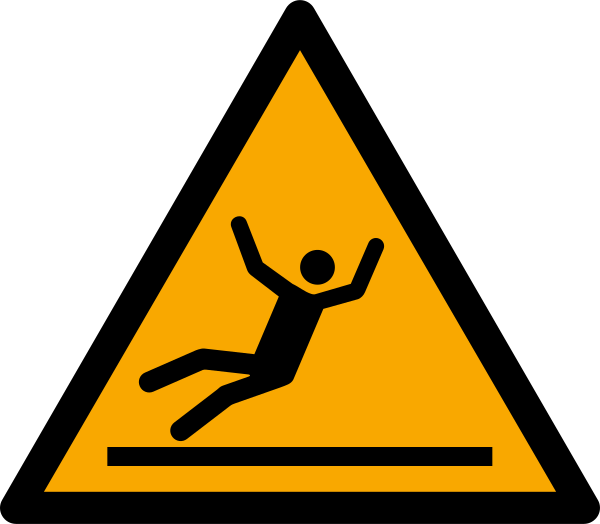
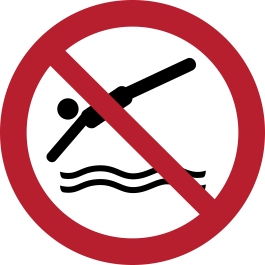
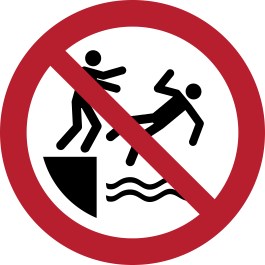
P048 states the rule; W011, the ISO 7010 slippery-surface warning, explains the hazard behind it, and the two are frequently mounted together where floors stay wet by design rather than by accident. In pools it also sits naturally beside P052 (no diving) and P062 (no pushing) as part of a poolside behavior panel, giving lifeguards one location to point to when correcting the common horseplay incidents.
Where you will see P048
Pool operators post it at the transition from changing village to wet deck, where tile, water, and bare feet combine, repeating it along large pool surrounds and pairing it with P052 no-diving on poolside behavior panels. Industrial sites use it in stairwells and mezzanines, corridors shared with forklift traffic, laboratories carrying open samples, kitchens, and wet marine decks, while schools and ice rinks mark changing-room exits and spectator walkways.
Common questions about P048
Why is running not allowed around swimming pools?
Pool surrounds combine wet, smooth flooring with bare feet, so runners slip easily and fall onto hard tile, the pool edge, or other bathers. Falls at the poolside cause head injuries and uncontrolled entries into shallow water, and a running child is also harder for lifeguards to track. The walking rule, communicated by P048, removes the speed that turns a routine slip into a serious injury.
Is there an official ISO sign for no running?
Yes. ISO 7010 registers P048 with the referent "No running" and the function "to prohibit running". It uses the standard prohibition format from ISO 3864-1 — a red circle and diagonal bar over a black running-figure pictogram — so it is recognized internationally without accompanying text.
What is the difference between P048 and the slippery floor sign?
P048 is a prohibition: it orders people not to run. W011 is a warning: it alerts people that the surface is slippery. They address the same incident from two directions and are often installed as a pair, with W011 explaining why the P048 rule exists. A temporary wet-floor cone serves the W011 role during cleaning; P048 is normally a permanent sign.
Where should a no running sign be placed in a leisure facility?
At the points where people enter the walking-pace zone — typically the changing-room exit onto the pool deck, the top and bottom of wet stairways, and slide or flume queue entrances — then repeated along long pool surrounds. Mounting it at eye level on the route of travel matters more than quantity; people must see it before they start moving quickly.
Reference details
| Symbol code | P048 |
|---|---|
| Sign family | ISO Prohibition Signs |
| Standard reference | ISO 7010:2019 / ISO 3864-1 ISO Online Browsing Platform: P048 |
| Screen color reference | #FF0000. Screen colors are not a production color specification. |
| Download formats | SVG reference artwork; a 1024 × 1024 pixel PNG conversion on a white canvas. |
| Record date | · How to interpret our dates |
| Page updated |
Choosing a physical sign size
Download dimensions are not installation dimensions. Select sign size, material, placement, and lighting using the applicable standard and the actual viewing conditions. Chemical label sizing follows its own rules. Read the artwork and sizing guide.
Sources and artwork credits
- Artwork source
- Wikimedia Commons file page
- Creator credited by source
- ISO
- License
- Public domain
- Source metadata checked
SVG files are local reference copies. PNG files are raster conversions. Check the linked file history and license terms before reuse; a source-metadata check is not certification of the artwork or a workplace installation.
Report a correction to this reference