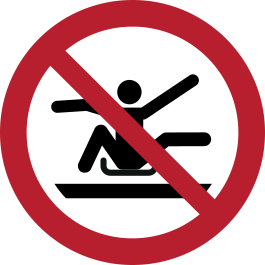
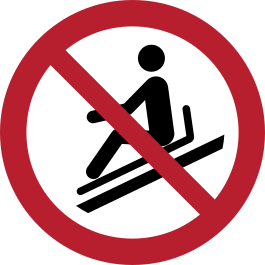
Do not ram into toboggans
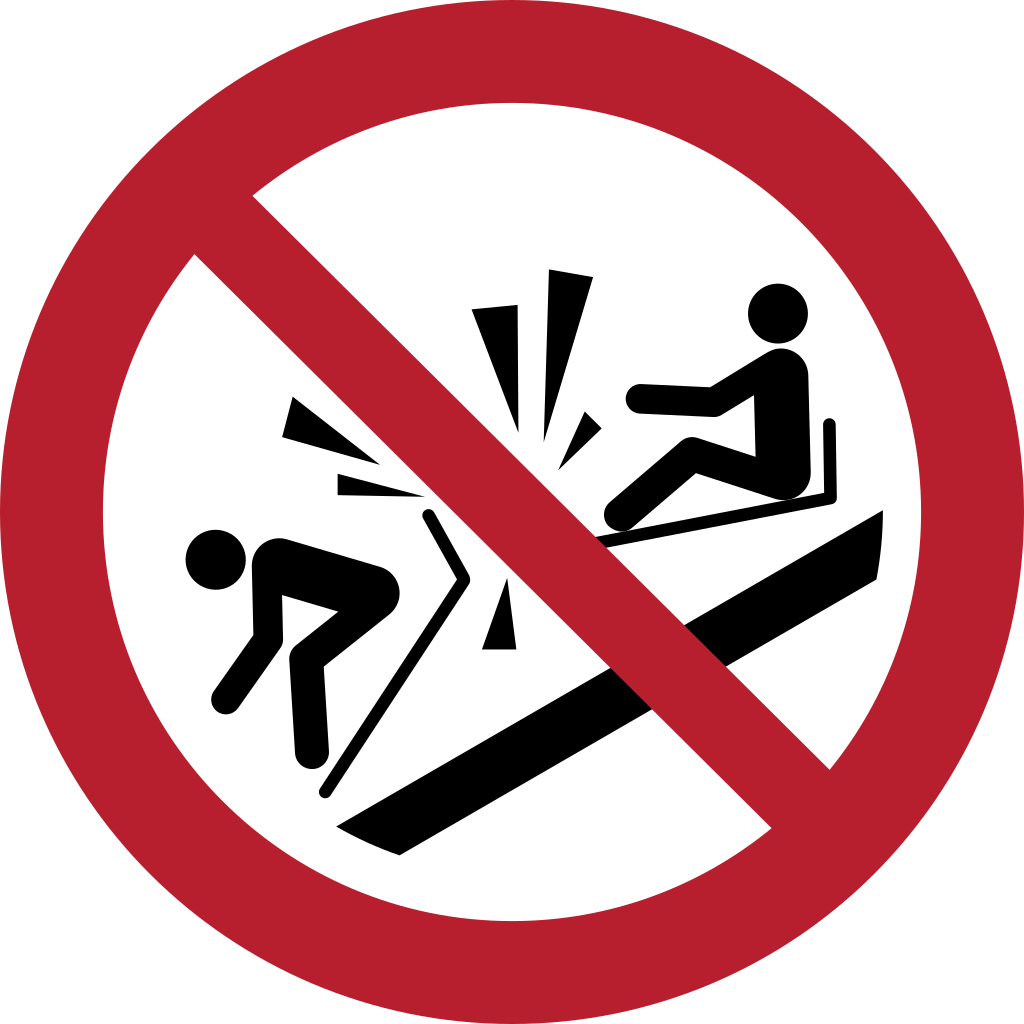
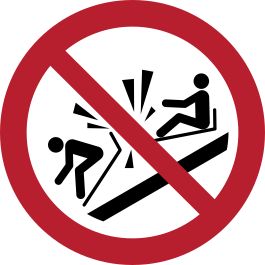
Ramming other toboggans is prohibited.
Understanding this sign
Red circular signs with a diagonal bar identify an action that must not be taken in the marked area.
Check what object or action the symbol prohibits. A prohibition sign does not identify all the hazards in an area.
What ISO 7010 P047 Means
P047 prohibits deliberately or carelessly running your toboggan into another one. Its ISO 7010 referent is Do not ram into toboggans, and the register states its function as prohibiting ramming other toboggans. The symbol depicts one sled striking another inside the red circle-and-slash of an ISO 3864-1 prohibition sign, and it was added to the standard with the same batch of winter-recreation pictograms as P046, the sign against stretching out of a toboggan.
The rule sounds obvious, but bumper-car behavior is genuinely common on sled runs, where groups ride together and riders have no formal training. Unlike skiers, toboggan riders share a narrow channel with limited ability to dodge, so collision avoidance depends almost entirely on spacing and speed control — the two things this sign exists to demand.
Why Collisions on Sled Runs Are Serious
A sled arriving from behind concentrates its impact on a seated, unprotected rider, often a child, with the head and lower back exposed at exactly sled height. Chain reactions are the second problem: a struck toboggan can spin sideways or stop dead in the channel, turning one careless rider into a pile-up as following sleds arrive around a blind curve with little braking distance on packed snow.
On rail-guided toboggan runs and mountain coasters, tailgating adds a mechanical dimension. Ride spacing is what prevents hard contact in the braking zones, so operators instruct riders to hold a gap and brake early when the sled ahead slows. Ramming there is not just rude — it defeats the ride's designed separation and is treated as grounds for removal from the attraction.
Posting Practice and Companion Rules
Operators display P047 at the run entrance and loading area, where staff brief riders, and again at known conflict points: the start gate where impatient riders push off early, blind curves, merge points, and the run-out zone where finished riders must clear the channel before the next sled arrives. That last placement matters — many rear-end contacts happen at the bottom, not on the descent.
It normally hangs beside P046 and the operator's spacing instructions, and on shared winter terrain it complements P078, the sign that bans tobogganing outright on slopes reserved for other traffic. The behavioral logic mirrors the FIS Rules for Conduct used on ski pistes, where the person behind always carries responsibility for avoiding the person ahead; P047 states that same principle for sledding in a single wordless image.
Where you will see P047
Sled run operators display it at the run entrance and loading area where staff brief riders, and again at known conflict points: the start gate, blind curves, merge points, and the run-out zone where finished riders must clear the channel before the next sled arrives. On rail-guided toboggan runs and mountain coasters it backs the instruction to hold a gap and brake early in the braking zones, normally hung beside P046 and the operator's spacing rules.
Common questions about P047
What does the Do not ram into toboggans sign require me to do?
Keep enough distance from the sled in front that you can slow or stop without contact, brake early when the rider ahead slows, and never push off from the start until the channel ahead is clear. On rail-guided toboggan rides, follow the posted gap to the sled ahead. Intentional bumping is treated as misuse of the ride and can get you removed.
Who is responsible if two toboggans collide?
As a general principle of slope conduct — the same one expressed in the FIS Rules for skiers — the rider approaching from behind must ride so they can avoid the person ahead. Operators apply the same logic on sled runs: rear-end contact points to insufficient spacing or excessive speed by the following rider, though local law and the operator's conditions of use decide any actual liability.
Where should P047 signage be placed on a toboggan run?
At the entrance and loading point where riders are briefed, at the start gate to stop premature push-offs, ahead of blind curves and merges, and at the run-out area at the bottom, where riders who linger in the channel are most likely to be hit. Pairing it with P046, the keep-your-limbs-inside rule, covers the two core riding requirements together.
Is P047 the same as the sign banning sledding on a slope?
No. P047 regulates behavior between riders on a run where tobogganing is allowed. The sign that prohibits sledding in an area altogether is P078, No tobogganing or sledding, used where sled traffic must be kept off ski pistes, lift corridors, or closed terrain.
Reference details
| Symbol code | P047 |
|---|---|
| Sign family | ISO Prohibition Signs |
| Standard reference | ISO 7010:2019 / ISO 3864-1 ISO Online Browsing Platform: P047 |
| Screen color reference | #FF0000. Screen colors are not a production color specification. |
| Download formats | SVG reference artwork; a 1024 × 1024 pixel PNG conversion on a white canvas. |
| Record date | · How to interpret our dates |
| Page updated |
Choosing a physical sign size
Download dimensions are not installation dimensions. Select sign size, material, placement, and lighting using the applicable standard and the actual viewing conditions. Chemical label sizing follows its own rules. Read the artwork and sizing guide.
Sources and artwork credits
- Artwork source
- Wikimedia Commons file page
- Creator credited by source
- ISO
- License
- Public domain
- Source metadata checked
SVG files are local reference copies. PNG files are raster conversions. Check the linked file history and license terms before reuse; a source-metadata check is not certification of the artwork or a workplace installation.
Report a correction to this reference