Do not stretch out of toboggan
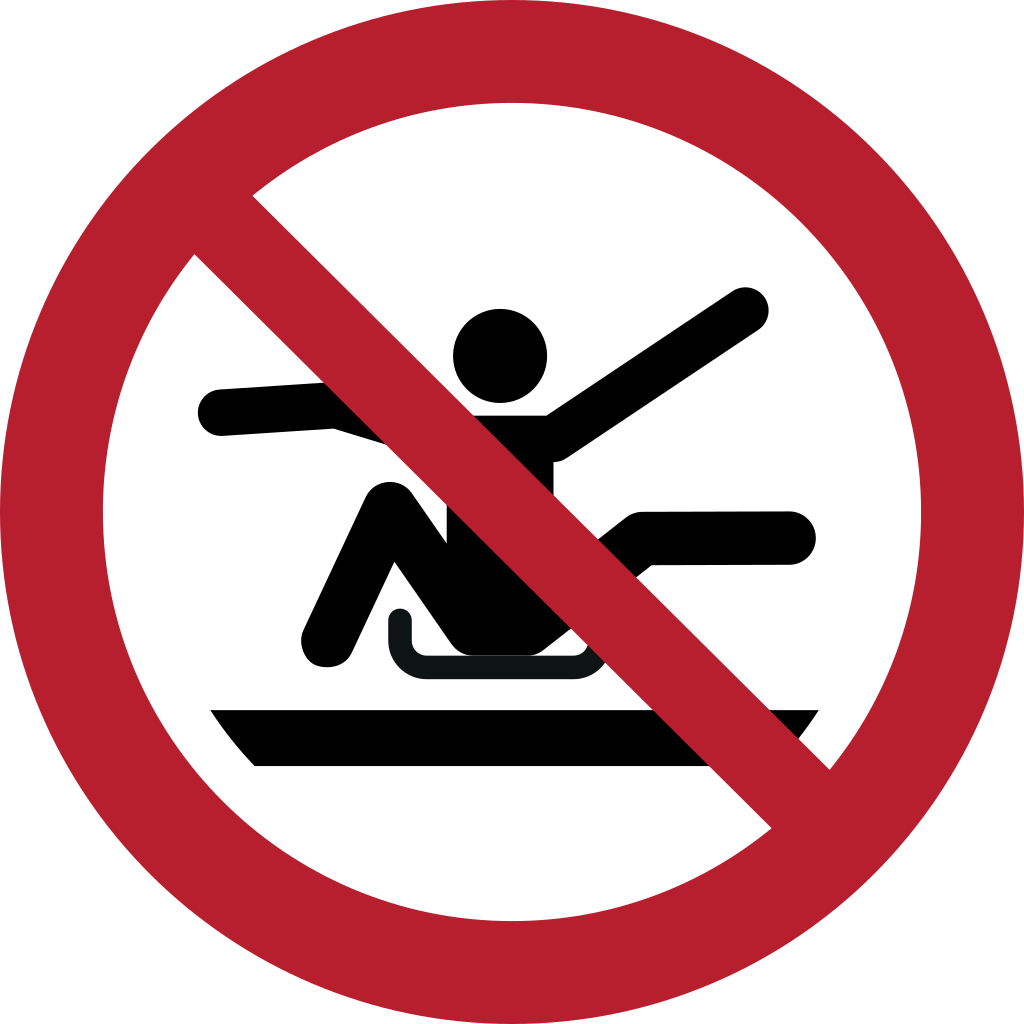
Stretching out of the toboggan is prohibited.
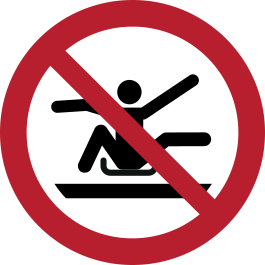
Understanding this sign
Red circular signs with a diagonal bar identify an action that must not be taken in the marked area.
Check what object or action the symbol prohibits. A prohibition sign does not identify all the hazards in an area.
Meaning of ISO 7010 P046
P046 instructs riders of a toboggan or sled to keep their arms, legs, and body inside the vehicle while it is moving. The ISO 7010 register gives its referent as Do not stretch out of toboggan, with the function of prohibiting stretching out of the toboggan. The pictogram — a seated rider with a limb extended beyond the sled, struck through by the red prohibition band of ISO 3864-1 — was registered alongside the other winter-recreation signs the standard acquired through its amendments.
The sign is aimed at commercial toboggan operations: dedicated winter sled runs at resorts, and rail-guided toboggan or mountain-coaster tracks where sleds follow a fixed channel or rail. In those settings the rider passes close to banked walls, track edges, supports, and other structures, and the operator has a duty to state the riding rules in a form every guest can understand.
The Hazard: Limbs Outside the Sled
A toboggan run steers the sled for the rider, which invites a false sense of freedom. An arm trailed in the snow or a leg stuck out to brake can catch on the bank of a curve, on ice at the track edge, or on trackside structures, twisting the rider out of the sled or wrenching the limb while the sled continues downhill. On rail-guided runs the clearances are engineered around a rider who stays within the sled profile; anything extended beyond that profile can strike supports and signage at full ride speed.
Reaching out also destabilizes the sled itself. Shifting weight over one edge mid-curve is a common cause of tip-overs on open toboggan runs, and a rider ejected in a curve lies in the path of whoever comes next. That is why P046 is normally displayed together with P047, the sign prohibiting ramming into other toboggans: both exist to keep sleds spaced, upright, and predictable.
Where and How Operators Use It
Typical placements are the ride entrance and queue area, the loading platform where staff give instructions, and repeated boards on the descent ahead of the curves where riders are most tempted to drag a hand or foot. Because toboggan runs draw families and international tourists, operators lean on the wordless pictogram and add local-language text only as reinforcement.
P046 has no meaning outside this recreational context — there is no industrial equivalent — so specifiers should not substitute it for general body-position signs such as P015 (no reaching in) around machinery. Conversely, a toboggan operator should use the registered P046 rather than an improvised keep-arms-inside graphic, because the ISO symbol is the version tested for comprehension and consistent with the rest of the resort's signage.
Where you will see P046
Commercial toboggan runs and rail-guided mountain-coaster tracks display it at the ride entrance and queue, on the loading platform where staff brief riders, and on repeated boards ahead of the curves where dragging a hand is most tempting. Resorts serving international families lean on the wordless pictogram, usually posting it together with P047, the sign against ramming other toboggans.
Common questions about P046
Why shouldn't you stick your arms or legs out of a toboggan?
An extended limb can catch on the banked wall of a curve, ice at the track edge, or trackside structures, pulling you off the sled or injuring the limb at ride speed. It also shifts your weight over one edge, which is a frequent cause of tip-overs in curves. Braking and steering should be done with the sled's own controls or as the operator instructs, not with your feet or hands in the snow.
Where does the P046 sign apply?
On commercial toboggan and sled runs — both open snow runs and rail-guided toboggan or mountain-coaster tracks. Operators post it at the entrance, at the loading point, and before curves along the descent. It is a recreation sign; for keeping hands out of machinery in a workplace, the correct symbol is P015, not P046.
Is P046 usually posted together with other signs?
Yes, most often with P047 (do not ram into toboggans), since the two rules work together to keep sleds spaced and stable, and with the operator's boards on minimum age, seating position, and braking. On rail-guided rides it typically joins instructions about keeping distance from the sled ahead and not stopping on the track.
Reference details
| Symbol code | P046 |
|---|---|
| Sign family | ISO Prohibition Signs |
| Standard reference | ISO 7010:2019 / ISO 3864-1 ISO Online Browsing Platform: P046 |
| Screen color reference | #FF0000. Screen colors are not a production color specification. |
| Download formats | SVG reference artwork; a 1024 × 1024 pixel PNG conversion on a white canvas. |
| Record date | · How to interpret our dates |
| Page updated |
Choosing a physical sign size
Download dimensions are not installation dimensions. Select sign size, material, placement, and lighting using the applicable standard and the actual viewing conditions. Chemical label sizing follows its own rules. Read the artwork and sizing guide.
Sources and artwork credits
- Artwork source
- Wikimedia Commons file page
- Creator credited by source
- ISO
- License
- Public domain
- Source metadata checked
SVG files are local reference copies. PNG files are raster conversions. Check the linked file history and license terms before reuse; a source-metadata check is not certification of the artwork or a workplace installation.
Report a correction to this reference