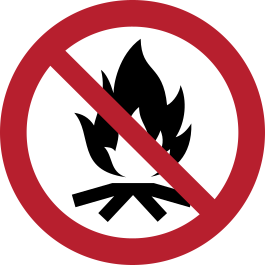
No campfire
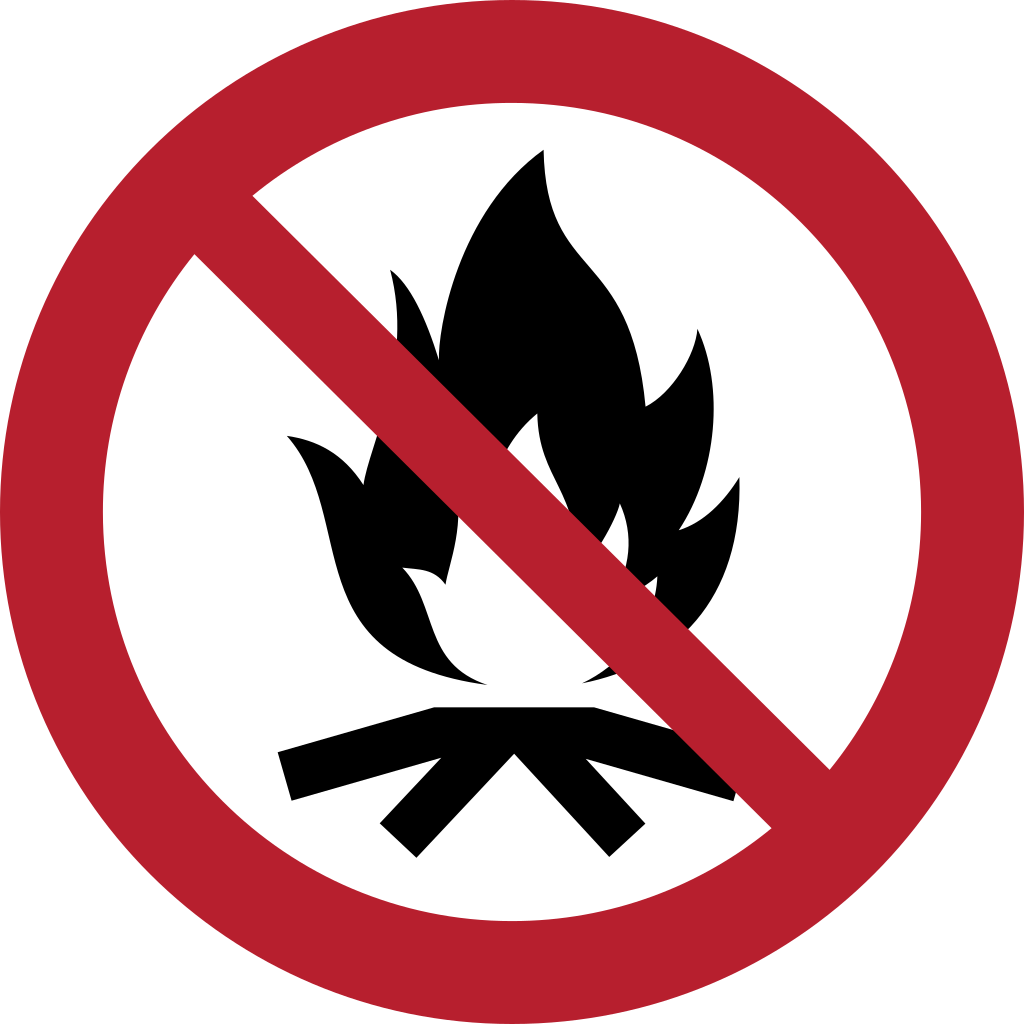
Campfires are prohibited.
Understanding this sign
Red circular signs with a diagonal bar identify an action that must not be taken in the marked area.
Check what object or action the symbol prohibits. A prohibition sign does not identify all the hazards in an area.
What ISO 7010 P045 Means
P045 prohibits making a campfire where the sign is displayed. In the ISO 7010 register, P045 carries the referent No campfire and the function of prohibiting making campfire; the pictogram depicts an open wood fire struck through by the red annulus and slash that ISO 3864-1 assigns to prohibitions. Its audience is the recreating public — campers, hikers, beachgoers, picnickers — rather than workers, which is why the image is a fire on the ground and not an abstract flame.
That specificity is what separates P045 from P003, the industrial sign covering flames, smoking, and every other ignition source at once. P003 speaks to anyone who might strike a spark; P045 speaks to someone planning to gather wood and build a fire for warmth, cooking, or atmosphere. Land managers choose P045 precisely because a visitor with firewood under their arm recognizes their own intention in the pictogram.
Campfires and Wildfire Prevention
Escaped campfires are a persistent cause of human-started wildfires. The failure modes are well documented: fires built on dry ground ignite root systems and duff that smolder unseen, wind lifts embers into surrounding vegetation, and fires abandoned without full extinguishment reignite hours later. A campfire that seems controlled at midnight can become a vegetation fire by morning, which is why land agencies restrict where fires may be built long before they restrict anything else.
Many jurisdictions tie campfire rules to a fire danger rating system: open fires may be lawful at low ratings, restricted to designated sites at moderate ones, and banned entirely during declared fire-ban or total-fire-ban periods. P045 serves both modes — posted permanently where fires are never acceptable, or deployed seasonally with the rating board when a ban takes effect. Operators should remove or cover seasonal postings when restrictions lift, so the sign keeps its force during the periods that matter.
Where the Sign Is Posted
Typical permanent locations include forest and nature-reserve entrances, trailheads, beaches and dunes with flammable vegetation behind them, peatland — where a ground fire can burn underground for weeks — and viewpoints or informal camping spots with a history of fire rings appearing. Campground operators post it in sections without fire facilities, and utilities and railways use it along rights-of-way where transient fires have started brush fires before.
A campfire prohibition is most effective when the sign sits at the decision point: the parking area or trailhead where visitors still have their firewood in the car, not only at the scenic spot where the fire would be built. Pairing P045 with a map or arrow to the nearest designated fire site converts a refusal into a redirection, which land managers consistently find gets better compliance than an unexplained ban.
Designated Fire Pits and Related Signs
P045 targets the open, self-built campfire. It does not by itself outlaw a managed fire in a designated pit or fireplace a few hundred meters away, and many parks run exactly that arrangement: prohibition across the terrain, provision at maintained sites with cleared surroundings and extinguishing water. Whether camping stoves and barbecues fall under a posting depends on local rules — during total fire bans they are often banned too — so operators should state the scope in supplementary text rather than leave visitors guessing.
In the wider ISO 7010 family, P045 works alongside P040 (do not set off fireworks) during fire-danger seasons, P002 where smoking in vegetation is the parallel concern, and P003 in industrial and fuel-handling contexts where every ignition source is unacceptable. Choosing the sign that shows the visitor's actual intended activity is the recurring principle: a camper is far more likely to obey a crossed-out campfire than a generic crossed-out match.
Where you will see P045
Forest and nature-reserve entrances, trailheads, beaches and dunes backed by flammable vegetation, peatland where ground fire can burn underground for weeks, and viewpoints with a history of fire rings are the typical permanent locations. Campground operators post it in sections without fire facilities, utilities and railways use it along rights-of-way, and land agencies deploy it seasonally beside fire-danger rating boards during declared bans, ideally at the parking area while firewood is still in the car.
Common questions about P045
What is the difference between a no campfire sign and a no open flame sign?
P045 (no campfire) prohibits building an open wood fire on the ground and is aimed at recreational visitors in outdoor settings. P003 (no open flame) is the broader industrial sign against any ignition source, including matches, lighters, and smoking, used around flammable materials. Land managers use P045 outdoors because it depicts the exact activity a camper intends, which communicates faster than an abstract flame symbol.
Can I use a camping stove where campfires are banned?
Sometimes, but never assume it. Many areas that prohibit open campfires still allow enclosed gas stoves at normal fire danger levels, yet declared fire bans or total-fire-ban days frequently prohibit stoves and barbecues as well. The posted supplementary text or the land agency's current fire restrictions are the deciding source — check them for the specific area and day before lighting anything.
Why are campfires banned even when the weather is cool and damp?
Some postings are permanent because the ground itself is the hazard: fires on peat or deep duff can ignite organic soil that smolders underground and resurfaces as a wildfire long after the weather changes. Other permanent bans protect sensitive habitats, prevent accumulation of fire scars and gathered-wood damage at popular sites, or apply where no one patrols to check that fires are fully extinguished.
Does a no campfire sign mean the designated fire pits are closed too?
Not necessarily. Many parks prohibit fires across the open terrain while providing maintained fire pits or fireplaces where fires remain lawful, so a P045 sign on a trail may coexist with a permitted fire site nearby. During a declared total fire ban, however, designated pits are usually closed as well — the fire danger board or ranger notices state which regime is in force.
Reference details
| Symbol code | P045 |
|---|---|
| Sign family | ISO Prohibition Signs |
| Standard reference | ISO 7010:2019 / ISO 3864-1 ISO Online Browsing Platform: P045 |
| Screen color reference | #FF0000. Screen colors are not a production color specification. |
| Download formats | SVG reference artwork; a 1024 × 1024 pixel PNG conversion on a white canvas. |
| Record date | · How to interpret our dates |
| Page updated |
Choosing a physical sign size
Download dimensions are not installation dimensions. Select sign size, material, placement, and lighting using the applicable standard and the actual viewing conditions. Chemical label sizing follows its own rules. Read the artwork and sizing guide.
Sources and artwork credits
- Artwork source
- Wikimedia Commons file page
- Creator credited by source
- ISO
- License
- Public domain
- Source metadata checked
SVG files are local reference copies. PNG files are raster conversions. Check the linked file history and license terms before reuse; a source-metadata check is not certification of the artwork or a workplace installation.
Report a correction to this reference