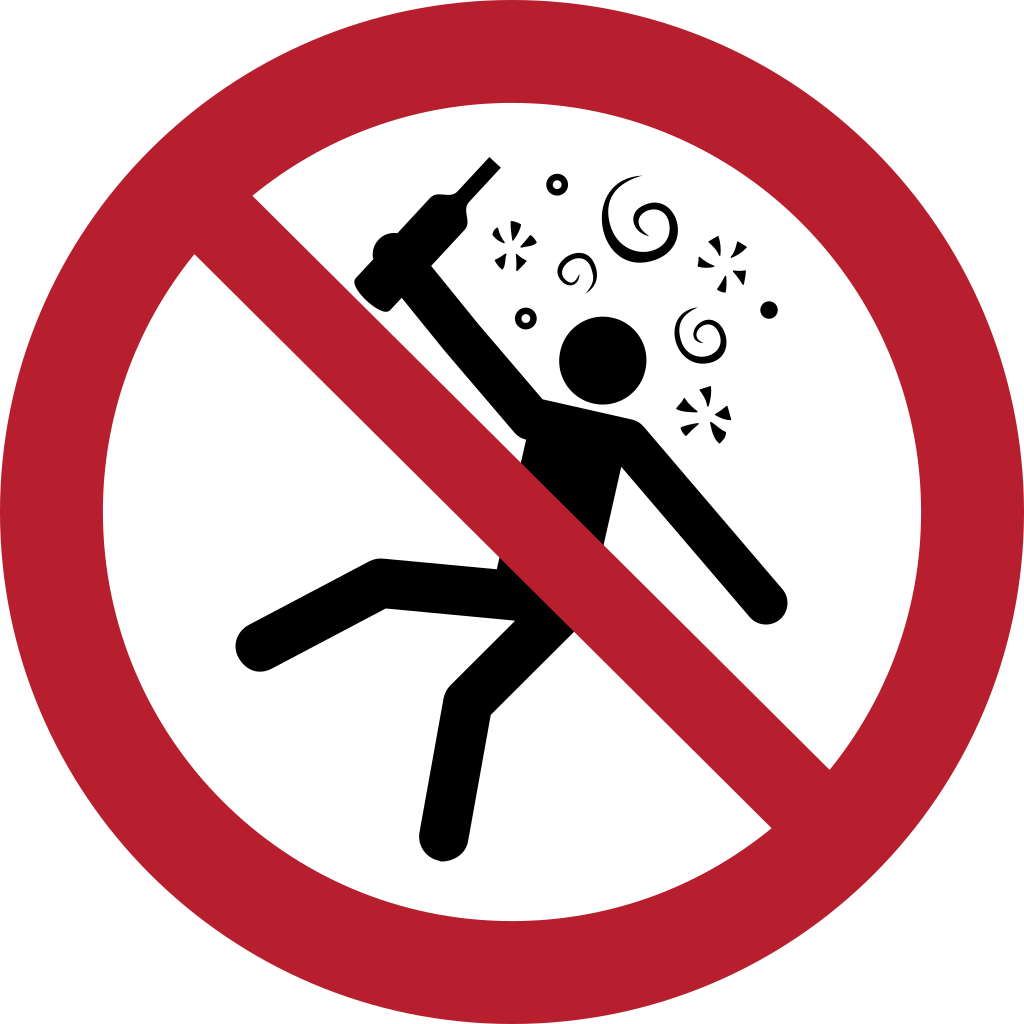
Not for people in the state of intoxication
The indicated activity, equipment, or area is not for people in a state of intoxication.
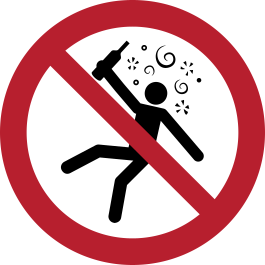
Understanding this sign
Red circular signs with a diagonal bar identify an action that must not be taken in the marked area.
Check what object or action the symbol prohibits. A prohibition sign does not identify all the hazards in an area.
What ISO 7010 P043 Prohibits
P043 bars people who are intoxicated from undertaking the activity where the sign is displayed. It covers impairment generally — alcohol is the archetype, but the prohibition extends in practice to recreational drugs and to medication that degrades balance, reaction time, or judgment, since the operational concern is the impairment itself rather than its source. Alcohol simply supplies the imagery, because it is the impairing substance a gatekeeper most often faces.
The pictogram exists because impaired participants endanger more than themselves: a drunk guest on a ride may defeat restraints or stand mid-cycle, an intoxicated renter can capsize a boat into other water users, and an impaired machine operator threatens everyone in reach of the equipment. The sign gives staff a pre-stated, impersonal basis for refusing entry.
Where Operators Rely on It
Amusement and water parks post P043 on ride restriction boards, typically next to height limits and the P042 pregnancy restriction, because ride manuals list intoxication among rider exclusions. Rental businesses are the other big user group: boat, jet-ski, kayak, go-kart, quad bike, e-scooter, and ski equipment hire desks display it to anchor a refusal-of-service policy at the point of contract.
Industrial versions appear at machinery, forklift charging bays, and site gates where a fitness-for-duty program is in force, and venues such as climbing gyms, trampoline parks, and shooting ranges use it at check-in. Wherever alcohol is sold on the same premises as a physical activity — marinas, après-ski areas, festival rides — the sign marks the boundary between the bar and the activity.
Enforcement and Legal Context
P043 sets no measurable threshold; there is no posted blood-alcohol figure behind it. Staff enforce it on observable signs of impairment — unsteady gait, slurred speech, the smell of alcohol — and the sign's value is that refusal cites a published rule rather than a personal judgment, which defuses confrontation and supports the operator if the refusal is challenged afterwards.
Statutory law runs in parallel rather than through the sign. Operating a vehicle or vessel while impaired is an offense in most jurisdictions regardless of signage, and workplace drug-and-alcohol policies rest on employment contracts and safety legislation. The sign neither creates nor replaces those duties; it warns participants that the operator will apply them at this doorway.
Where you will see P043
Amusement and water parks include it on ride restriction boards next to height limits, and rental desks for boats, jet-skis, kayaks, go-karts, quad bikes, and ski equipment display it to anchor refusal-of-service policies at the point of contract. It also appears at machinery and site gates where fitness-for-duty programs operate, and at climbing gyms, trampoline parks, shooting ranges, and marinas where alcohol is sold near the activity.
Common questions about P043
Can a ride operator legally refuse entry to someone who has been drinking?
Yes, in most places. Ride manufacturers list intoxication as a rider exclusion, operators are obliged to follow the operating manual, and businesses generally retain the right to refuse service on safety grounds applied consistently. A posted P043 sign strengthens the refusal by showing the rule was published before the guest arrived, not invented on the spot.
Does the P043 sign cover drugs and medication or only alcohol?
The referent is intoxication as a state, not alcohol as a substance, so operators apply it to impairment from any cause — cannabis, other recreational drugs, and prescription medicines that cause drowsiness or poor coordination. Staff cannot identify the source anyway; they act on the observable impairment, which is what the sign prohibits.
Is there a blood-alcohol limit behind the no-intoxication sign?
No. Unlike driving law, the sign carries no numeric threshold and venues almost never test guests. Enforcement rests on visible impairment judged by trained staff, sometimes guided by a written policy describing indicators. Separate statutory limits — for boating or operating machinery, for example — still apply on top of the sign in many jurisdictions.
Why do boat and jet-ski rental companies display this sign?
Because handing powered watercraft to an impaired customer is both a safety and a liability problem: impaired operation of a vessel is an offense in many jurisdictions, and the rental firm may face claims after a crash. Displaying P043 at the hire desk makes sobriety an explicit condition of the rental agreement and gives staff cover to decline a customer who arrives from the beach bar.
Reference details
| Symbol code | P043 |
|---|---|
| Sign family | ISO Prohibition Signs |
| Standard reference | ISO 7010:2019 / ISO 3864-1 ISO Online Browsing Platform: P043 |
| Screen color reference | #FF0000. Screen colors are not a production color specification. |
| Download formats | SVG reference artwork; a 1024 × 1024 pixel PNG conversion on a white canvas. |
| Record date | · How to interpret our dates |
| Page updated |
Choosing a physical sign size
Download dimensions are not installation dimensions. Select sign size, material, placement, and lighting using the applicable standard and the actual viewing conditions. Chemical label sizing follows its own rules. Read the artwork and sizing guide.
Sources and artwork credits
- Artwork source
- Wikimedia Commons file page
- Creator credited by source
- ISO
- License
- Public domain
- Source metadata checked
SVG files are local reference copies. PNG files are raster conversions. Check the linked file history and license terms before reuse; a source-metadata check is not certification of the artwork or a workplace installation.
Report a correction to this reference