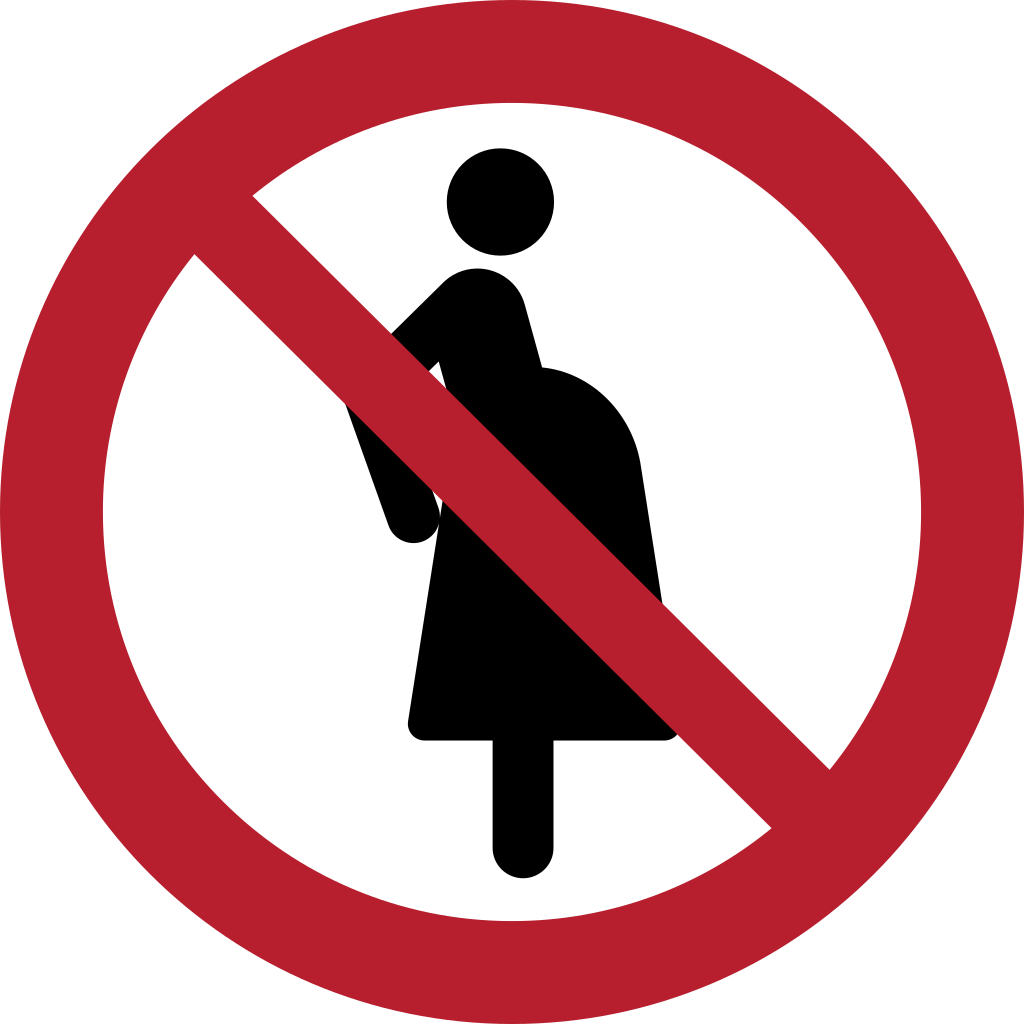
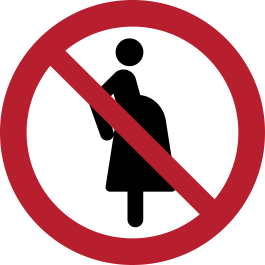
Not for pregnant women
The indicated activity, equipment, or area is not for pregnant women.
Understanding this sign
Red circular signs with a diagonal bar identify an action that must not be taken in the marked area.
Check what object or action the symbol prohibits. A prohibition sign does not identify all the hazards in an area.
What ISO 7010 P042 Prohibits
P042 tells pregnant women not to undertake the activity or enter the area where it is posted, because doing so poses a risk to them or to the unborn child that other participants do not face. The prohibition attaches to hazards that act specifically on pregnancy: sudden acceleration and jolting forces, elevated heat, certain chemicals, and ionizing radiation.
It differs from most prohibition signs in that compliance is self-identified — no operator can verify pregnancy at a gate, and early pregnancy is not visible at all. The sign works by informing a decision the individual alone can make, which is why it should always be positioned before the point of commitment: at the queue entrance, the treatment booking desk, or the area boundary, not at the seat.
Rides, Pools, and Leisure Facilities
Amusement parks are where the public most often meets P042. Ride manufacturers list pregnancy among rider restrictions for attractions with rapid acceleration, hard braking, drops, or restraint bars that press against the abdomen, and operators translate those manuals into entrance signage. The symbol commonly shares a restriction board with height limits, P043 for intoxicated guests, and cardiac or back-condition advisories.
Beyond rides, the sign appears at saunas, steam rooms, and hot tubs — where prolonged heat exposure is the concern — and at spa treatments, sunbeds, and some watersports and trampoline attractions. Operators inherit these restrictions from equipment suppliers and insurers, and the pictogram lets them state the rule without wordy multilingual notices at every entrance.
Workplace Use and the Legal Backdrop
In workplaces, pregnancy risks come mainly from reprotoxic chemicals (lead is the historic example), ionizing radiation, biological agents such as rubella and toxoplasma, manual handling of heavy loads, and whole-body vibration. EU law addresses these through the pregnant workers directive (92/85/EEC), which obliges employers to assess risks to pregnant and breastfeeding employees and adjust their work; radiation protection rules separately tighten dose limits once a pregnancy is declared.
Importantly, the legal mechanism in employment is individual risk assessment and adjustment, not blanket exclusion — barring all women of childbearing age from an area has been ruled discriminatory in several jurisdictions. P042 in a workplace is therefore usually an information trigger, prompting an employee to notify her employer so the assessment can happen, rather than a self-executing ban.
Where you will see P042
Amusement parks translate ride manufacturers' restrictions into this symbol on entrance boards for attractions with rapid acceleration, drops, or abdominal restraint bars, usually alongside height limits and P043. It also appears at saunas, steam rooms, hot tubs, spa treatments, and sunbeds where prolonged heat is the concern, and in workplaces it acts as an information trigger prompting risk assessment under rules like EU Directive 92/85/EEC rather than a blanket exclusion.
Common questions about P042
Why do roller coasters have a no-pregnant-women sign?
Because the ride manufacturer's operating manual lists pregnancy as a rider restriction, and the operator is bound to enforce the manual. The concerns are abrupt acceleration and deceleration forces, jarring impacts, and rigid lap restraints bearing on the abdomen. The sign at the queue entrance passes the manufacturer's restriction to the guest before she boards.
Can an employer ban pregnant workers from part of a site using this sign?
Generally not as a blanket measure. Employment law in the EU and elsewhere requires an individual risk assessment once an employee notifies her pregnancy, followed by adjusted duties, alternative work, or paid leave if the risk cannot be removed. A posted P042 flags where such risks exist and prompts notification; a categorical exclusion of pregnant staff imposed by signage alone risks a discrimination finding.
Does the sign apply during early pregnancy?
Yes — arguably it matters most then. Radiation and many reprotoxic chemicals pose their greatest developmental risk in the first trimester, and ride forces are a concern throughout. Since early pregnancy is invisible, the sign is deliberately placed where individuals can act on private knowledge, and workplace systems rely on confidential declaration rather than appearance.
What hazards is P042 typically warning about?
Four clusters account for most postings: dynamic forces from rides and vibrating equipment; heat from saunas, steam rooms, and hot tubs; chemical exposure to substances classified as toxic to reproduction; and ionizing radiation in medical, industrial radiography, and nuclear settings. The supplementary text or the surrounding warning signs usually reveal which one applies at a given location.
Reference details
| Symbol code | P042 |
|---|---|
| Sign family | ISO Prohibition Signs |
| Standard reference | ISO 7010:2019 / ISO 3864-1 ISO Online Browsing Platform: P042 |
| Screen color reference | #FF0000. Screen colors are not a production color specification. |
| Download formats | SVG reference artwork; a 1024 × 1024 pixel PNG conversion on a white canvas. |
| Record date | · How to interpret our dates |
| Page updated |
Choosing a physical sign size
Download dimensions are not installation dimensions. Select sign size, material, placement, and lighting using the applicable standard and the actual viewing conditions. Chemical label sizing follows its own rules. Read the artwork and sizing guide.
Sources and artwork credits
- Artwork source
- Wikimedia Commons file page
- Creator credited by source
- ISO
- License
- Public domain
- Source metadata checked
SVG files are local reference copies. PNG files are raster conversions. Check the linked file history and license terms before reuse; a source-metadata check is not certification of the artwork or a workplace installation.
Report a correction to this reference