No leaning against
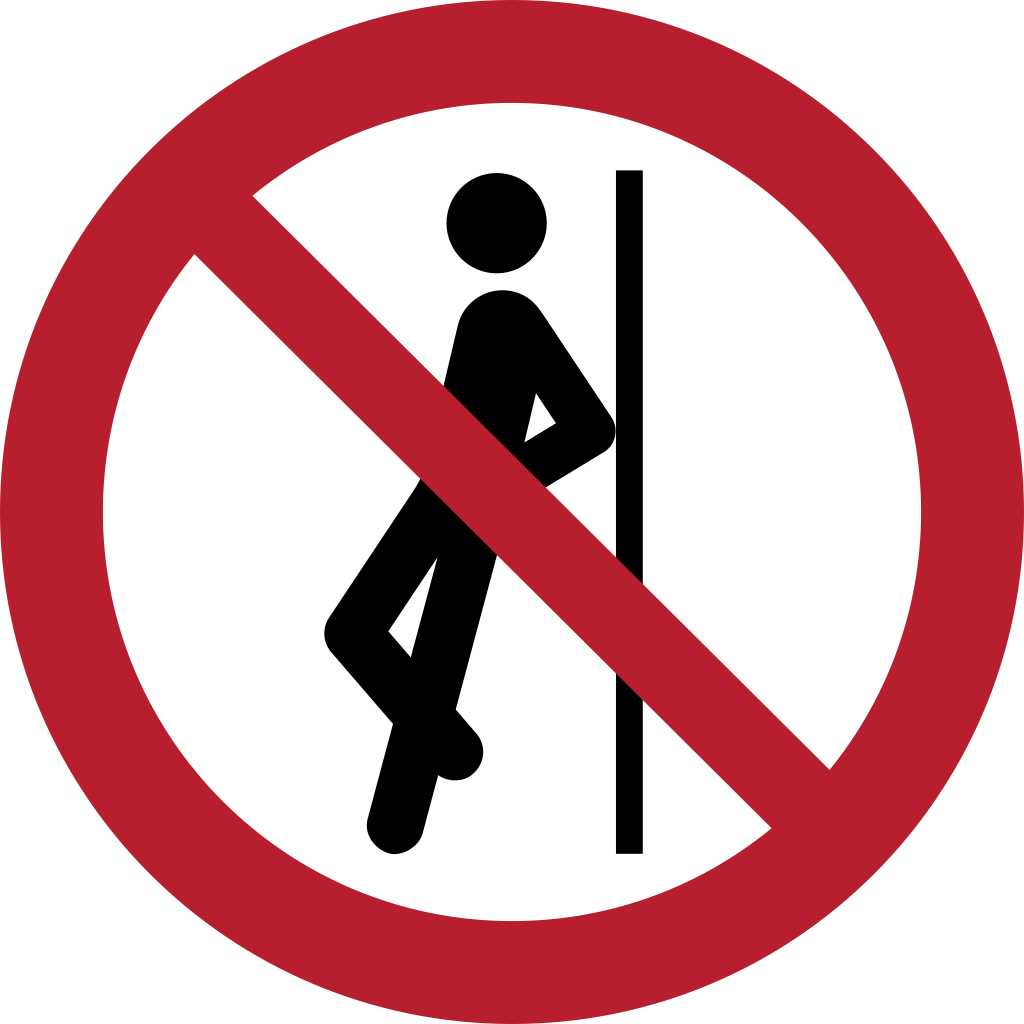
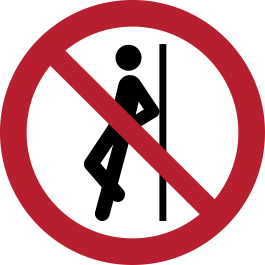
Leaning against the marked object or surface is prohibited.
Understanding this sign
Red circular signs with a diagonal bar identify an action that must not be taken in the marked area.
Check what object or action the symbol prohibits. A prohibition sign does not identify all the hazards in an area.
What No Leaning Against Protects
P041 prohibits leaning against the object it marks. The pictogram shows a figure resting body weight against a vertical surface, canceled by the red ISO 3864-1 band. Leaning seems harmless — it is what people do while waiting, talking, or watching — but it transfers a sustained lateral load into structures that may only have been designed to be looked at, touched lightly, or loaded vertically.
Guardrails and balustrades illustrate the stakes. Building codes assign railings a specific design load for horizontal force, and a rail that is corroded, poorly fixed, temporary, or awaiting repair may no longer meet it. Someone settling their full weight against such a rail above a stairwell, mezzanine edge, or loading dock is performing an unplanned structural test with themselves as the payload.
Common Installations
Glass is the leading civilian application: shopfront glazing, interior partitions, atrium balustrades, and viewing panels invite shoulders and backs, and a panel that fractures can drop a person through the opening or shower them with fragments. Museums and showrooms mark display cases and freestanding exhibits. Transit operators post P041 on platform screen doors and on the inside of train and lift-lobby doors that open unexpectedly.
Industrial settings extend the list to temporary edge protection on construction sites, handrails flagged as damaged pending repair, machine guarding panels that flex into moving parts, stacked materials, and vehicle-restraint barriers whose rating covers impact from one side only. Event and crowd contexts add pipe-and-drape walls, staging skirts, and barrier lines where sustained leaning by a crowd row loads the system beyond its intent.
Applying It Without Diluting It
P041 loses force fastest of almost any prohibition when overused, because leaning is universal behavior and a sign on every wall trains people to ignore all copies. Reserve it for elements where a risk assessment identifies genuine failure or displacement potential, mount it at torso height on the element itself, and repeat it along long glazed or railed runs at intervals matched to the sign size and viewing distance.
When a railing or panel is known to be defective, the sign is a stopgap, not a fix. Good practice barriers off the approach or hard-excludes the area until repair, since a person who trips or is pushed will load the element regardless of what they intended. Pick companion signs by behavior: P018 where the same edge invites sitting, P017 where deliberate pushing is the risk, P010 where no contact of any kind is acceptable.
Where you will see P041
Shopfront glazing, atrium balustrades, museum display cases, and platform screen doors are leading applications, with transit operators also marking the inside of train and lift-lobby doors that open unexpectedly. Industrial users apply it to temporary edge protection on construction sites, handrails flagged as damaged pending repair, machine guarding panels that flex into moving parts, and vehicle-restraint barriers rated for impact from one side only, mounted at torso height on the element itself.
Common questions about P041
What kind of objects get a no leaning sign?
Elements that fail or move under sustained sideways body weight: glass panels and balustrades, guardrails that are temporary, damaged, or of unverified rating, display cases, machine guards, platform screen doors, doors that open away from the leaner, stacked goods, and lightweight temporary walls. The common feature is a vertical surface at comfortable leaning height whose lateral strength is lower than it appears.
Are guardrails not designed to be leaned on?
Permanent guardrails are designed to resist a defined horizontal load, and a compliant, well-maintained rail tolerates ordinary leaning. The sign appears where that assumption breaks: temporary edge protection, rails with corrosion or loose fixings awaiting repair, decorative rails never built as fall protection, or locations where crowds could load a rail collectively far beyond the single-person design case.
Is P041 enough for a damaged railing above a drop?
No. A sign informs the deliberate; it does nothing for someone who stumbles into the rail or gets bumped against it. A known-defective railing at height calls for physical exclusion — barriers set back from the edge or closure of the area — with P041 marking the barrier until the repair restores the rail's rated capacity.
Reference details
| Symbol code | P041 |
|---|---|
| Sign family | ISO Prohibition Signs |
| Standard reference | ISO 7010:2019 / ISO 3864-1 ISO Online Browsing Platform: P041 |
| Screen color reference | #FF0000. Screen colors are not a production color specification. |
| Download formats | SVG reference artwork; a 1024 × 1024 pixel PNG conversion on a white canvas. |
| Record date | · How to interpret our dates |
| Page updated |
Choosing a physical sign size
Download dimensions are not installation dimensions. Select sign size, material, placement, and lighting using the applicable standard and the actual viewing conditions. Chemical label sizing follows its own rules. Read the artwork and sizing guide.
Sources and artwork credits
- Artwork source
- Wikimedia Commons file page
- Creator credited by source
- ISO
- License
- Public domain
- Source metadata checked
SVG files are local reference copies. PNG files are raster conversions. Check the linked file history and license terms before reuse; a source-metadata check is not certification of the artwork or a workplace installation.
Report a correction to this reference